
Editorial independence: our scores and rankings are produced using the fixed criteria above and are not influenced by advertisers. This is an independent ranking site and is not operated by, or affiliated with, any provider we list.
Affiliate disclosure: some links on this page may earn us a commission at no extra cost to you. This does not affect our rankings.
| Best for | Not for |
|---|
Liquity is an Ethereum DeFi borrowing protocol centered on ETH-backed stablecoins. Its original system lets users borrow LUSD against ETH collateral, while Liquity V2 introduces BOLD. The protocol is non-custodial and uses smart-contract rules for borrowing, redemptions and liquidation.
| Criterion | Score | Note |
|---|---|---|
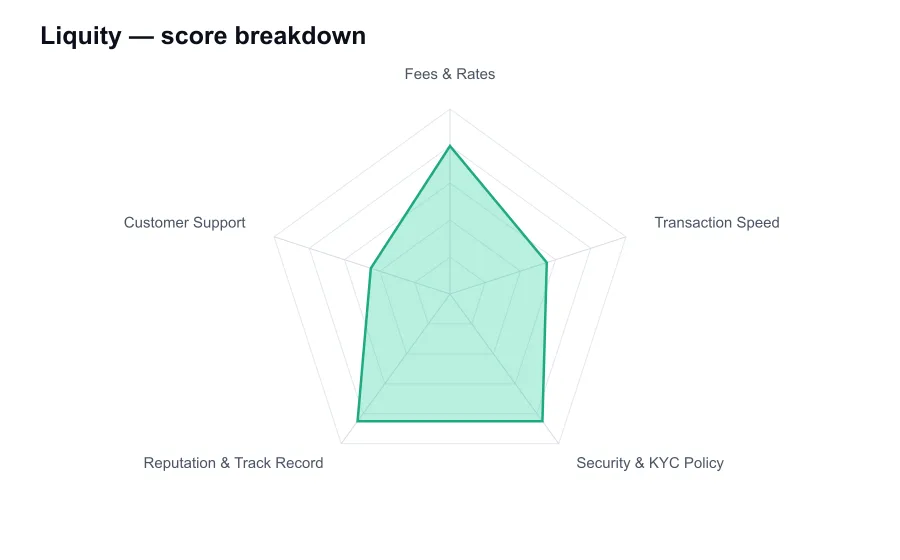
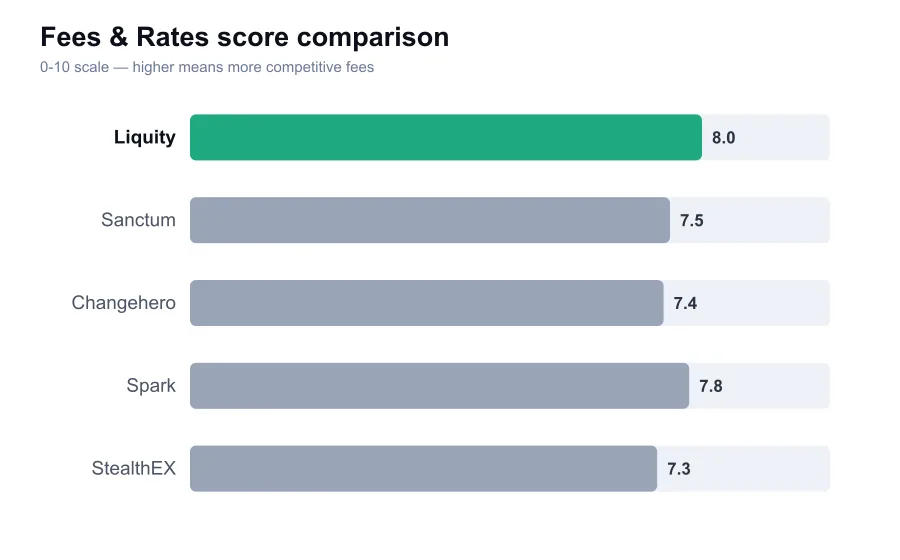
| Fees & Rates | 8.0 | Original LUSD loans use a one-off fee with a 0.5% minimum. |
| Transaction Speed | 5.5 | Ethereum mainnet confirmation and gas costs limit convenience. |
| Security & KYC Policy | 8.5 | Audited, immutable original contracts with long live operation. |
| Reputation & Track Record | 8.5 | One of DeFi's more proven ETH-backed borrowing systems. |
| Customer Support | 4.5 | Documentation and community help, no personal recourse. |
| Requirement | none |
|---|---|
| Notes | Liquity is a wallet-based DeFi protocol. It does not run a conventional KYC account process for direct contract interaction. |
| Notable Coins | ETH, LUSD, BOLD, LQTY |
|---|---|
| Networks | Ethereum |
Liquity is a decentralized borrowing protocol best known for letting Ethereum users borrow a stablecoin against ETH collateral without paying recurring interest in its original version. Its first system issued LUSD, a USD-pegged stablecoin backed by ETH and designed around direct redemptions, liquidations and a Stability Pool. That model made Liquity one of DeFi's more distinctive lending protocols. It is not an exchange, and it is not a bank. It is a set of Ethereum smart contracts with strict rules.
The original Liquity design attracted attention because it rejected the usual variable-rate lending model. Borrowers paid a one-time borrowing fee that changed with redemption activity, while there was no ongoing interest rate. For a borrower who expected to hold a position for months, that could be attractive compared with a floating-rate loan on Aave. The trade-off was a relatively high minimum collateral ratio of 110 percent and a system that uses redemptions to keep LUSD close to one dollar.
That redemption mechanism is often misunderstood. If LUSD trades below its target, holders can redeem LUSD against ETH collateral from the least-collateralized borrower positions. The protocol reduces those borrowers' debt and collateral proportionately. This is not a discretionary liquidation by a company and it is not an optional feature. Anyone borrowing LUSD needs to understand that a low collateral ratio can make their position a likely target for redemption even if ETH has not crashed.
Liquity V2 changed the product direction by introducing BOLD, an ETH-backed stablecoin with user-set interest rates and multiple collateral branches. That is a more flexible architecture than the original fixed-fee model, but it also asks users to pay closer attention to the branch, rate and position mechanics they choose. The original system and the newer product should not be treated as interchangeable. A user needs to confirm whether they are opening a LUSD Trove in the original protocol or a BOLD position in the newer system.
Fees are where Liquity's reputation remains deservedly strong, though the details differ by version. In the original protocol, borrowers pay a one-off borrowing fee, subject to a 0.5 percent minimum, rather than recurring loan interest. Redeeming LUSD also carries a fee, and liquidations have their own mechanics. In V2, BOLD borrowing uses interest rates selected by borrowers, so it is wrong to repeat the old claim that Liquity never charges interest. The protocol is cheap in structure, not universally free.
Ethereum mainnet is Liquity's main speed limitation. A transaction is usually visible quickly, but prudent users wait for confirmations, and gas costs can become painful during congestion. Opening or adjusting a small position may not make sense when gas is high. This is an area where Solana lenders such as Kamino are plainly more convenient. Liquity's advantage is its deliberately narrow ETH-backed design, not fast or inexpensive transaction throughput.
Liquidations are efficient from the protocol's perspective and unforgiving from the borrower's. In the original Liquity system, Troves below the 110 percent minimum collateral ratio can be liquidated. The Stability Pool absorbs debt in exchange for collateral, and users providing LUSD to that pool take on the risk and reward of liquidations. In a severe ETH move, Stability Pool depositors can end up with more ETH and less LUSD. That is the mechanism working, not necessarily a malfunction.
Security is Liquity's strongest category. The original protocol was designed to be immutable after deployment, which sharply reduces governance attack surface. It has been audited and has operated through real crypto market stress. Immutability is not the same as invulnerability, but it removes a category of risk found in upgradeable protocols, where a governance vote or admin key can alter core logic. The price is that bugs, if discovered, are harder to patch.
Liquity does not require KYC because users interact directly with Ethereum contracts through a wallet. That is useful for privacy and censorship resistance, but it is also absolute in its consequences. There is no customer support department capable of restoring a lost wallet, unwinding a liquidation, or sending a password reset. A user controls the assets and bears the operational burden. For some people that is the point. For others, it is simply too much responsibility.
The LQTY token has a defined role in the original system. Stakers can receive fees generated by borrowing and redemptions, while Stability Pool depositors can receive liquidation gains and token incentives. Those revenue streams are tied to actual protocol activity, which is better than purely decorative governance tokens. Still, token holders should not confuse fee exposure with a guaranteed yield. Borrowing volume, redemptions, token incentives and market demand can all change.
Liquity's reputation has held up better than many DeFi protocols from its era. It has a focused design, a recognizable stablecoin and a history that extends through difficult market conditions. Yet LUSD has never achieved USDC-scale liquidity or acceptance, and that limits convenience. On many venues, a borrower will need to swap LUSD into another asset, adding slippage and gas. A cheap loan is less compelling if the stablecoin proceeds are awkward to use.
The support experience is intentionally thin. Documentation and community forums can explain the mechanics, and third-party front ends have historically competed to provide access to the protocol. But Liquity is not built to provide personal assistance. Front-end availability can change, and users should learn how the contracts work rather than relying on a single website. This is an advanced product despite its deceptively simple promise of borrowing against ETH.
For ETH holders with a long time horizon, the original LUSD system can still make sense. A borrower with a healthy collateral buffer may value the lack of recurring interest, especially during periods when variable lending rates are elevated. The correct buffer is much higher than 110 percent for anyone who does not want to watch ETH constantly. A 110 percent minimum is a liquidation threshold, not a recommendation. Treating it as a target is an expensive beginner error.
Liquity remains one of DeFi's clearest examples of a protocol that chose rules over product sprawl. It is excellent for users who want ETH-backed borrowing and can live with Ethereum gas, redemption mechanics and self-custody. It is a poor choice for someone seeking fast small transactions, broad collateral choice or responsive customer service. The protocol has real strengths because it is narrow. Those same limits are why it will never fit every borrower.
| Pros | Cons |
|---|
Liquity fits experienced ETH holders who understand collateral ratios, want an ETH-backed stablecoin loan, and can tolerate Ethereum mainnet costs. The original LUSD model is particularly relevant to borrowers seeking to avoid recurring interest. It does not suit users needing small, rapid adjustments or broad collateral choices. Anyone unfamiliar with liquidation and redemption mechanics should learn with a tiny position or look elsewhere.
No. Liquity is accessed through an Ethereum wallet and does not use standard customer account onboarding or routine identity checks.
The original LUSD system uses a 110% minimum collateral ratio. Falling below it can trigger liquidation, so prudent users normally maintain far more collateral.
Original LUSD borrowing does not charge recurring interest. It uses a one-time borrowing fee, with a stated minimum fee of 0.5%.
LUSD holders can redeem LUSD for ETH from the least-collateralized Troves. The process helps the peg but can reduce debt and collateral in affected positions.
The Stability Pool holds LUSD that can absorb liquidated debt. Depositors can receive ETH from liquidations, so their LUSD balance and asset exposure can change.
No. BOLD is associated with Liquity V2, while LUSD belongs to the original Liquity system. Their borrowing and interest mechanics differ.
| Alternative | Score |
|---|---|
| Sanctum Review | 7.5/10 |
| Changehero Review | 7.5/10 |
| Spark Review | 7.4/10 |
| StealthEX Review | 7.4/10 |
| Independentreserve Review | 7.7/10 |
| Morpho Review | 7.7/10 |