Editorial independence: our scores and rankings are produced using the fixed criteria above and are not influenced by advertisers. This is an independent ranking site and is not operated by, or affiliated with, any provider we list.
Affiliate disclosure: some links on this page may earn us a commission at no extra cost to you. This does not affect our rankings.
| Best for | Not for |
|---|
Sanctum is a Solana DeFi protocol focused on liquid staking tokens. It helps users stake SOL, exchange supported LSTs, and access shared liquidity without handing assets to a centralized exchange. Users interact through a self-custody wallet.
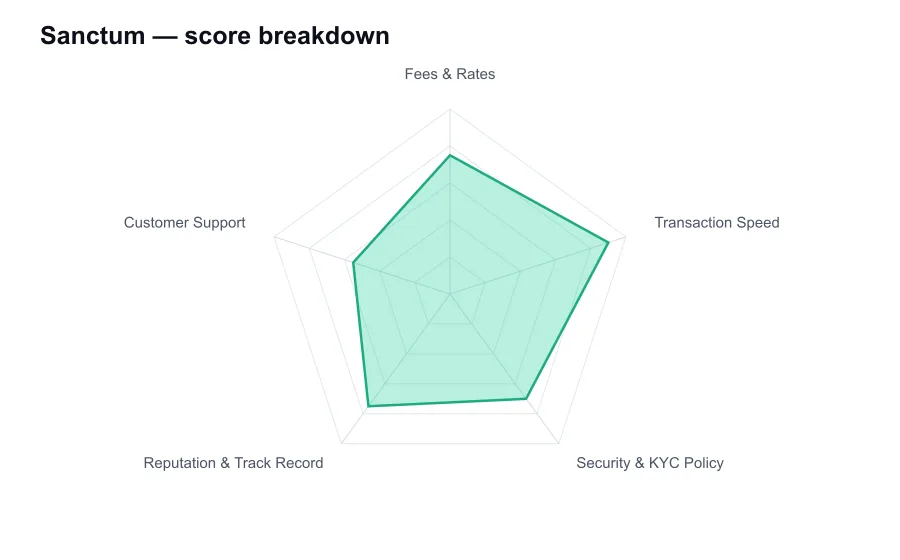
| Criterion | Score | Note |
|---|---|---|
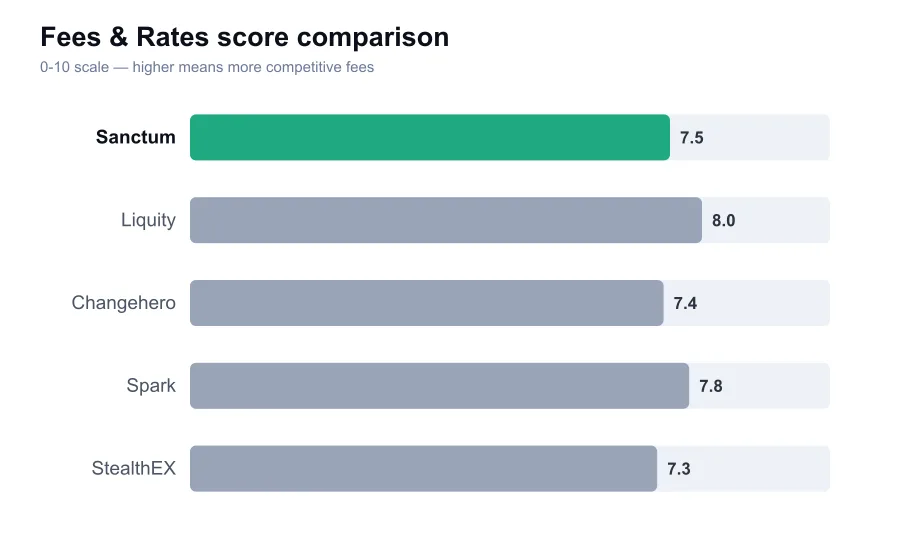
| Fees & Rates | 7.5 | Low visible routing costs, but slippage varies by LST. |
| Transaction Speed | 9.0 | Solana transactions usually settle within seconds. |
| Security & KYC Policy | 7.0 | Non-custodial, with smart-contract and LST risks. |
| Reputation & Track Record | 7.5 | Well known on Solana, but still a young protocol. |
| Customer Support | 5.5 | Docs and community channels, no account-level support. |
| Requirement | none |
|---|---|
| Notes | The protocol is accessed with a self-custody Solana wallet and does not use a standard account onboarding or identity-check flow. |
| Notable Coins | SOL, INF, CLOUD, JitoSOL, mSOL, bSOL |
|---|---|
| Networks | Solana |
Sanctum is a Solana liquid staking protocol built around a simple but useful idea: staked SOL should not become stranded capital. Rather than offering a single liquid staking token, it provides infrastructure for exchanging and using a range of Solana LSTs, including its own INF token and the reserve-backed CLOUD token. It sits closer to an LST liquidity layer than a conventional exchange, and that distinction matters. People using Sanctum are taking Solana protocol and smart-contract risk, not dealing with a company holding their coins in an account.
The product arrived at a good moment for Solana. Liquid staking had grown, but liquidity was split between JitoSOL, mSOL, bSOL, LST and many smaller validator-specific tokens. Selling a smaller LST could be awkward or expensive. Sanctum's Router tries to find the most efficient route across supported pools and sources, while its Infinity pool makes many LSTs redeemable into a shared liquidity system. That can make a niche validator token far more practical than it would be on a standard automated market maker.
The headline appeal is clear for a SOL holder who wants staking yield without giving up DeFi access. Deposit SOL, receive an LST, then use that asset as collateral or liquidity elsewhere in Solana. Sanctum also lets users swap among supported LSTs, which is genuinely useful for people changing validator preferences. The protocol has made a strong effort to turn an arcane part of Solana staking into something approachable, though the underlying mechanics are still more complex than the friendly interface suggests.
Fees need to be read carefully because there is no single Sanctum price. Stake accounts continue to earn validator rewards, LST issuers can charge their own management or validator fees, and a swap can incur pool fees, price impact and network costs. Sanctum's interface may show a low explicit route fee while the real cost of exiting a thin LST is mostly in slippage. That is better than hiding the number, but users should not mistake a visible fee of near zero for a costless trade.
For mainstream LSTs, execution is often impressively efficient. A SOL to INF conversion or an exchange between deep Solana LSTs generally settles in one Solana transaction, typically within seconds once the wallet signs. That is a major advantage over native stake account activation and deactivation, which follows Solana epoch timing and can take days. Sanctum is at its best when it lets a staker avoid that waiting period without accepting a huge discount.
The speed story changes at the edges. A little-used LST can have shallow Infinity liquidity, and the best route may involve several pools. The chain is fast, but price discovery is not magic. A large order can move the pool materially, especially during stressed markets where many holders seek SOL at once. People who regularly rebalance five-figure or larger SOL positions should run a quote first, compare it with Jupiter, and avoid treating the displayed estimate as a guaranteed redemption value.
Sanctum is non-custodial in the normal DeFi sense. A connected wallet signs the transaction, and the protocol does not take custody through an email account or a customer balance. There is no standard identity check for swapping or staking through the app. That is appealing to privacy-conscious Solana users, but it also means there is no support agent who can reverse a wrong transaction, recover a compromised wallet, or freeze a scammer's address.
Its security posture rests on code quality, audits, governance decisions and the security of integrated LST issuers. That is a broad risk surface. An LST is exposed to its validator set, its staking mechanics, its own program design and the liquidity path used to trade it. Sanctum's architecture reduces fragmentation, but aggregation does not erase the risks of the assets being aggregated. INF and CLOUD may feel simple in a wallet, yet users should understand what backs each token before holding it through a volatile period.
CLOUD deserves special attention. It is designed as a reserve-backed SOL liquidity token rather than a conventional yield-bearing LST. That makes it useful for swaps and DeFi routing, but users should not assume every token with SOL exposure has identical yield behavior or redemption conditions. A buyer seeking staking returns may prefer a yield-bearing LST. A trader who wants an on-chain SOL-adjacent asset for liquidity may find CLOUD more relevant. Confusing the two is an easy mistake.
Sanctum's reputation is strong within the Solana DeFi crowd. The team became highly visible through its Wonderland points campaign and later the CLOUD token launch, which brought a wave of retail attention. That attention was not all flattering. Points programs can attract mercenary liquidity, and token launches invite complaints from users whose expectations about eligibility, pricing or rewards were different from the final rules. The protocol remains respected technically, but it has already learned that community excitement can turn into scrutiny quickly.
The project does not have the multi-cycle, battle-tested history of Lido or the long lending history of Aave. It is also operating in a Solana ecosystem where integrations and incentives shift rapidly. I would not class Sanctum as experimental in the casual sense, because it handles meaningful liquid-staking flows, but neither would I treat it as a risk-free substitute for native staking. The right comparison is not a bank account. It is a young but influential piece of DeFi infrastructure.
Support is adequate for a self-custody protocol, rather than exceptional. Documentation, Discord and social channels are the practical routes for help. A user can often get an explanation of a route, an LST or a transaction issue, but response quality depends on community activity and the complexity of the question. There is no phone line, regulated complaints process, or individualized account management. If you need certainty before moving funds, test the route with a small amount first.
Wallet hygiene matters more here than it does at a centralized platform. Use the real Sanctum domain, inspect transaction prompts, and keep enough SOL for transaction fees. Phishing sites often imitate popular Solana apps, especially around airdrops and point programs. A hardware wallet offers meaningful protection for long-term holdings, although it cannot save someone who signs a malicious transaction without reading it.
Sanctum is compelling because it solves a real liquidity problem rather than manufacturing a token for its own sake. Its routing makes Solana liquid staking more usable, and its settlement speed is excellent. Still, the best users are people who already understand LST risk and are willing to compare quotes. For a passive SOL holder who wants the fewest moving parts, native staking remains easier to reason about. For active Solana DeFi users, Sanctum is one of the protocol's more useful pieces of plumbing.
| Pros | Cons |
|---|
Sanctum fits active Solana users who hold liquid staking tokens, compare routes, and want to keep staked SOL useful in DeFi. It is especially relevant to users holding smaller validator-linked LSTs. Native staking may suit conservative SOL holders who do not need liquidity. Beginners who need live account support should use a simpler regulated service instead.
No standard KYC is required to connect a Solana wallet and use Sanctum's on-chain functions. Transactions are signed from your own wallet.
Infinity is Sanctum's shared liquidity system for supported Solana liquid staking tokens. It is intended to make conversion between LSTs and SOL more practical.
A completed Solana transaction normally confirms within seconds. The economic result can still differ from the quote if liquidity is thin or the market moves.
No. CLOUD is designed as a reserve-backed SOL liquidity token. Users should check its current backing and yield mechanics rather than assuming it earns staking rewards like every LST.
No. Sanctum is non-custodial. Once a Solana transaction is signed and confirmed, the protocol cannot reverse it for you.
The final cost can include liquidity-provider fees and price impact. This is most relevant for smaller LSTs or large swaps through shallow liquidity.
| Alternative | Score |
|---|---|
| Liquity Review | 7.5/10 |
| Changehero Review | 7.5/10 |
| Spark Review | 7.4/10 |
| StealthEX Review | 7.4/10 |
| Independentreserve Review | 7.7/10 |
| Morpho Review | 7.7/10 |