Editorial independence: our scores and rankings are produced using the fixed criteria above and are not influenced by advertisers. This is an independent ranking site and is not operated by, or affiliated with, any provider we list.
Affiliate disclosure: some links on this page may earn us a commission at no extra cost to you. This does not affect our rankings.
| Best for | Not for |
|---|
Spark is a permissionless DeFi protocol for stablecoin savings, collateralized borrowing and liquidity management. It is closely connected to the Sky ecosystem, formerly MakerDAO. Users connect their own crypto wallet and interact with smart contracts rather than opening a normal custodial account.
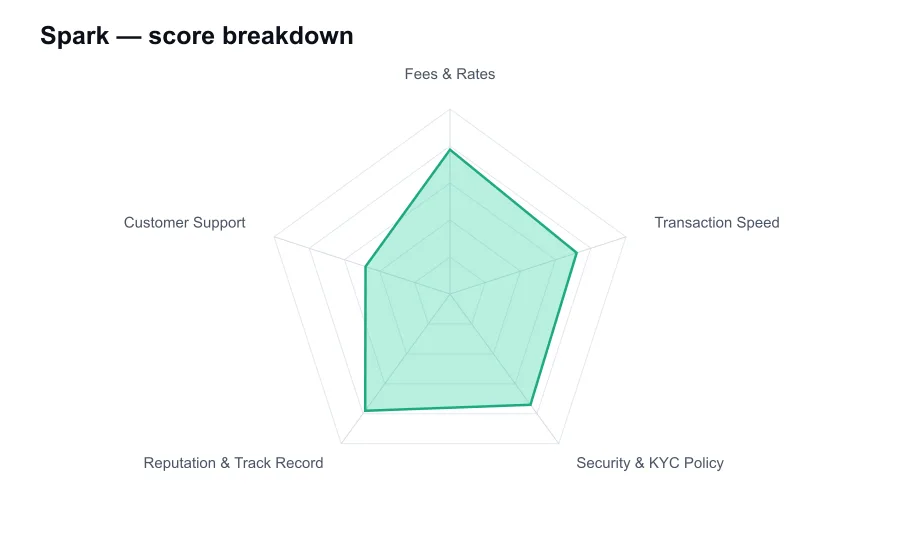
| Criterion | Score | Note |
|---|---|---|
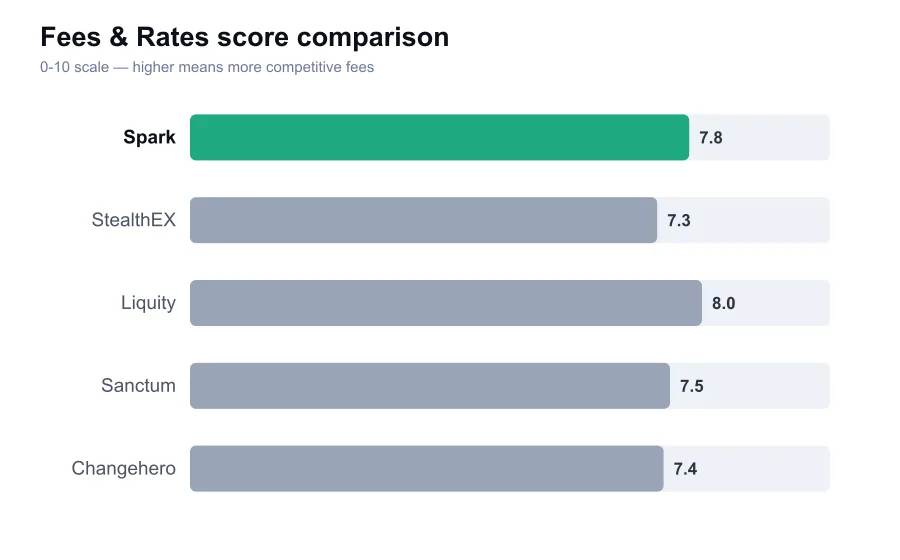
| Fees & Rates | 7.8 | No standard trading fee, but variable rates and Ethereum gas apply. |
| Transaction Speed | 7.2 | Execution follows blockchain confirmation times and gas conditions. |
| Security & KYC Policy | 7.4 | Audited DeFi lineage, but smart contract and liquidation risk remain. |
| Reputation & Track Record | 7.8 | Connected to the established MakerDAO, now Sky, ecosystem. |
| Customer Support | 4.8 | Documentation and community support, with no transaction recovery. |
| Requirement | none |
|---|---|
| Notes | The protocol does not use conventional account verification. Users remain responsible for complying with laws and interface access rules in their location. |
| Notable Coins | DAI, USDS, Ethereum, Wrapped Bitcoin |
|---|---|
| Networks | Ethereum |
Spark is a decentralized finance protocol built around the Sky ecosystem, previously known as MakerDAO. It is not a conventional exchange where a company takes custody of customer balances. Spark combines lending, borrowing, stablecoin savings and liquidity infrastructure, with a particular focus on DAI and USDS. Its appeal is clear for DeFi users who want to put stablecoins to work or borrow against accepted collateral. It is not a beginner-friendly replacement for a bank account.
The protocol launched as Spark Protocol in 2023 and was created through the Maker ecosystem's Endgame structure. SparkLend is its lending market, Spark Savings lets eligible users access the Sky Savings Rate through tokenized representations, and Spark Liquidity Layer helps allocate stablecoin liquidity across approved venues. These components are linked by a stablecoin-first philosophy. Spark is trying to make DAI and USDS useful at scale, rather than competing to list every on-chain asset.
Users interact through a self-custody wallet such as MetaMask. There is no email-password account in the usual sense, and no company can reset a lost seed phrase. You connect a wallet, approve token access and submit transactions to a smart contract. That gives experienced users control, but it also means every signature matters. A mistaken approval, malicious website or wrong network choice can produce losses that ordinary customer support cannot reverse.
Spark's fee picture is more complicated than a centralized exchange's maker and taker table. There is no standard trading commission because Spark is not primarily a spot exchange. Borrowers pay an interest rate that changes by market and governance parameters. Savers receive a variable rate tied to the relevant product, while Ethereum transaction fees must be paid separately. The rate on a dashboard is not a contractual fixed return, and gas can make small deposits irrational.
For DAI and USDS users, this can still be economically attractive. A holder who already has stablecoins and understands wallet security may access yield or credit without paying a broker a percentage of each trade. But the cost is not zero. Ethereum gas, borrowing interest, price impact when swapping into collateral, and liquidation penalties all matter. Calling DeFi lending cheap without adding those costs is misleading, especially for smaller balances.
Transaction speed follows Ethereum and any supported network integration, not Spark's own customer-service promises. A transaction may be visible quickly, but finality and completion depend on the chain, congestion and the gas fee selected. During busy periods, users can wait longer or pay more to be included. That is still often faster than bank lending paperwork, yet it is not the instant, guaranteed experience implied by some DeFi marketing.
The key lending risk is liquidation. Deposit collateral, borrow against it and the position can be liquidated if collateral value falls enough relative to debt. The relevant health metrics, liquidation threshold and interest accumulation must be monitored. Users should borrow conservatively, especially with volatile assets such as Ether. Stablecoins reduce price volatility on one side of the position, but they do not make a collateralized loan risk-free.
Spark benefits from its relationship with MakerDAO, now Sky, one of DeFi's most battle-tested stablecoin systems. The underlying protocol lineage matters. Maker survived major market stress and has handled vast collateral positions over many years. Still, Spark is a newer deployment and a different collection of smart contracts and governance decisions. Past resilience at Maker is encouraging evidence, not a blanket insurance policy for every Spark interaction.
There is no conventional KYC requirement at protocol level. A compatible wallet can interact directly with permissionless smart contracts, subject to interface controls and applicable law. That privacy is part of the appeal, but readers should not mistake it for legal immunity or guaranteed access from every place. Front ends can geoblock addresses or territories, and wallets, RPC providers and fiat gateways each impose their own rules.
Security is technically serious, with code audits, governance oversight and a mature ecosystem behind the core stablecoin products. Yet the security burden is shared with the user in a way that centralized-exchange customers often underestimate. Smart contract risk, governance risk, oracle risk, stablecoin depegging and wallet compromise remain live concerns. Spark is safer than an unaudited yield farm with anonymous developers, but that is a low bar, not an invitation to use leverage carelessly.
Spark's reputation is strong inside DeFi circles because it is connected to a major stablecoin system rather than a short-lived yield project. The project is also relatively young, so it does not have a decade of independent operating history. It should be judged as a protocol with strong parentage and meaningful governance backing, not as a fully mature bank substitute. Users who need deposit protection or accountable human escalation should stay with regulated financial institutions.
Support is intentionally limited compared with a centralized company. Documentation, community channels and governance forums are the main resources. There is no call centre that can reverse a liquidation, recover a wallet or cancel a confirmed transaction. That is not a flaw unique to Spark, it is the nature of permissionless DeFi. It does make the protocol unsuitable for users who need someone else to handle operational errors.
The best Spark user is already comfortable with self-custody, stablecoins and collateral ratios. They should understand why an approval should be limited, why hardware wallets matter and why a small test transaction is sensible. A user simply looking to earn a bank-like rate on savings will likely find the technical and financial risks out of proportion to the potential reward. DeFi yields are compensation for risks, not free interest.
Spark is a capable piece of DeFi infrastructure with a clearer purpose than many protocols. It offers useful stablecoin lending and savings tools, backed by a serious ecosystem, but it asks users to accept real responsibility. Fees can be efficient at scale, while small users may lose much of the benefit to gas and complexity. I would use it only for capital I understand well enough to manage on-chain. For everyone else, the safer answer is a simpler product with human support and clearer consumer protections.
| Pros | Cons |
|---|
Spark fits experienced DeFi users who already hold DAI, USDS or accepted collateral and understand liquidation mechanics. It can suit borrowers seeking on-chain credit without conventional account onboarding. Beginners, users needing guaranteed rates, and anyone unable to manage wallet security should look elsewhere. It is not a substitute for insured savings or a simple crypto brokerage account.
Spark's smart contracts are permissionless and do not use conventional account KYC. Interface access can still vary by location or provider policy.
Spark is primarily a lending and savings protocol, not a spot exchange. Users face variable borrowing rates, product rates and blockchain gas rather than a standard trading fee.
It can be liquidated according to the market's collateral rules. Borrowers should watch their health metrics and maintain a conservative collateral buffer.
Spark is closely associated with DAI and USDS, the stablecoin products linked to the Sky ecosystem.
No. Confirmed blockchain transactions are generally irreversible, and Spark does not operate a conventional support desk that can reverse them.
Ethereum gas costs can represent a large percentage of a small deposit or withdrawal, even where the protocol itself has no standard trading commission.
| Alternative | Score |
|---|---|
| StealthEX Review | 7.4/10 |
| Liquity Review | 7.5/10 |
| Sanctum Review | 7.5/10 |
| Changehero Review | 7.5/10 |
| BitcoinVN Review | 7.3/10 |
| Ripio Review | 7.2/10 |