
Editorial independence: our scores and rankings are produced using the fixed criteria above and are not influenced by advertisers. This is an independent ranking site and is not operated by, or affiliated with, any provider we list.
Affiliate disclosure: some links on this page may earn us a commission at no extra cost to you. This does not affect our rankings.
| Best for | Not for |
|---|
YaObmen is an online exchanger that facilitates selected conversions between cryptocurrencies and electronic or regional payment methods. It uses individual exchange orders rather than a conventional trading account and public order book. Customers should treat it as a transaction service, not a custody platform.
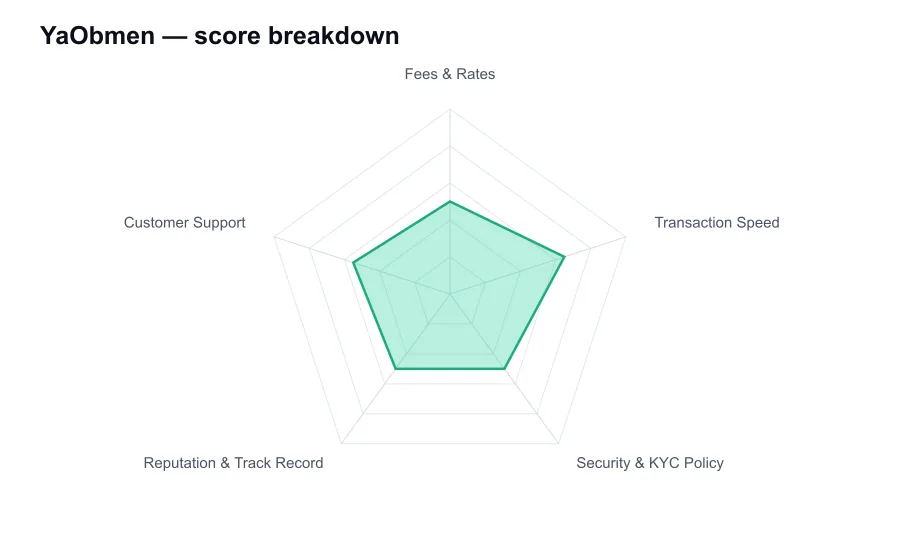
| Criterion | Score | Note |
|---|---|---|
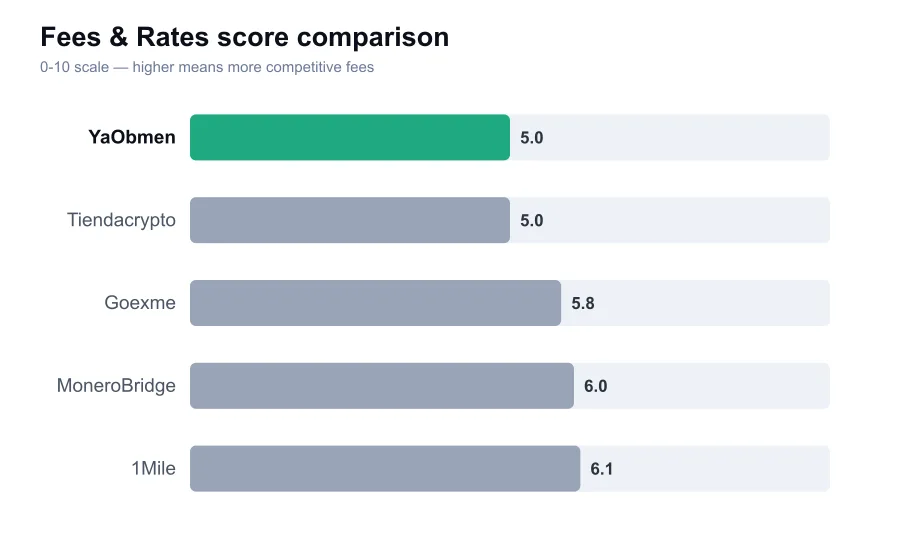
| Fees & Rates | 5.0 | Spread-based quotes require careful comparison |
| Transaction Speed | 6.5 | Timing varies sharply by payment direction |
| Security & KYC Policy | 5.0 | Short-exposure use is prudent for this niche |
| Reputation & Track Record | 5.0 | Limited public institutional transparency |
| Customer Support | 5.5 | Crucial for payment-route and order exceptions |
| Fact | Value | Source |
|---|---|---|
| Service model | Online crypto and e-money exchanger | - |
| Order flow | Quote, pay, then receive | - |
| Pricing model | Exchange-rate spread | - |
| Custody model | Short-term transaction service | - |
| Verification policy | Review may be requested | - |
| Requirement | optional |
|---|---|
| Notes | A conventional account may not be required for every order, but compliance and transaction-risk checks can result in a request for additional information. |
YaObmen is a compact online exchanger serving the familiar post-Soviet and Eastern European demand for moving value between cryptocurrencies, electronic payment systems, bank cards, and sometimes cash-oriented exchange channels. It is not a major centralized exchange and should not be evaluated as if it were one. Its main purpose is practical conversion, often for a customer who wants a specific payment route rather than a trading account.
The service sits in a part of crypto where convenience can be genuinely useful but due diligence is essential. A customer chooses a direction, sees a rate, enters receiving details, and funds an order. The process is easier than learning a conventional exchange. It is also more dependent on the exchanger's ability to process an order accurately and on the customer's ability to follow payment instructions without making a mistake.
YaObmen's product makes sense for someone converting a limited amount between a supported crypto asset and a regional payment method. It makes far less sense for a person building a diversified crypto portfolio, trading daily, or depositing large savings. A full exchange gives those users better market depth, clearer account controls, and often lower all-in costs. YaObmen is a specialized conversion service, nothing more glamorous than that.
The advertised exchange rate is the fee discussion. Instant and electronic-money exchangers often do not charge a neat 0.1 percent trading fee visible beside an order book. Instead, the operator earns through the spread between the market rate and its quote, together with any route-specific costs. That model is legitimate if it is disclosed through the final amount, but it demands comparison shopping from the customer.
Checking one quote is not enough. The relevant question is how much reaches the destination after every cost and after any network fee. A cheap-looking USDT price can be offset by an expensive payout route. A favorable bank-card quote can have a lower reserve limit or more restrictive payment instructions. Compare the same amount and the same payment direction with at least one alternative before committing.
Speed depends on the direction. Crypto-to-crypto orders can move once the incoming transfer has enough confirmations and the service has liquidity for the outgoing asset. Bank-card, electronic-wallet, and cash-related routes may involve manual processing, partner schedules, fraud controls, or banking delays. An exchanger that says an order is processed promptly is not promising that every external bank or blockchain will settle immediately.
The risk profile is materially different from a top-tier regulated exchange. YaObmen is a smaller exchanger, and the public information available about its governance, reserves, audit practices, and regulatory standing is limited compared with Coinbase, Kraken, or a licensed European broker. That does not prove wrongdoing. It does mean the platform should earn only a cautious security and reputation score until stronger independently verifiable disclosure is available.
Customers should also understand the difference between no routine account creation and no compliance controls. An exchanger may allow an order without a conventional user profile, then pause it if automated monitoring flags the sending wallet or payment pattern. That is common across this niche. It can be frustrating, especially if a customer expected a fast cash-out, but users should assume that transaction questions and identity requests are possible.
The safest way to use YaObmen is to keep exposure short. Create an order, send the exact amount required, wait for the destination payment, and move on. Do not leave funds sitting with the service. Do not split a large transaction into unusual fragments in an attempt to bypass review. And do not send money before checking that the payment details shown in the live order match the method you actually intend to use.
Technical mistakes are a serious threat. Crypto transfers are irreversible, and payment systems can be unforgiving about account numbers, card details, tags, and network selection. If the order calls for a particular amount, sending a different amount can complicate matching. If a token is sent on an unsupported chain, recovery may be impossible. These are not theoretical concerns. They are among the most common causes of delayed exchange orders.
Reputation in the exchanger niche is difficult to score generously because review sites can be incomplete, promotional, or manipulated. A listing on an exchange-monitoring website is a useful starting signal, not a guarantee of solvency or fair dealing. Look for a consistent domain history, clear contact channels, current reserve information where the service provides it, and customer reports that describe completed orders rather than vague five-star praise.
Support quality matters more than polished design. A good support team should be able to ask for an order number, identify whether the issue is a blockchain confirmation or a payment queue, and tell the customer what evidence is needed. A bad one simply repeats that the order is being processed. Before using YaObmen for anything important, test whether its official support channel is reachable and whether its terms explain disputed or delayed transactions.
I would not recommend YaObmen to a beginner making their first crypto purchase. The user needs to understand wallet addresses, confirmation times, payment instructions, and the possibility of a compliance hold. For an experienced user who understands those risks and has found a clearly superior quote for a small, defined conversion, it can be a practical option. The emphasis should be on small and defined.
My final view is that YaObmen belongs in the useful-but-cautious category. It offers the convenience that makes electronic exchangers attractive, particularly where regional payment routes matter more than sophisticated trading tools. Its shortcomings are the embedded pricing model, limited public transparency, and the higher consequence of any operational delay. Use it as a short-lived bridge between two payment methods, never as a home for funds, and use a larger regulated provider for major transactions.
| Pros | Cons |
|---|
YaObmen can suit experienced users making a small, time-limited conversion between a supported crypto asset and a regional payment route. It is not a strong choice for beginners, long-term investors, or users moving substantial sums. Anyone needing low trading fees, deep liquidity, or robust regulatory disclosure should choose a major exchange instead. Test the full process with a small order first.
No. YaObmen is an online exchanger focused on order-based conversion between supported crypto and payment directions, rather than a public order-book trading platform.
The effective cost is generally reflected in the live exchange quote and any route-specific charges. Compare the final amount received, not only a headline market price.
Yes. Blockchain confirmations, bank processing, payment partners, manual checks, and liquidity for the chosen direction can all affect completion time.
Potentially. An order-based flow does not guarantee that no compliance review will occur. Transaction monitoring can lead to requests for information or identity documents.
Order matching can be delayed if the received amount differs from the requested amount. Follow the payment instructions exactly and keep the transaction proof.
No. It is best treated as a short-lived conversion service. Move crypto to your own wallet or confirm receipt in the target payment account.
Check the token name, blockchain network, wallet address, and any required tag or memo before sending. Run a small test for an unfamiliar route.
| Alternative | Score |
|---|---|
| Tiendacrypto Review | 5.2/10 |
| Baltex Review | 5.4/10 |
| WmMoney Review | 5.5/10 |
| Goexme Review | 5.6/10 |
| MoneroBridge Review | 5.6/10 |
| ClickPay Review | 4.9/10 |