Editorial independence: our scores and rankings are produced using the fixed criteria above and are not influenced by advertisers. This is an independent ranking site and is not operated by, or affiliated with, any provider we list.
Affiliate disclosure: some links on this page may earn us a commission at no extra cost to you. This does not affect our rankings.
| Best for | Not for |
|---|
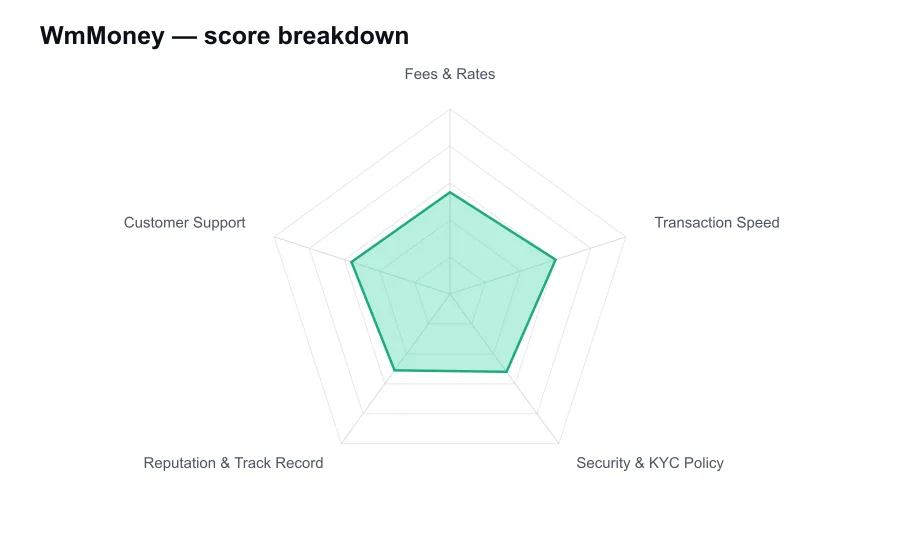
| Criterion | Score | Note |
|---|---|---|
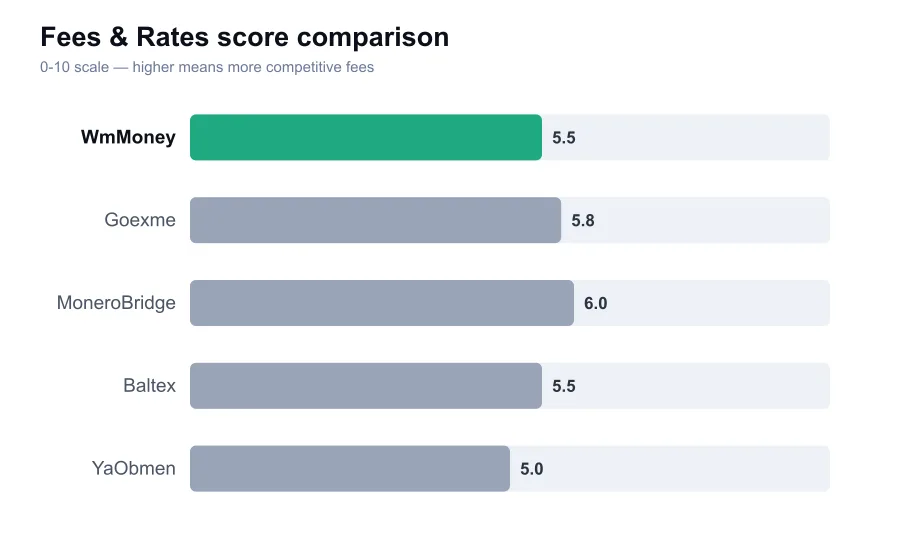
| Fees & Rates | 5.5 | Embedded spreads can be costly on smaller or complex routes. |
| Transaction Speed | 6.0 | Fast for clean orders, but bank and review delays remain. |
| Security & KYC Policy | 5.2 | Reasonable for temporary conversion, weak for stored funds. |
| Reputation & Track Record | 5.1 | Some exchanger-market visibility, limited institutional proof. |
| Customer Support | 5.6 | Useful only if order-specific status is provided. |
WmMoney presents itself in a part of the market where convenience can easily be mistaken for certainty. It is an online exchanger, not a full-service cryptocurrency exchange, and its appeal is the ability to move value between selected digital assets, payment systems and fiat payout methods without mastering order books or P2P negotiations. For a customer who has already decided what to exchange, that is useful. For someone seeking the strongest custody, compliance and price discovery, it is not the right category of service.
The first impression of a typical exchanger is usually a calculator and a promise of a straightforward transaction. WmMoney should be approached with a little more discipline than that. The calculator is an invitation to check an offer, not a guarantee that every route has deep liquidity. Reserve levels, payment limits and the availability of operators can determine whether an order that looks easy at noon remains easy after the customer has already sent funds.
Fees are the central weakness I see with services of this type, including WmMoney. The customer often does not pay a plainly labeled trading commission, but the exchange rate includes the provider's margin. That is perfectly legitimate if disclosed through the final payout. It becomes frustrating when users compare only headline rates or ignore network charges. The only number that matters is the final amount in the receiving wallet, card or account.
On liquid pairs, WmMoney may be competitively priced enough to justify the shortcut. A customer selling USDT on a low-fee network can often get a decent result, particularly if the alternative involves multiple withdrawals and a P2P sale. The picture changes with Bitcoin, Ethereum mainnet transfers and niche assets. High network costs and a wider exchanger spread can turn a seemingly minor conversion into an expensive one. Smaller transactions need especially careful arithmetic.
There is also a difference between an attractive rate and a reliable rate. If the quote floats until funds arrive, the final settlement can differ from the initial screen in a fast market. If it is fixed only briefly, users need to send promptly and with the exact amount. That does not make WmMoney unusual. It is standard exchanger risk. The problem is that customers who are new to crypto may discover the distinction only after a delayed withdrawal changes their payout.
WmMoney's transaction speed should be viewed as conditional. A simple order, paid correctly through a widely used network, can be completed quickly once the deposit is confirmed. That is the experience the service is built to deliver. But "quick" does not mean guaranteed instant settlement. Bank card rails can pause payments, reserves can be replenished, and an operator may need to inspect the transaction. A conventional bank transfer can take longer even after WmMoney has released it.
I would avoid using it for money needed at a precise deadline, such as a rent payment due within an hour or a time-sensitive business invoice. That is not a criticism unique to WmMoney. It is sensible risk management with any exchanger. If timing matters, make the conversion earlier, use a well-tested route, and leave room for the possibility that a compliance or banking check interrupts an otherwise routine order.
Security is less about flashy claims than operational discipline. The service temporarily controls the transaction flow, so a user should minimize exposure. Send funds only after validating the browser address and order details. Keep the transaction hash, payment confirmation and correspondence. Never assume an online exchanger is a wallet. Once the payout is received, move crypto to a wallet you control or fiat to an account in your own name.
KYC and AML handling deserve a candid discussion. WmMoney may offer routes that feel less bureaucratic than opening an account on a regulated exchange, but low-friction does not equal immunity from review. A card payment from another person's account, a transfer connected to a flagged wallet, or behavior that looks like payment fraud can trigger a request for documents. A responsible customer should be prepared for that possibility and should not send funds that require guaranteed anonymity.
The service's public reputation is middling rather than commanding. It may have operational history and customer feedback in exchanger communities, but that is a lower bar than independent audits, clearly published licensing and a substantial global user base. This is where WmMoney loses ground to recognized centralized exchanges. The absence of a giant corporate structure can make a service nimble. It can also leave fewer visible safeguards if an order becomes disputed.
I would check more than the average rating before trusting WmMoney. Search for recent feedback related to delayed orders, rate recalculation and support disputes. Read how the company responds, if it responds at all. A one-star complaint is not proof of misconduct, because crypto users make mistakes. A pattern of unresolved complaints with identical explanations is far more revealing. The newest reports matter more than praise posted years ago.
Support is competent only if it gives actionable answers. "Wait" is not a status update. A useful reply identifies whether the crypto transaction has been found, how many confirmations are needed, whether the payout has been sent, and what further evidence is required. WmMoney users should contact support before payment if they have an unusual amount, a nonstandard payout destination or any concern about reserve. That is easier than trying to unwind an already funded order.
For everyday use, WmMoney is most convincing as a secondary conversion option. It can spare a user the complexity of P2P and may be handy for a route their main platform does not support. The sensible approach is a small first exchange on a cheap network. If the quote holds, communication is clear and the payout lands as expected, then the service has earned some trust. Not unlimited trust, but enough for similar future orders.
My verdict is reserved rather than hostile. WmMoney can be useful for practical exchanges, especially where speed and direct payout matter more than polished institutional infrastructure. It does not offer enough visible transparency for me to recommend it as a primary financial home or a place for high-value transactions without prior testing. Compare rates, understand the conditions, and use it as an exchanger rather than a bank. That is the line between a convenient transaction and an avoidable headache.
| Pros | Cons |
|---|
WmMoney can suit users who already understand wallet networks and need a direct one-time conversion rather than a trading account. It is more appropriate for modest stablecoin transactions than for expensive mainnet transfers. Anyone needing audited custody, predictable compliance procedures or a large business payout should use a regulated exchange or payment provider.
The service cost is typically reflected in the quoted exchange rate. Also include the network fee charged by the wallet or exchange that sends your crypto.
Some routine exchanges can be quick after blockchain confirmation, but no online exchanger can guarantee instant completion through every bank and compliance check.
No. Use an exchanger to complete a conversion, then keep crypto in a wallet or platform with security controls you have independently chosen.
| Alternative | Score |
|---|---|
| Goexme Review | 5.6/10 |
| MoneroBridge Review | 5.6/10 |
| Baltex Review | 5.4/10 |
| YaObmen Review | 5.3/10 |
| BTC2Pay Review | 5.8/10 |
| 1Mile Review | 5.8/10 |