
Editorial independence: our scores and rankings are produced using the fixed criteria above and are not influenced by advertisers. This is an independent ranking site and is not operated by, or affiliated with, any provider we list.
Affiliate disclosure: some links on this page may earn us a commission at no extra cost to you. This does not affect our rankings.
| Best for | Not for |
|---|
1Mile is an instant cryptocurrency exchange service. It lets a user exchange one cryptoasset for another through a quoted order rather than through a conventional trading account and order book. The user sends crypto to a generated deposit address and receives the converted asset at a chosen wallet address.
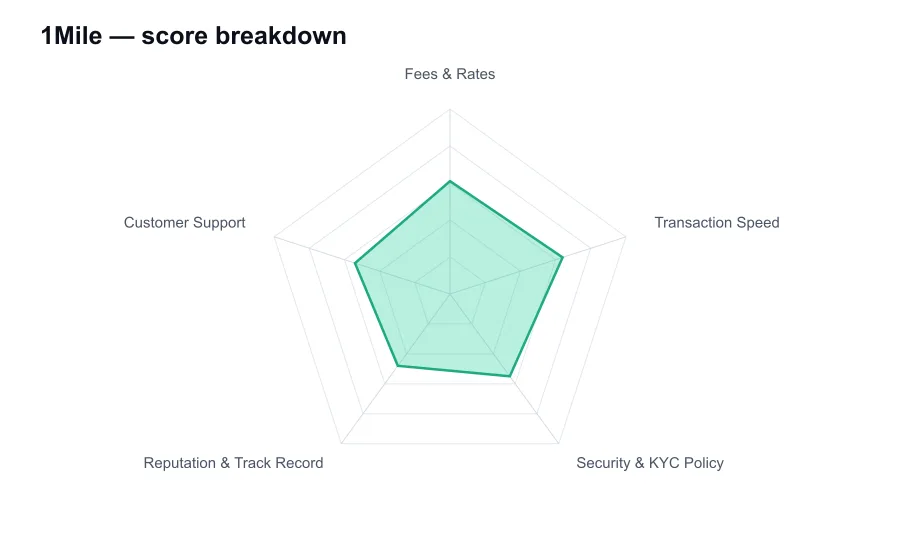
| Criterion | Score | Note |
|---|---|---|
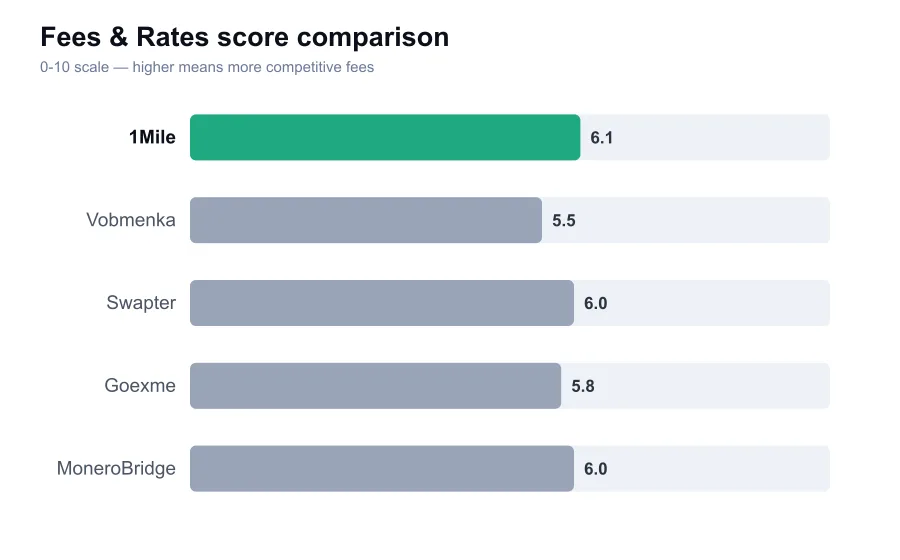
| Fees & Rates | 6.1 | Compare final payout closely, the spread matters more than slogans. |
| Transaction Speed | 6.4 | Fast-chain swaps can be quick, network confirmations still govern timing. |
| Security & KYC Policy | 5.5 | No-account flow, but compliance checks may still hold flagged transfers. |
| Reputation & Track Record | 4.8 | A limited independent public track record versus major rivals. |
| Customer Support | 5.4 | Keep the order ID and transaction hash for any support case. |
| Fact | Value | Source |
|---|---|---|
| Service model | Instant crypto exchange | - |
| Account flow | No account for standard swaps | - |
| Execution model | Quoted conversion, not an order book | - |
| Price check | Compare final payout before sending | - |
| Transfer risk | Wrong-network sends may be unrecoverable | - |
| Requirement | optional |
|---|---|
| Notes | The normal flow is designed without account registration, but compliance screening can lead to identity or transaction-information requests for flagged orders. |
| Notable Coins | Bitcoin, Ethereum, Tether, USD Coin |
|---|
1Mile is a small instant crypto exchange service aimed at people who want to swap assets without creating a trading account or learning an exchange terminal. Its proposition is familiar: choose a pair, enter a receiving address, send the deposit, and wait for delivery. That puts it in the same broad category as ChangeNOW, SimpleSwap, and LetsExchange, although 1Mile has far less public visibility than those bigger names.
The first thing to understand is that 1Mile is not a conventional exchange with an order book. You are accepting a quoted conversion from a service that sources liquidity through outside partners. That can be convenient, especially for a one-off conversion, but it means the rate is more important than any advertised fee. A service can say it charges no explicit commission while still earning through the spread between the market rate and the rate shown to you.
In practice, users should compare the final amount, not just the headline exchange rate. Open the same BTC to USDT or ETH to BTC quote at 1Mile and at two larger competitors before sending anything. On liquid pairs, the difference may be modest. On smaller tokens, lower-volume networks, or swaps during sharp market moves, the gap can get expensive quickly. That is the basic weakness of smaller instant exchangers, and 1Mile has not earned enough public scrutiny to get a free pass on pricing.
There is no compelling evidence that 1Mile is consistently among the cheapest services in its class. That does not mean every quote is poor. It does mean you should treat each transaction as its own price comparison. Fixed-rate quotes are usually the safer choice if the option is available, because a floating quote can deteriorate between the time you create the order and the time your deposit receives confirmations.
Speed depends less on 1Mile's website than on the asset you send and the liquidity route behind the quote. A USDT transfer on Tron can settle substantially faster than a Bitcoin deposit that needs network confirmations. For mainstream pairs, an instant exchange should generally finish after the incoming deposit is detected and confirmed, often within minutes for fast chains and longer for Bitcoin. If the service has to source liquidity manually or perform a risk review, that expectation can disappear.
This is where 1Mile's smaller footprint matters. Larger brands have years of published user reports, integrations, and support records that make delays easier to assess. With 1Mile, the independent evidence base is thinner. A smooth transaction is likely to feel simple. A delayed transaction is harder to judge because there is less outside reporting showing how the company handles difficult cases.
The service is marketed in the no-account style common to instant exchangers. That should not be confused with a guarantee of anonymity. Crypto swap services can ask for identity documents, source-of-funds evidence, or extra transaction details when automated screening flags an address or transfer. Most providers reserve that right in their policies, and users should assume 1Mile can do the same even if a normal swap begins without registration.
That policy creates a practical risk. If funds are stopped for compliance review, you are dealing with a provider that does not have the public reputation, regulatory disclosure, or large support operation of a major centralized exchange. The sensible approach is to test the service with a small amount before trusting it with a meaningful holding. Never use an instant exchanger as a place to park funds while waiting for a better rate.
There is also the usual address risk. 1Mile cannot reverse a completed blockchain transfer if you send funds to the wrong deposit address, choose the wrong network, or enter a token address that does not support the asset. USDT is the classic trap because Ethereum, Tron, BNB Smart Chain, Solana, and other networks all have distinct transfer routes. Match the network in the order screen exactly, and do not rely on a wallet's token ticker alone.
The interface is simple enough for a newcomer, which is a genuine positive. You do not need to set limit orders, manage an exchange wallet, or understand maker and taker fees. That simplicity has a cost. You have less control over execution, no visible order book, and fewer tools for investigating why a quote changed. Traders who care about execution quality should use a liquid spot exchange instead.
Customer support is likely to be the deciding factor if anything goes wrong. Instant-exchange support is strongest when an agent can identify an order by its transaction ID, explain the status clearly, and provide a realistic completion or refund path. 1Mile should be judged by that standard, not by whether a support widget exists. Before sending, save the order ID, quoted amount, deposit address, and transaction hash. Those details are essential if you need help.
I would also be cautious around unusually large swaps. A large transaction can exceed available liquidity, create a worse-than-expected fill, or trigger additional checks. Splitting a transaction may reduce operational risk, although it can also mean paying network fees more than once. For a sizeable conversion, an exchange with a transparent order book or an OTC desk is usually the better venue.
1Mile's reputation is its weakest category. It appears to be an operating instant exchange, but it does not carry the long public history of Kraken, Coinbase, Bitstamp, ChangeNOW, or even several established no-account swap brands. That is not proof of wrongdoing. It is a reason to demand more caution, because a limited record leaves fewer independent data points on support quality, delayed orders, and dispute handling.
For a small, straightforward swap, 1Mile can be a practical option if its delivered amount beats alternatives and you verify every order detail. I would not call it a first-choice venue for a large transfer, an urgent conversion, or any transaction where a compliance hold would cause serious trouble. The service is usable, but it has not built the level of transparency and public confidence needed to justify blind trust.
| Pros | Cons |
|---|
1Mile fits users making a small, non-urgent crypto conversion who are comfortable comparing quotes before sending. It can suit someone moving between common assets without opening a centralized exchange account. Large holders, frequent traders, and anyone who needs a documented compliance process should choose a more established exchange or a major instant-swap brand instead.
Its service is built around a no-account instant-swap flow. That does not guarantee every transaction will pass without questions, since risk screening can lead to a request for additional information.
Check the final amount you will receive against at least two alternatives. The effective cost includes the rate spread and network fees, even where no separate platform fee is displayed.
Bitcoin deposits need blockchain confirmations before the order can proceed. A transfer on a faster network such as Tron may be credited sooner, subject to the receiving service's confirmation rules.
Save the order ID, deposit address, quoted payout, timestamp, and your blockchain transaction hash. Those are the key records support needs to locate a delayed swap.
No. Send only on the exact network shown in the order. USDT on Tron, Ethereum, BNB Smart Chain, and Solana uses different routes and a wrong-network transfer can be difficult to recover.
It is better to test a small amount first. For a large conversion, a venue with transparent liquidity, strong support history, and clearer compliance procedures is the safer choice.
| Alternative | Score |
|---|---|
| BTC2Pay Review | 5.8/10 |
| Vobmenka Review | 5.8/10 |
| XChangic Review | 5.9/10 |
| BtcChange24 Review | 6.0/10 |
| HotExchange Review | 6.0/10 |
| 111Obmen Review | 6.0/10 |