Editorial independence: our scores and rankings are produced using the fixed criteria above and are not influenced by advertisers. This is an independent ranking site and is not operated by, or affiliated with, any provider we list.
Affiliate disclosure: some links on this page may earn us a commission at no extra cost to you. This does not affect our rankings.
| Best for | Not for |
|---|
| Criterion | Score | Note |
|---|---|---|
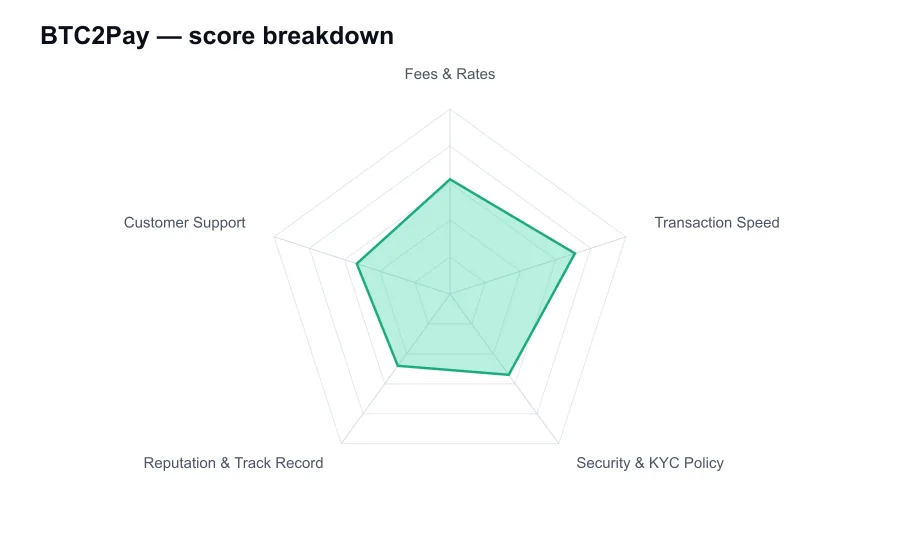
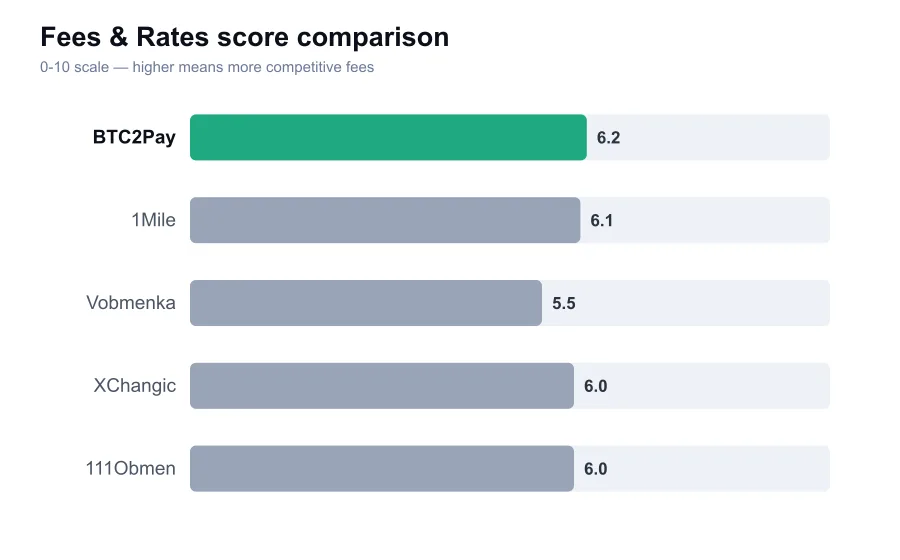
| Fees & Rates | 6.2 | Convenient quotes, but spread comparison is essential |
| Transaction Speed | 7.1 | Routine swaps can be quick after confirmations |
| Security & KYC Policy | 5.4 | No standing balance helps, counterparty risk remains |
| Reputation & Track Record | 4.8 | Limited public operating record versus major exchanges |
| Customer Support | 5.3 | Support quality matters most during exceptions |
BTC2Pay sits in the small, fast-moving corner of the crypto exchange market where convenience matters more than a glossy trading terminal. It appears built for straightforward swaps and payment-style crypto transactions rather than chart-heavy speculation. That gives it a clear audience: people who already know what they want to send and receive, and don't want to spend an hour opening an account at a large centralized exchange.
The first thing to understand is that BTC2Pay is not in the same category as Coinbase, Kraken, or Binance. Those platforms are deep liquidity venues with formal account systems, large compliance teams, and public corporate footprints. BTC2Pay feels closer to an exchange service or payment intermediary. That can be refreshing for a one-off swap, but it also changes the risk calculation substantially.
Its appeal starts with the relatively simple customer journey. A user selects a pair, enters a receiving address, sends funds, and waits for the service to complete the conversion. For experienced wallet users, that is much less cumbersome than moving money through an exchange account. There is no reason to romanticize simplicity, though. A simple front end doesn't eliminate the need to verify every address, network, and minimum amount before sending.
Fees are the area where exchange services often look cheaper than they really are. BTC2Pay may not present a large separate commission at checkout, but the meaningful cost is usually embedded in the quoted exchange rate. That is normal in this sector. The problem is that a customer can't sensibly judge value without comparing the final received amount against at least two alternatives, such as ChangeNOW, SimpleSwap, or an offer listed on BestChange.
For small conversions, a slightly weaker rate may be an acceptable price for speed and fewer account hurdles. On a larger transaction, that spread can become expensive very quickly. A rate that is only one or two percent worse than the market sounds harmless until the transfer is worth several thousand dollars. BTC2Pay is therefore better suited to convenience-driven exchanges than to users who need execution close to the market midpoint.
Whether a quote is fixed or floating matters even more than the headline rate. A floating quote can move while a blockchain transaction waits for confirmations, especially during volatile periods or congested network conditions. If BTC2Pay offers a fixed-rate route for a pair, read the time limit and send exactly the required amount. Fixed rates are useful, but they are not magic. An expired quote, an underpayment, or a wrong network can still turn a supposedly predictable trade into a support case.
Speed should be judged realistically. Crypto swaps are constrained by the chain being sent, required confirmations, liquidity availability, and the chain receiving the funds. A USDT transfer on a low-fee network can complete far sooner than a Bitcoin transaction waiting through a busy mempool. Fast processing by BTC2Pay is helpful, but no provider can make an unconfirmed deposit settle instantly.
In routine conditions, the likely experience is a transaction measured in minutes rather than days. That is the standard buyers should expect from a competent instant exchange. It is not the same as a guaranteed service level. Large transactions, unusual pairs, wallet compliance flags, and maintenance at a liquidity partner can all extend a swap. Anyone facing a hard deadline should test the route with a modest amount first.
The security question requires more skepticism. A non-custodial-style exchange flow means BTC2Pay may not hold a standing balance for users in the way a conventional exchange does. That reduces one particular risk: leaving funds parked indefinitely on a platform. It does not remove counterparty risk once coins have been sent to the service. During the conversion process, the user is relying on the provider and its liquidity arrangements to send the output correctly.
KYC is another area where buyers should avoid assumptions. Services marketed as quick swaps may allow many ordinary transactions without a full account verification process, but they can still request identification or source-of-funds information under risk controls. That is common across the industry, even at providers that advertise privacy. If a transaction gets flagged after deposit, the practical issue is not the marketing language but how clearly the service explains its review process and how fast it resolves the case.
BTC2Pay does not have the long, independently documented public history that makes a major exchange easier to assess. A smaller footprint is not proof of misconduct, but it means there are fewer years of operational evidence, fewer detailed outside reviews, and less public information to fall back on if something goes wrong. I would not treat it as a place to store value or route a life-changing amount merely because the initial interface is smooth.
That reputation gap affects support too. Smaller exchange providers can offer personal and quick responses when everything is normal, yet become difficult to reach during a disputed transaction. The useful test is whether support provides a transaction ID, explains confirmation requirements, and gives a concrete next step rather than a generic promise to investigate. A contact form alone is not enough for a service handling irreversible transfers.
BTC2Pay makes the most sense for a technically literate user making a limited-size swap who understands wallets and can independently compare quotes. It is not the obvious choice for first-time buyers, businesses needing invoices and compliance documentation, or anyone who expects telephone-level support. Those users will usually pay more at a regulated major exchange, but they receive a stronger operational framework in return.
My view is measured rather than enthusiastic. BTC2Pay's direct swap model can be useful, particularly where a full exchange account is unnecessary, but its value depends entirely on the live quote and the reliability of execution at that moment. Use a fresh receiving address, save transaction hashes and screenshots, and make the first transaction small. It can serve as a practical utility, but it has not earned the level of trust I would give to a long-established, heavily scrutinized exchange.
| Pros | Cons |
|---|
BTC2Pay fits experienced self-custody users who need a modest, uncomplicated crypto conversion and are willing to compare live quotes. It can suit someone moving between established assets without opening another exchange account. Beginners, large-volume traders, and businesses that need formal compliance support should look to Kraken, Coinbase, or a regulated local provider instead.
A quick swap flow may not require full verification for every transaction, but crypto exchange services can request ID or source-of-funds documents after risk screening. Do not assume any transaction is guaranteed to be verification-free.
Timing depends on the deposit blockchain, required confirmations, liquidity, and the destination network. Routine swaps may take minutes, while Bitcoin deposits, congestion, or manual review can take much longer.
The important number is the final amount you receive. A service may include its compensation in the quoted rate rather than show a separate fee, so compare the output against competing providers before sending.
| Alternative | Score |
|---|---|
| 1Mile Review | 5.8/10 |
| Vobmenka Review | 5.8/10 |
| XChangic Review | 5.9/10 |
| BtcChange24 Review | 6.0/10 |
| HotExchange Review | 6.0/10 |
| 111Obmen Review | 6.0/10 |