
Editorial independence: our scores and rankings are produced using the fixed criteria above and are not influenced by advertisers. This is an independent ranking site and is not operated by, or affiliated with, any provider we list.
Affiliate disclosure: some links on this page may earn us a commission at no extra cost to you. This does not affect our rankings.
| Best for | Not for |
|---|
| Criterion | Score | Note |
|---|---|---|
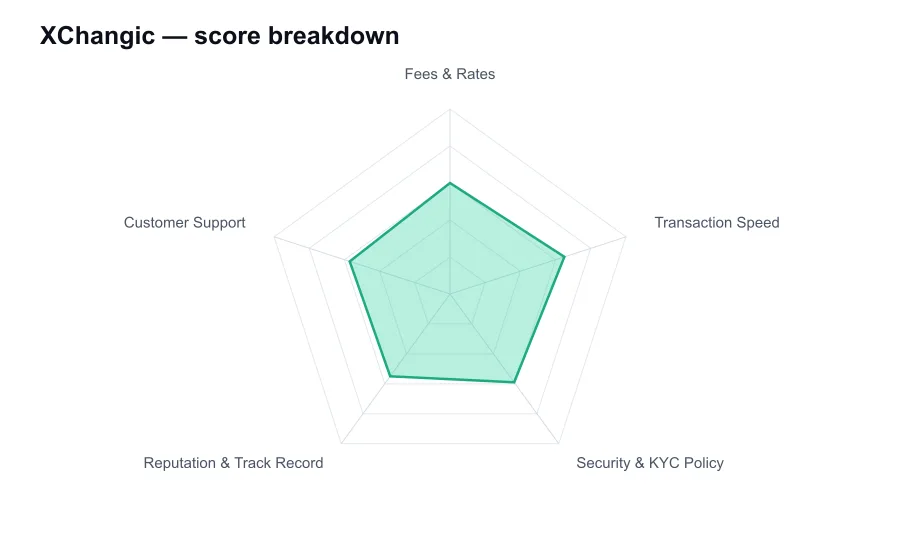
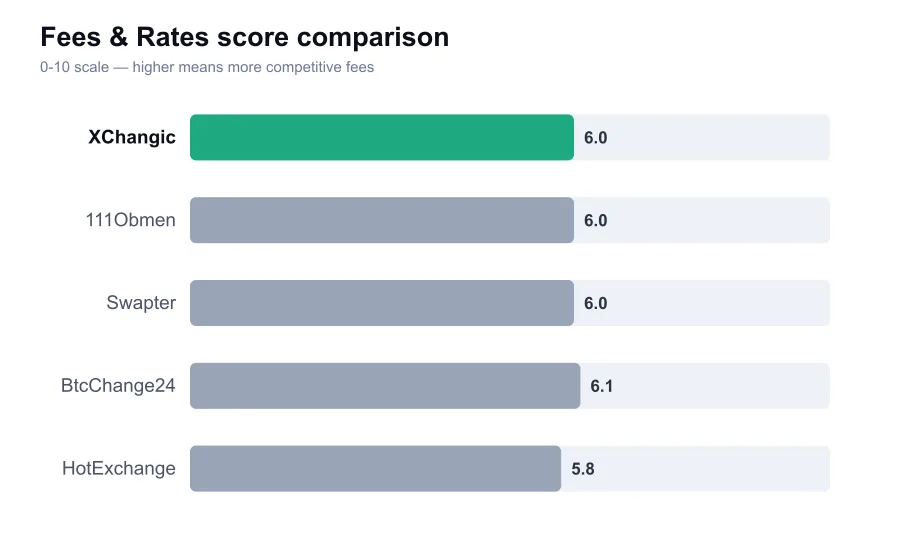
| Fees & Rates | 6.0 | All-in quotes can be fair, but spreads need comparison |
| Transaction Speed | 6.5 | Routine crypto settlement depends chiefly on confirmations |
| Security & KYC Policy | 5.9 | No standing balance helps, conditional checks can interrupt orders |
| Reputation & Track Record | 5.5 | Smaller public footprint than long-established global exchanges |
| Customer Support | 5.7 | Order-focused help rather than deep beginner guidance |
XChangic is the kind of compact exchange service that appeals to people who want to turn one asset into another without living inside a trading terminal. It occupies the middle ground between a peer-to-peer marketplace and a large centralized exchange. The workflow is usually direct, the choice is usually transaction-specific, and the customer is paying for operational convenience as much as for the conversion itself. That can be useful, but it is not the same thing as getting institutional execution.
The service's market position is shaped by its focus on practical exchange directions. A customer is likely to care less about dozens of obscure tokens than about whether a familiar stablecoin, Bitcoin, Ethereum or local payment method is available at a workable price. That makes live availability important. A provider can advertise a broad list of directions while temporarily pausing individual pairs due to reserve levels, banking conditions or network maintenance. The order page is more authoritative than a generic asset list.
XChangic's fee structure is best judged through its all-in quote. In this business, an explicit service fee can be small or absent while the exchange rate contains the commercial margin. The only meaningful question is how much reaches the destination after every deduction. Compare that result with a liquid spot market, but also include withdrawal and network costs. A quote that looks expensive versus a raw market chart may still be reasonable after those separate costs are included. A quote that is worse after that comparison is simply expensive.
This is not a venue for chasing basis points. The spread can be acceptable for small, urgent or awkward conversions, but a frequent user will almost always benefit from learning a mainstream exchange's deposit, trading and withdrawal process. XChangic is paying for staff, payment rails, reserve management and risk. Those costs show up somewhere. The service is worth the premium only when it saves enough time or friction to justify it.
The quote can also change in ways customers do not expect. Volatile coins move between the time an order is created and the time the transfer reaches the operator's wallet. The amount may be recalculated if the order uses a floating rate or if the sent amount differs from the instructions. A fixed rate is safer for predictability, but it often has a narrow payment window and may carry a less favorable initial price. Read the terms for the particular direction instead of assuming every route behaves alike.
On routine crypto orders, XChangic should be judged by settlement after confirmations, not by how quickly its homepage loads. If the platform releases the outgoing transaction promptly after the incoming payment is confirmed, that is competent service. If a network is congested, even an immediate payout can take time to become spendable. Sending an asset with a suitable network fee helps. It is unreasonable to choose the cheapest possible Bitcoin fee and then blame the exchanger for the resulting delay.
Fiat and bank-adjacent transactions deserve more patience. Receiving systems can hold payments, sender names may be checked, and manual review becomes more likely where anti-fraud rules are strict. The best approach is to avoid using a third party's bank account, do not add unrequested payment references, and do not send multiple partial transfers unless the operator explicitly permits them. Small deviations create reconciliation work, and reconciliation work is where instant exchanges stop being instant.
XChangic benefits from the fact that users do not need to maintain a large standing balance on its platform. That is a genuine security advantage over keeping assets indefinitely on a small exchange. Still, each order is an act of trust. The service receives the incoming funds and controls the outgoing settlement. Customers should use official access points, double-check destination addresses, and ignore unsolicited messages offering to change payment details. Social-engineering attacks are often more dangerous than technical hacking for this type of service.
KYC should not be treated as a binary marketing badge. XChangic may allow many standard transactions to proceed without lengthy registration, but compliance rules can permit or require document requests in certain cases. The distinction matters to privacy-minded users. A person who needs a legally predictable, fully verified relationship may be better served by a regulated exchange that makes its onboarding requirements clear upfront. A person who values a low-friction transaction must still accept that a flagged order can be paused.
Public information is thinner than I would like. That is a common weakness in smaller exchange brands, and it limits the confidence score even if ordinary orders appear to work. A strong reputation is built through years of visible operations, consistent reviews across independent venues, clear dispute handling and transparent business information. XChangic has more to prove on that standard than household-name exchanges. I would not confuse a professional-looking order form with the depth of assurance provided by audited or heavily supervised platforms.
The review landscape can help, but it needs interpretation. Look for detailed accounts that name the payment direction, timing and outcome, not generic five-star comments that say only "good exchanger." Also examine how unresolved complaints are handled. A provider cannot prevent every bank delay or customer input error, but it can explain what happened and show evidence. Silence, vague replies or pressure to communicate only through unofficial channels are warning signs at any exchange service.
Support appears most relevant as an order-resolution channel. That is enough for experienced customers who know to provide an order identifier and blockchain hash. It is not enough to make the product beginner-friendly by itself. A first-time user may find the terminology, rate rules and network choices intimidating, and a rushed transfer can be irreversible. XChangic would benefit from more prominent, plain-language guidance around payment windows, recipient requirements and what happens during a compliance hold.
For my own use, I would begin with a small stablecoin exchange on a network I understand, then evaluate the exact payout, timing and communication. I would not use the first interaction to convert a substantial balance or meet a hard payment deadline. This test-first approach is not paranoia. It is the sensible response to any service where a single typo, an unconfirmed transaction or an unexpected review can interrupt settlement.
XChangic is credible as a practical exchanger for a user who understands its limitations. It is not a destination for portfolio management, advanced trading or blind trust. The best reason to use it is that its live quote and available payment direction solve a real problem better than the alternatives at that moment. If that condition is not met, there is little reason to pay the exchanger premium. Convenience is valuable, but it should be priced and measured, not assumed.
| Pros | Cons |
|---|
XChangic suits crypto-literate users who need a specific supported conversion and are prepared to compare final quotes. It is better for occasional, modest transfers than for frequent trading or long-term custody. Users requiring guaranteed processing times, deep liquidity or highly documented compliance should choose a major exchange. Beginners should not use it without first understanding wallet networks and fixed versus floating rates.
Compare the final amount received against at least two exchangers and a spot-exchange route, including network and withdrawal costs.
Yes. Even low-friction exchange services can request documents or payment evidence when compliance or anti-fraud checks are triggered.
Keep the order number, payment receipt, sending wallet address, transaction hash, destination address and screenshots of the quoted terms.
| Alternative | Score |
|---|---|
| BtcChange24 Review | 6.0/10 |
| HotExchange Review | 6.0/10 |
| 111Obmen Review | 6.0/10 |
| Swapter Review | 6.0/10 |
| BTC2Pay Review | 5.8/10 |
| 1Mile Review | 5.8/10 |