
Editorial independence: our scores and rankings are produced using the fixed criteria above and are not influenced by advertisers. This is an independent ranking site and is not operated by, or affiliated with, any provider we list.
Affiliate disclosure: some links on this page may earn us a commission at no extra cost to you. This does not affect our rankings.
| Best for | Not for |
|---|
111Obmen is an online exchanger for cryptocurrency and electronic-money or fiat-oriented payment directions. Instead of offering a trading terminal, it accepts an exchange request for a chosen route and sends the corresponding payout after it receives and processes the customer's payment.
| Criterion | Score | Note |
|---|---|---|
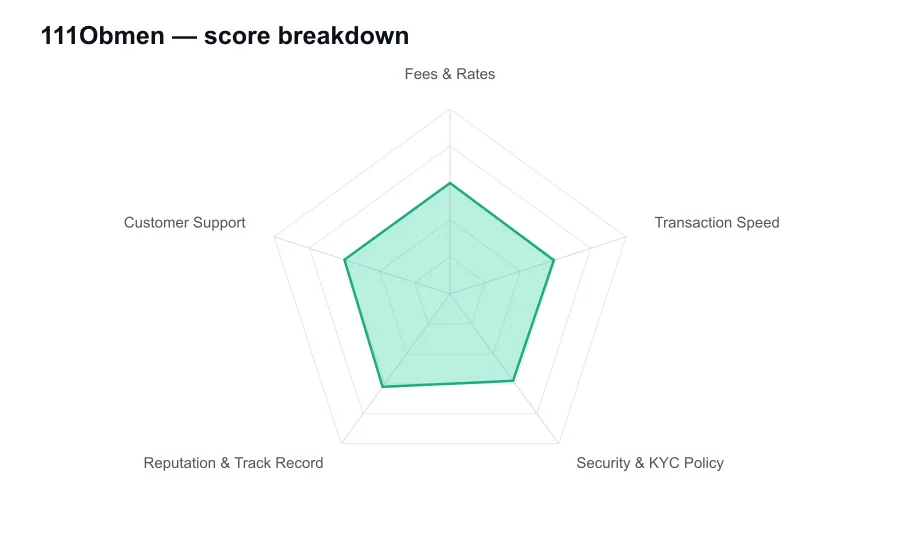
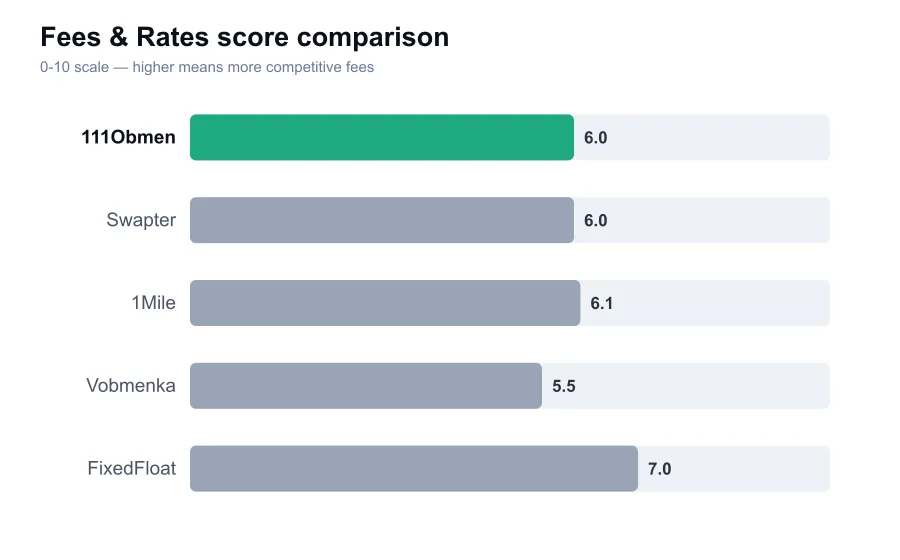
| Fees & Rates | 6.0 | Rates vary sharply by payment direction, compare net received amounts. |
| Transaction Speed | 5.9 | Crypto can be quick, fiat and payment routes may need manual handling. |
| Security & KYC Policy | 5.8 | Transaction-based exposure remains, verification can apply by route. |
| Reputation & Track Record | 6.2 | Known in the regional exchanger-monitoring ecosystem. |
| Customer Support | 6.0 | Keep payment receipts and application numbers for disputes. |
| Fact | Value | Source |
|---|---|---|
| Service model | Electronic currency and crypto exchanger | - |
| Market focus | Russian-language regional users | - |
| Execution model | Direction-based exchange requests | - |
| Price model | Route-specific conversion rates | - |
| Processing model | Automatic and manual routes may differ | - |
| Dispute records | Keep application and payment references | - |
| Requirement | tiered |
|---|---|
| Notes | Requirements can depend on the payment method, amount, transaction history, and risk controls. Fiat and payment-system routes can require more information than a routine crypto transfer. |
| Notable Coins | Bitcoin, Ethereum, Tether, Litecoin |
|---|
111Obmen is a Russian-language electronic currency and cryptocurrency exchanger, built for practical conversion rather than speculative trading. It sits closer to the traditional online-exchanger model than to a global crypto platform. The service is relevant to users who need to move between cryptocurrencies, payment systems, and fiat-oriented transfer methods, depending on the directions available at a given time.
That specialization is important. A customer coming from Binance, Kraken, or Coinbase may expect charts, a trading account, market orders, and deep liquidity. 111Obmen is not trying to be that. It presents exchange directions and rates, then processes a request according to the chosen payment method. For users in its core market, that can be more convenient than moving funds through several separate services.
The rate is the first area where buyers need discipline. Electronic exchangers often make their margin through the conversion rate, not through a clean maker and taker schedule. A transaction involving bank transfers, payment processors, cash-related services, or less liquid crypto can include costs that are not obvious from a single percentage. The proper comparison is the amount you pay and the exact amount you receive after all route-specific terms.
111Obmen can be useful when it supports a difficult local direction that a large global exchange does not. That convenience can justify a wider spread. It does not justify accepting an uncompetitive quote without checking. BestChange-style monitoring services and direct comparisons with other exchangers are valuable here, particularly for ruble-linked directions and payment-system exchanges where quoted rates can differ materially across providers.
Crypto-only users should be even more selective. If you are simply exchanging BTC for USDT, an international spot exchange or a large instant-swap provider may offer more liquid execution and clearer pricing. 111Obmen's advantage is operational access to particular payment routes, not necessarily the cheapest crypto conversion. Its rate can be perfectly acceptable on one direction and weak on another.
Processing speed varies heavily by method. A blockchain transfer can be delayed by required confirmations. Bank or payment-system transfers may be subject to working hours, manual review, recipient-bank processing, or identity checks. Anyone expecting every transaction to finish in five minutes will be disappointed by this category of service. The correct expectation is that automatic crypto directions may move relatively quickly, while fiat-linked routes can require human handling.
The service has a stronger local reputation than a random new swap site because it has been visible in the exchanger-monitoring ecosystem. That kind of listing is useful, but readers should not treat it as insurance. Monitoring platforms can show reserves, feedback, and availability. They cannot make a dispute disappear, guarantee a bank transfer, or eliminate the counterparty risk of sending funds to an exchanger.
Security is a mixed picture, as it is for most electronic exchangers. The customer does not need to leave an ongoing trading balance on the platform, which reduces one kind of custody risk. Yet the exchange transaction itself still requires trust. You send money or crypto first, and the company completes the other side afterward. That is a real counterparty relationship, not an atomic blockchain swap.
Identity requirements can depend on the exchange direction. Crypto transactions may be handled with limited customer data, while fiat, bank, payment-processor, or suspicious transactions can produce requests for identification or proof of payment. Users should read the current rules before depositing, especially if they are converting a large amount or using a payment source that does not match their own name.
The toughest operational issue with services in this category is compliance and payment reversals. A payment processor or bank may flag a transfer even if the exchanger is prepared to process it. Conversely, the exchanger may ask a customer to verify control of a wallet or payment account before releasing funds. If you cannot produce those documents, a conversion can become a slow dispute. Do not use someone else's card, bank account, or payment wallet.
Support is likely to be most useful for fiat-linked directions, where a transaction receipt, bank reference, or payment-system screenshot may be needed. A customer should retain every record: the exchange application number, payment receipt, sender details, recipient details, wallet address, and blockchain transaction ID. That is not paranoia. It is what distinguishes a solvable delay from a frustrating back-and-forth with support.
111Obmen's interface and communication are most comfortable for Russian-speaking users who already understand local payment rails. International users may find the terminology, verification expectations, and availability of payment directions less familiar. There is nothing inherently wrong with a regionally focused service, but it means the platform should be judged within that context rather than against a global exchange built for dozens of jurisdictions.
I would not use 111Obmen as a primary long-term crypto venue. It is an exchanger, not a vault, broker, or sophisticated marketplace. Its practical value lies in completing a specific route that is otherwise inconvenient. Send the minimum necessary, complete the transaction, and return the proceeds to your own wallet or bank account.
My final take is that 111Obmen is useful for its niche, but its niche demands care. It can solve local exchange problems that mainstream crypto platforms ignore. Its rates need active comparison, fiat routes can be slower and more document-heavy than customers expect, and the customer has to accept counterparty exposure during every order. For the right payment direction it may be a sensible tool. For general crypto trading, it is the wrong tool.
| Pros | Cons |
|---|
111Obmen is best for Russian-speaking users who need a specific crypto, electronic-payment, or local transfer direction that large exchanges do not serve well. It can work for a one-off conversion after checking rates against other exchangers. International users, high-frequency traders, and people seeking strong global regulatory protections should look to established centralized exchanges or locally licensed providers.
111Obmen is an electronic currency and cryptocurrency exchanger. It processes selected conversion directions rather than operating as a conventional order-book trading exchange.
Each route has its own liquidity, payment-processing cost, fraud risk, and settlement workload. Compare the exact net payout, especially for bank and electronic-payment directions.
Yes. Bank and payment-system transactions may require manual review, working-hour processing, or confirmation from an outside payment provider, unlike a straightforward on-chain transfer.
For a delayed fiat order, support may need the application number, payment reference, sender details, amount, and timestamp. A receipt is the strongest proof that the payment was made.
Yes. Requirements can vary by exchange direction and transaction risk. Fiat, bank, payment-processor, or flagged transactions are more likely to require additional information.
No. Third-party payments can trigger verification or rejection because the sender details may not match the exchange request. Use an account and wallet you control.
| Alternative | Score |
|---|---|
| BtcChange24 Review | 6.0/10 |
| HotExchange Review | 6.0/10 |
| Swapter Review | 6.0/10 |
| XChangic Review | 5.9/10 |
| UAchanger Review | 6.2/10 |
| BTC2Pay Review | 5.8/10 |