Editorial independence: our scores and rankings are produced using the fixed criteria above and are not influenced by advertisers. This is an independent ranking site and is not operated by, or affiliated with, any provider we list.
Affiliate disclosure: some links on this page may earn us a commission at no extra cost to you. This does not affect our rankings.
| Best for | Not for |
|---|
| Criterion | Score | Note |
|---|---|---|
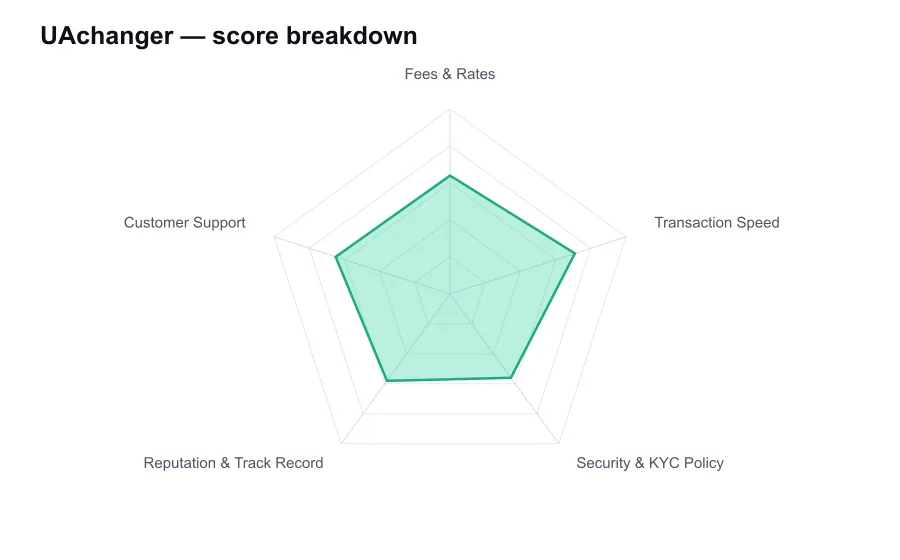
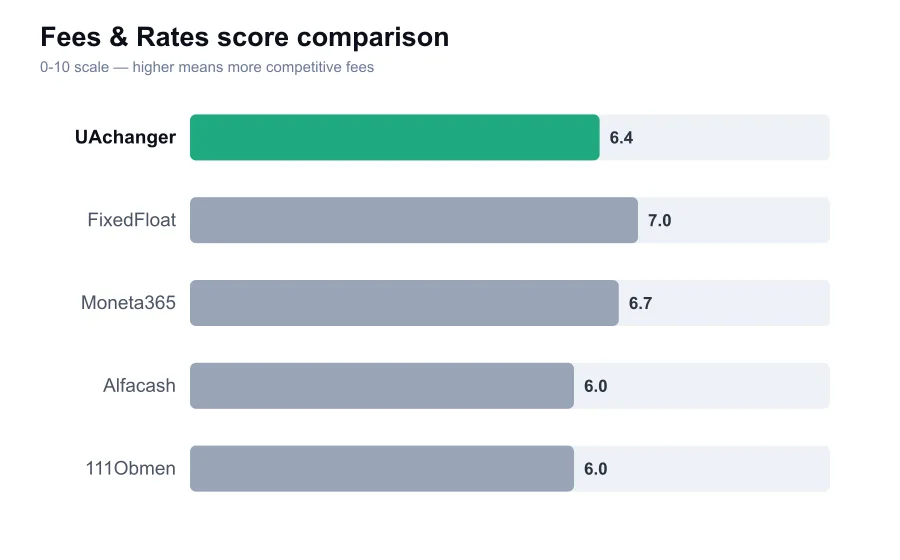
| Fees & Rates | 6.4 | Rates can be competitive, but the spread is the real fee. |
| Transaction Speed | 7.1 | Routine popular-network orders can clear quickly. |
| Security & KYC Policy | 5.6 | Use as a one-off exchanger, not as long-term custody. |
| Reputation & Track Record | 5.8 | A smaller regional brand with limited institutional visibility. |
| Customer Support | 6.5 | Direct operator contact matters for manual orders. |
UAchanger is a Ukrainian oriented online exchanger built for people who want to move between crypto, electronic money and local payment methods without opening an account at a large trading platform. It sits closer to the classic exchanger model than to Binance or WhiteBIT. You select a direction, enter recipient details, pay, and wait for an operator or automated system to complete the order. That simplicity is its appeal, but it also means users need to pay close attention to the quoted rate before committing.
The service appears designed around practical exchange routes rather than speculative trading. Crypto pairs, stablecoins, bank card payments and local transfer options are the core proposition. For a Ukrainian customer converting USDT into hryvnia, that can be more direct than withdrawing from an international exchange, passing through a P2P market and negotiating with a counterparty. UAchanger is not trying to be a sophisticated portfolio platform. It is a conversion desk with a web interface.
Rates are the first thing I would inspect here, and I would inspect them on every order rather than relying on a general claim of low fees. Like most instant exchangers, UAchanger's economics are usually embedded in the exchange rate. There may be no separate line reading "service fee," but that does not mean the transaction is free. Compare the final amount with two or three alternatives, including BestChange listed services where available, before sending funds.
For mainstream routes such as USDT TRC20 to a Ukrainian bank card, the spread can be acceptable if you value convenience and a direct payout. It becomes less attractive on thinly traded assets, smaller bank routes, or exchanges involving cash-like electronic wallets. The advertised figure can also move while an application is being created. That's normal in volatile markets, but users should understand whether the order has a fixed rate, a floating rate, or a rate that will be recalculated after the crypto deposit arrives.
The practical fee is not just UAchanger's spread. Network costs matter. A USDT ERC20 withdrawal can make a modest exchange irrational even if the displayed conversion rate looks decent. TRC20, TON and other lower-cost rails often make more sense for smaller sums, provided the receiving address and network are checked carefully. UAchanger cannot rescue a user who sends an asset on the wrong chain, and this is one area where a quick transaction flow can punish carelessness.
Speed is a genuine reason to consider this type of service. A routine order on a popular network can be processed in minutes after blockchain confirmation, especially during normal working hours and where the payout method supports instant crediting. Card and bank side delays are outside the exchanger's control, though. A transfer marked complete by the service may still take longer to appear if the recipient bank is conducting its own checks or processing cycle.
I would not treat every order as fully automatic. Larger amounts, unusual payment details, weak blockchain confirmation, or an exchange direction with limited reserve can pull an application into manual handling. This is where the experience can shift from fast to frustrating. UAchanger is better suited to a transaction that can tolerate some waiting than to an urgent payment with a hard deadline in the next fifteen minutes.
The service's security posture needs to be judged realistically. An exchanger is a custodial counterparty for the period between your payment and the payout. You are trusting its operators, its wallet controls and its payment infrastructure. The safer habit is to send the exact amount required, avoid keeping a balance with the service, save the order page and transaction hash, and make a small test exchange before using a substantial amount.
KYC is another point where users should not make assumptions. Many exchangers market a light onboarding experience, but they can request identification, proof of payment, source-of-funds information or a card verification if an order triggers fraud controls. That is not automatically a red flag. It is a reality of bank card payments and blockchain compliance. What matters is whether the service explains the request, limits the data it asks for, and resolves the case without leaving funds in limbo.
UAchanger does not carry the long institutional history of an international regulated exchange. That affects the reputation score. A smaller regional exchanger may build trust through completed orders, monitoring site feedback and responsive operators, but those signals are not the same as public financial reporting, a major licensing footprint or years of independently audited custody practices. I would use it as a transaction service, not as a place to store meaningful crypto.
Public reviews for exchangers also need a skeptical reading. A page with positive feedback is encouraging, yet it tells you little about how disputed orders are handled. Look for recent reviews mentioning your exact direction, payout bank and transaction size. A customer exchanging $50 of USDT may have a very different experience from someone sending a large amount of BTC during a sharp market move. Complaints about changing rates and delayed AML checks deserve particular attention.
Support is likely one of UAchanger's more important differentiators, because exchange problems are rarely solved by a polished interface alone. A visible messenger channel or live chat is useful for confirming reserves and clarifying an order before payment. The test is whether support can provide a concrete status, not merely say that the request has been passed to a specialist. Screenshot every relevant detail before opening a ticket.
There are sensible ways to use UAchanger. Confirm the receiving card number twice, verify the crypto network, read the rate conditions, and avoid splitting or underpaying a crypto transfer unless the instructions expressly allow it. If the service gives a payment time limit, respect it. Late payment during a moving market is one of the common ways an apparently cheap quote turns into a disputed recalculation.
My view is that UAchanger can be a practical regional exchange tool for users who understand how online exchangers work and check each quote carefully. Its convenience is real, especially for straightforward crypto to hryvnia transactions. I would not rank it alongside a major exchange on transparency or institutional safeguards, and I would not use it blindly for a first large transaction. Start small, judge the actual execution, then decide whether the rate and service justify returning.
| Pros | Cons |
|---|
UAchanger fits experienced Ukrainian users making straightforward crypto to local payment conversions, especially those who compare live quotes before paying. It can also suit a small test transaction when an exchange does not offer a convenient withdrawal route. Long-term holders, high-volume traders and users seeking strong published compliance credentials should look to larger regulated platforms instead.
The effective cost is commonly reflected in the quoted exchange rate, plus any blockchain withdrawal fee you pay before sending crypto. Compare the final payout, not just a stated fee.
A common crypto order may take minutes after the required blockchain confirmations, but bank processing, reserve limits and manual checks can extend that.
It may request verification or payment evidence where fraud, card or compliance checks are triggered. Do not assume an exchanger is permanently no-KYC.
| Alternative | Score |
|---|---|
| Moneta365 Review | 6.3/10 |
| FixedFloat Review | 6.3/10 |
| Alfacash Review | 6.4/10 |
| BtcChange24 Review | 6.0/10 |
| HotExchange Review | 6.0/10 |
| 111Obmen Review | 6.0/10 |