
Editorial independence: our scores and rankings are produced using the fixed criteria above and are not influenced by advertisers. This is an independent ranking site and is not operated by, or affiliated with, any provider we list.
Affiliate disclosure: some links on this page may earn us a commission at no extra cost to you. This does not affect our rankings.
| Best for | Not for |
|---|
FixedFloat is an instant cryptocurrency exchange service for swapping one cryptoasset into another without a conventional trading account. It offers floating-rate and fixed-rate orders. Users supply a receiving wallet address, send the deposit, and receive the converted asset after confirmations and routing.
| Criterion | Score | Note |
|---|---|---|
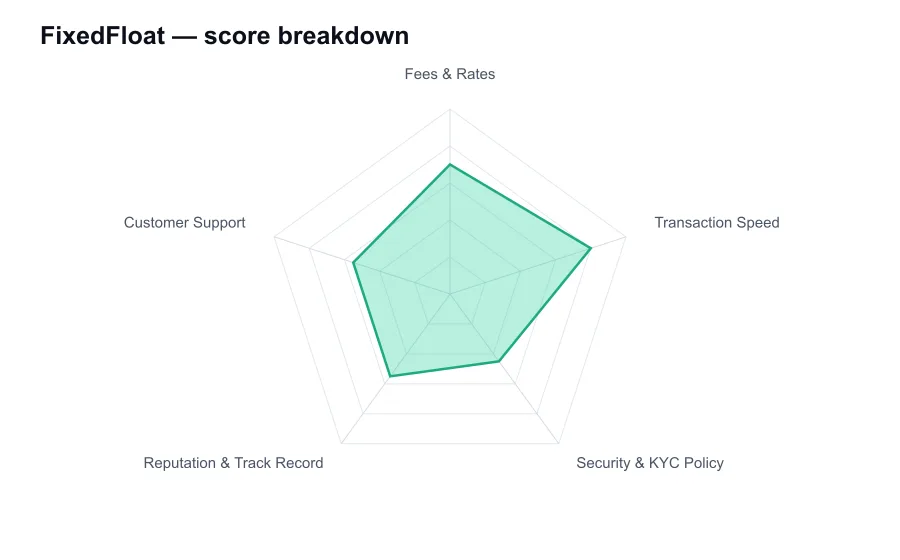
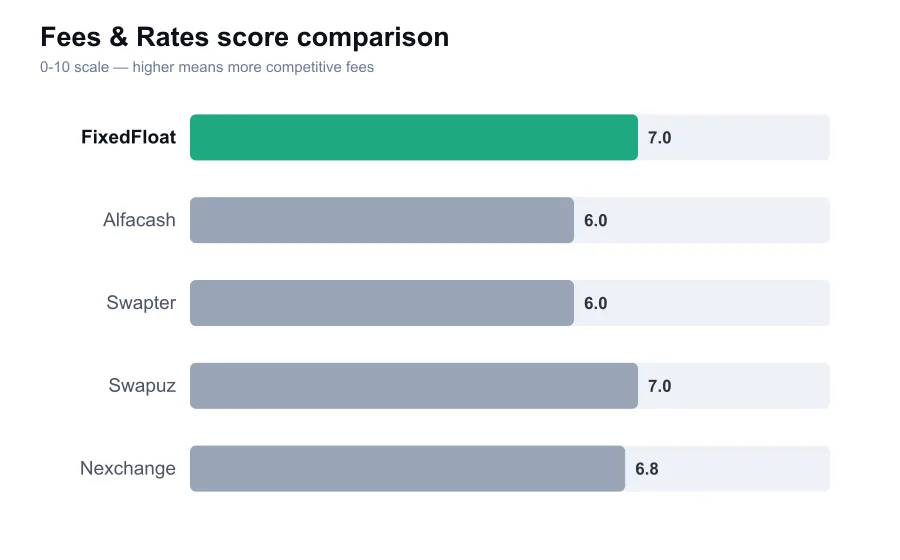
| Fees & Rates | 7.0 | 0.5% floating and 1% fixed service fees |
| Transaction Speed | 8.0 | Automated swaps after network confirmations |
| Security & KYC Policy | 4.5 | No-account convenience, but a 2024 breach weighs heavily |
| Reputation & Track Record | 5.5 | Well-known instant exchanger with a serious hack history |
| Customer Support | 5.5 | Useful order support, limited escalation options |
| Fact | Value | Source |
|---|---|---|
| Floating-rate fee | 0.5% | Source |
| Fixed-rate fee | 1% | Source |
| Account requirement | No routine account creation | Source |
| Reported security incident | February 2024 | - |
| Reported theft | About $26 million in BTC and ETH | - |
| Service model | Instant crypto-to-crypto exchanger | Source |
| Requirement | none |
|---|---|
| Notes | FixedFloat has historically offered no-account swaps without routine KYC. This does not guarantee that an order will never be reviewed or that compliance requirements cannot change. |
| Notable Coins | Bitcoin, Ethereum, Litecoin, Monero, Dogecoin, Tether, USD Coin |
|---|---|
| Networks | Bitcoin, Ethereum, Litecoin, Tron |
FixedFloat is one of the better known instant crypto exchangers, built for users who want to swap one asset for another without opening a conventional trading account. Its attraction is obvious. You choose a pair, enter a destination address, send the deposit, and receive the output without dealing with order books, fiat deposits, or a lengthy signup process. It occupies a useful middle ground between a centralized exchange and an on-chain decentralized swap.
The service is designed around speed and simplicity, not account management. That makes FixedFloat appealing to users who already hold crypto in self-custody and need a one-off conversion. It is not a venue for earning yield, storing a portfolio, placing limit orders, or gradually building a regulated trading history. Think of it as a transaction tool. Use it, complete the swap, and move on.
FixedFloat has historically offered two pricing choices: a floating rate and a fixed rate. The floating option is generally cheaper, with the exchange result moving with the market while the order is processed. The fixed option locks a quoted outcome for a limited payment window and charges more for that certainty. Its published floating service fee has been 0.5 percent, while the fixed-rate service fee has been 1 percent, before network fees and any rate movement.
Those fees are straightforward by instant-exchange standards. A 0.5 percent service charge is competitive with many no-account exchangers, though it is far more expensive than trading a liquid pair on Kraken, Coinbase Advanced, or Binance at lower volume tiers. The comparison should be fair. FixedFloat is selling convenience, routing, and no-account access. It is not trying to win a fee war against a deep spot market.
The fixed-rate option needs particular care. It protects the user from market movement only if the deposit arrives within the stated time and meets the required amount. A late deposit, an underpayment, a different asset, or an incorrectly selected network can break the assumptions behind the quote. FixedFloat cannot make blockchain confirmation risk disappear. Users should avoid choosing a fixed rate for an asset whose network is congested unless they understand the timing risk.
For straightforward crypto-to-crypto swaps, FixedFloat can be quick. Once the incoming transaction has the needed confirmations, automated routing can often complete the transaction in minutes. Actual speed depends on the deposit chain, the output chain, liquidity, and the number of confirmations needed. A Bitcoin deposit may take materially longer than a swap funded on a faster network. No instant exchanger can honestly promise the same timing for every pair.
FixedFloat's no-account design is a privacy and convenience advantage, but it removes several safety nets. There is no normal user dashboard with a long account history, strong account-level access controls, or an exchange balance that you can manage later. The order ID and transaction records are important. If you lose the order information or enter the wrong destination address, support may have little room to help.
The service has historically operated without routine KYC for ordinary exchange flow. That should not be interpreted as a guarantee of anonymity or a promise that every order will complete without questions. Blockchain transactions are traceable, providers may apply risk controls, and legal or compliance obligations can change. Anyone whose priority is regulatory certainty should use a licensed exchange with clear onboarding, rather than relying on a no-account converter.
Security is also shaped by custody. FixedFloat holds the deposited funds while the swap is being processed, so there is counterparty risk, even if the holding period is brief. Users retain more control than they would by parking a portfolio on an exchange, but they still surrender control during the conversion. The sensible practice is to swap only what is needed and to send the output to a wallet you control.
A major mark against FixedFloat is the February 2024 security incident. Blockchain investigators reported that roughly $26 million in Bitcoin and Ether was stolen from FixedFloat wallets. The service acknowledged a cyberattack and suspended operations while investigating. That incident is not a small footnote. It materially changes how a prudent user should assess operational security, especially compared with a provider that has not suffered a public custody breach of that scale.
The service's response and subsequent availability matter, but a hack of that magnitude cannot be erased by a clean interface or competitive fees. Any centralized or semi-custodial exchange can be attacked. Still, the incident is a concrete reminder that rapid no-account swapping has tradeoffs. FixedFloat should be used for transit, never as a place to hold value while waiting for a better price.
Reputation is therefore mixed. FixedFloat had built recognition among users looking for no-KYC, fixed-rate crypto swaps and had a clear, functional product identity. It also carries the reputational damage of a serious breach. That places it above an anonymous, untested exchanger in terms of visibility, but below established regulated exchanges on trust and institutional resilience.
Support is limited by the accountless model. The website's support channels can help with an active order, but they cannot provide the same relationship, phone escalation, or account recovery process that a large broker may offer. A user with a wrong address or a transaction sent on the wrong network should expect a difficult conversation, not a guaranteed rescue. Documentation and the order ID are essential.
FixedFloat remains a useful specialist tool for experienced crypto users who understand self-custody, blockchain confirmations, and exchange-rate risk. It is not where I would send a large share of a portfolio, and it is not the right first crypto purchase for a beginner. My recommendation is to use the floating option for small, non-urgent swaps where rate movement is acceptable, use fixed quotes only when you can fund promptly, and keep every transaction small enough that a delay will not become a crisis.
| Pros | Cons |
|---|
FixedFloat suits experienced self-custody users making small to medium crypto-to-crypto swaps without wanting a trading account. It is useful for users who understand confirmation delays and can fund a fixed quote promptly. Beginners, large holders, and anyone who wants regulated custody, fiat deposits, or phone support should use a major exchange instead.
FixedFloat has published a 0.5% fee for floating-rate exchanges and a 1% fee for fixed-rate exchanges. Network fees and the exchange rate also affect the final payout.
A floating rate changes with the market while the order is processed. A fixed rate locks the quoted outcome for a limited payment window, but its published service fee is 1% rather than 0.5%.
Yes. In February 2024, blockchain investigators reported roughly $26 million in Bitcoin and Ether stolen from FixedFloat wallets. FixedFloat acknowledged a cyberattack and suspended operations during its investigation.
The deposit must receive the required blockchain confirmations, then the service must route the output. Bitcoin confirmation time, network congestion, liquidity, and the selected pair can all add delay.
FixedFloat's standard swap flow has historically not required account creation. Keep the order ID and transaction hashes because the accountless model gives you fewer recovery and history tools.
A fixed quote depends on payment arriving within its stated window. A late or incorrect deposit may no longer qualify for the locked result and can require support handling.
| Alternative | Score |
|---|---|
| Moneta365 Review | 6.3/10 |
| UAchanger Review | 6.2/10 |
| Alfacash Review | 6.4/10 |
| BtcChange24 Review | 6.0/10 |
| HotExchange Review | 6.0/10 |
| 111Obmen Review | 6.0/10 |