Editorial independence: our scores and rankings are produced using the fixed criteria above and are not influenced by advertisers. This is an independent ranking site and is not operated by, or affiliated with, any provider we list.
Affiliate disclosure: some links on this page may earn us a commission at no extra cost to you. This does not affect our rankings.
| Best for | Not for |
|---|
| Criterion | Score | Note |
|---|---|---|
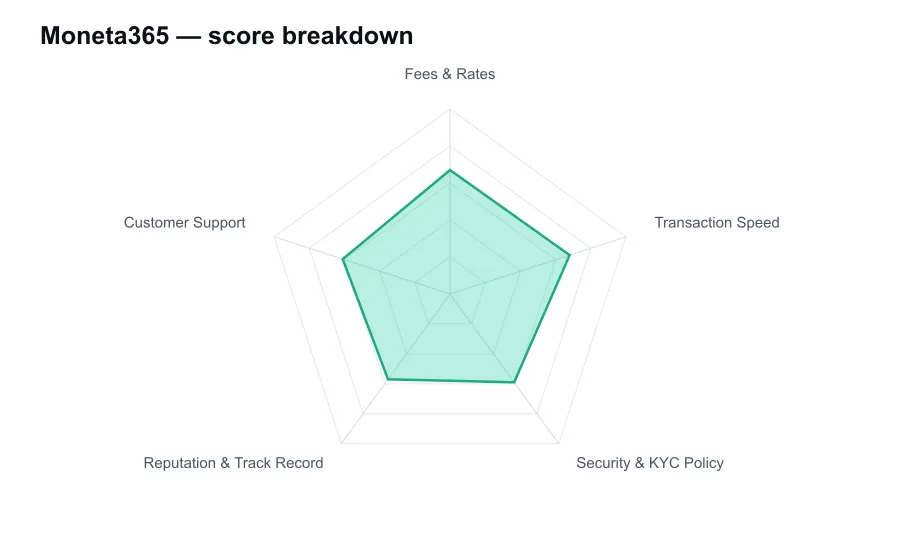
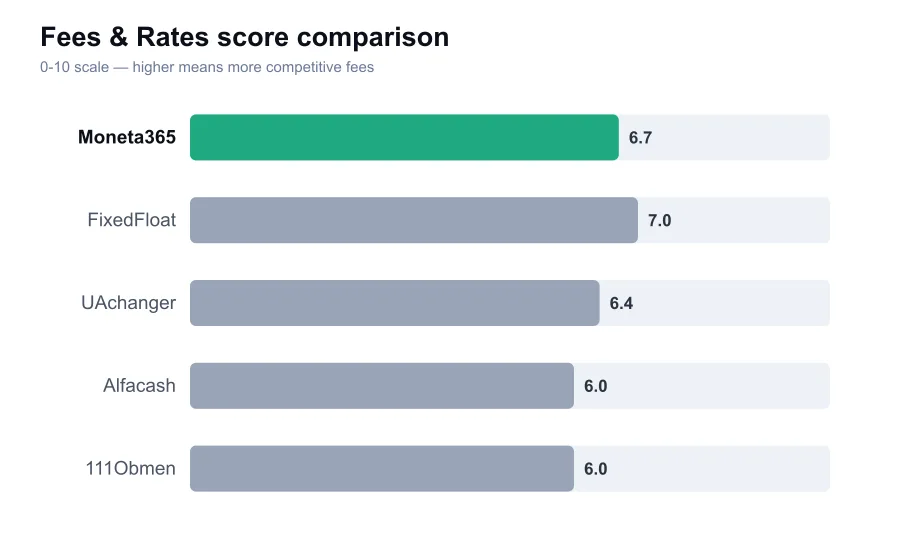
| Fees & Rates | 6.7 | Quote can be competitive, but varies by payment route |
| Transaction Speed | 6.8 | Routine orders can move quickly after confirmation |
| Security & KYC Policy | 5.9 | Use caution around phishing, KYC, and payment rules |
| Reputation & Track Record | 5.7 | More suitable for transactions than institutional trust |
| Customer Support | 6.1 | Order-specific updates are crucial during delays |
Moneta365 is the kind of crypto exchange provider that attracts users looking for a practical conversion service rather than a full trading ecosystem. Its name suggests round-the-clock availability, and that expectation is reasonable for the website and order system. But buyers should separate a service being online all day from every payment route, liquidity source, or support agent being able to resolve an exception instantly.
This distinction matters because Moneta365 operates in a part of the market where customers often need to move quickly between crypto and fiat-linked payment methods. For routine orders, an exchanger can feel much more convenient than onboarding at a global exchange. There are fewer screens, less trading jargon, and a direct focus on the amount sent and amount received. For a user who knows the route, that is a real advantage.
The trade-off is that this convenience is generally paid for through the quote. Moneta365 should be judged by its delivered amount, not by an isolated claim about low commission. Smaller exchangers commonly build their margin into the exchange rate and may also face different costs across banks, cards, electronic wallets, and blockchain networks. A quote that looks fine on a small purchase can be noticeably less attractive on a larger order.
I would compare Moneta365 against offers from other established exchangers for the exact same direction, amount, and payment rail. Do that just before creating the order, because reserves and market conditions change. Check whether the number shown already includes the network withdrawal cost. If the provider offers a fixed rate, verify the payment window and permitted amount difference. If it is a floating rate, accept that the final figure can move before settlement.
A sound exchange service makes those mechanics visible before money is sent. Users should be able to see the receiving amount, rate, reserve, minimum, maximum, payment instructions, and any special conditions. If a route requires a card payment from an account in the user's own name, that should be stated plainly. Those small rules are not bureaucracy for its own sake. They prevent fraud and make payment reconciliation possible.
Moneta365's speed should be viewed as route-dependent. Crypto-to-crypto exchanges can often be processed quickly once the deposit is confirmed and liquidity is available. Fiat payments take more variables into account. Bank transfers may settle slowly outside banking hours, cards can be reviewed by processors, and electronic payment systems can flag activity. A 24-hour site cannot force a third party to clear funds on demand.
That does not excuse silence. The quality benchmark is communication during the wait. A good order page should distinguish payment awaiting confirmation, funds received, exchange in progress, and payout sent. Once a crypto payout has been broadcast, the user should receive a transaction hash. That is the moment a service stops asking for trust and provides something independently verifiable on the blockchain.
Security is more operational than glamorous at Moneta365. Customers need to guard against phishing, inspect the URL carefully, and avoid copycat support channels. They should also use a personal wallet address they control and confirm the target network. Sending USDT through the wrong chain or providing an incompatible deposit address can create a problem that neither Moneta365 nor any other exchanger can quickly repair.
The provider's approach to identity checks deserves realistic expectations. A user may encounter a quick transaction flow with no traditional exchange account, but transaction monitoring and payment-provider rules can still lead to KYC requests. That is normal in the modern exchange market. The decisive issue is whether Moneta365 explains the trigger, the required documents, data handling, and refund procedure clearly enough that a user can make an informed decision before depositing.
I would not recommend sending a large amount to any smaller exchanger without reading its refund and AML rules first. These policies reveal how the business handles the hard cases: incorrect payment details, third-party payments, blocked cards, compliance flags, and unavailable reserves. A policy that gives the provider unlimited discretion with no timing commitment is a concern. A policy that explains procedures in plain language is far more reassuring.
Reputation is where Moneta365 should be placed below household-name exchanges but not automatically dismissed. A regional exchange service can earn a decent standing through repeat customers and monitoring-site feedback, yet that does not equate to the oversight, public reporting, and corporate resilience of Coinbase or Kraken. Users need to assess recency and substance. Repeated comments about completed orders are more useful than a page full of generic compliments.
The support experience is likely most important when an order is not automatic. A competent agent should ask for an order number, payment proof where appropriate, and a transaction hash, then provide a specific status. Beware of anyone requesting a seed phrase, remote computer access, or a payment to unlock funds. No legitimate crypto exchange needs a customer's recovery phrase, and a support agent should never ask for it.
Moneta365 is a reasonable candidate for a user who has already compared rates and needs a particular supported route, especially for a modest amount. It is not an ideal first encounter with crypto. New users need the educational material, account security controls, and clearer escalation options that a large regulated exchange is more likely to provide. Businesses moving treasury funds should also demand stronger counterparty assurances than a typical exchanger can offer.
My final view is cautiously positive at the transaction level and cautious at the trust level. Moneta365 can be useful if the quote is competitive, instructions are followed exactly, and the customer treats it as a short bridge between wallets or payment methods. It has not earned the role of a primary financial institution. Test the route, preserve the evidence, and keep long-term assets somewhere you control.
| Pros | Cons |
|---|
Moneta365 suits experienced users who need a defined exchange route and can independently check rates, networks, and payment instructions. It is most appropriate for modest transactions where convenience has value. Beginners, corporate users, and people seeking robust regulatory protections should use a well-established licensed exchange or bank-integrated provider instead.
An exchange website and order system may operate around the clock, but actual completion still depends on payment-provider processing, blockchain confirmations, available reserves, and any manual review.
Confirm the exact amount, payment reference, wallet address, network, rate type, limits, and refund terms. Save the order details and payment receipt before sending funds.
Yes. A transaction-based service may still request identity or payment documents if risk controls or a payment provider flag the order. Read the AML and refund rules before making a large transfer.
| Alternative | Score |
|---|---|
| FixedFloat Review | 6.3/10 |
| UAchanger Review | 6.2/10 |
| Alfacash Review | 6.4/10 |
| BtcChange24 Review | 6.0/10 |
| HotExchange Review | 6.0/10 |
| 111Obmen Review | 6.0/10 |