Editorial independence: our scores and rankings are produced using the fixed criteria above and are not influenced by advertisers. This is an independent ranking site and is not operated by, or affiliated with, any provider we list.
Affiliate disclosure: some links on this page may earn us a commission at no extra cost to you. This does not affect our rankings.
| Best for | Not for |
|---|
| Criterion | Score | Note |
|---|---|---|
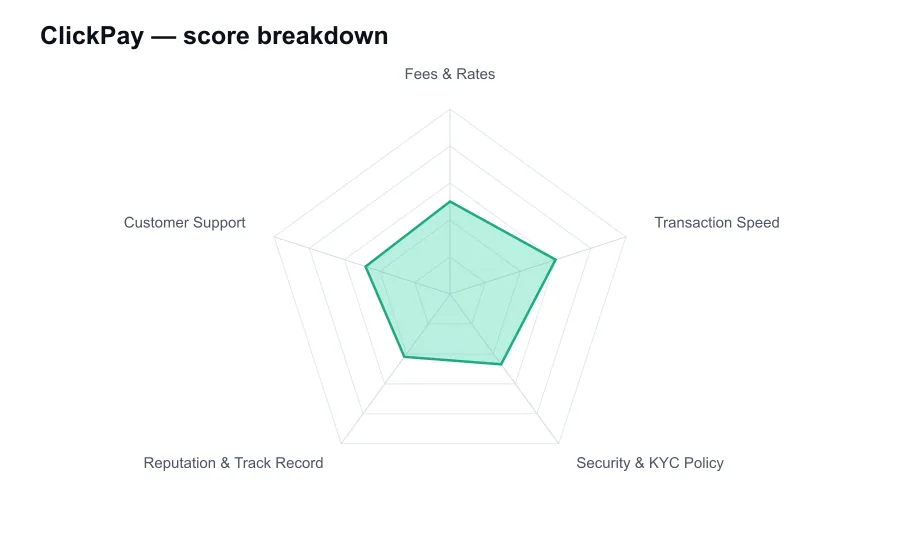
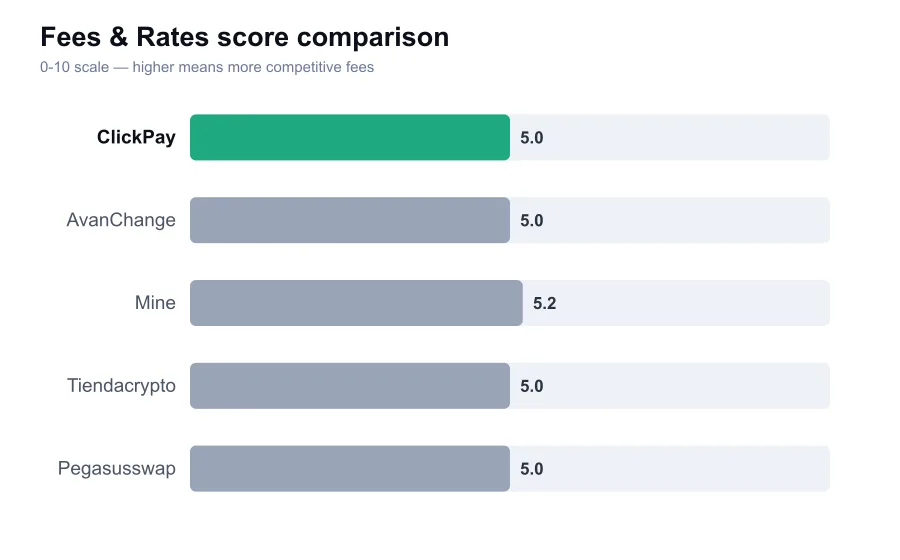
| Fees & Rates | 5.0 | Ask for conversion, settlement, and network costs |
| Transaction Speed | 6.0 | Checkout can be quick, finality depends on chain |
| Security & KYC Policy | 4.7 | Crypto-specific controls need clearer verification |
| Reputation & Track Record | 4.2 | Generic branding complicates due diligence |
| Customer Support | 4.8 | Merchants should verify escalation and API support |
ClickPay is a difficult name to assess as a crypto exchange provider because it is widely generic and has been used by payment businesses in more than one market. That alone should make prospective users slow down. A provider handling digital assets needs to be identifiable beyond a brand label. You should be able to establish the exact website, legal entity, jurisdiction, product terms, and support contact before sending crypto. If those details are unclear, the right decision is to stop rather than guess.
Assuming the relevant ClickPay offering is being considered as a crypto conversion or payment service, it belongs closer to the payments and checkout end of the market than to a dedicated trading exchange. That can be useful for merchants or users who care about accepting, sending, or converting value quickly. It is not automatically useful for investors seeking deep liquidity, transparent order books, audited reserves, advanced account controls, or sophisticated execution. Those are very different jobs, and providers should not be graded as if they are interchangeable.
The core appeal of a ClickPay-style service is obvious. Payment-focused products reduce friction. A merchant may want a customer to pay in crypto while receiving a settlement asset, and an individual may want to move value without opening a full trading account. If the implementation is sound, crypto payments can be faster than some traditional cross-border methods and can operate outside bank opening hours. That appeal is real, but it does not eliminate volatility, blockchain finality, or compliance obligations.
Fees are where payment branding can become misleading. A provider might advertise a low processing charge while leaving exchange spread, network fees, refund costs, conversion costs, or settlement charges less visible. Merchants should ask for the complete pricing model in writing. Is the fee charged on the incoming payment, the conversion, the withdrawal, or all three? Is the rate locked at invoice creation, at payment detection, or at settlement? Does the customer bear the network fee? These details determine whether a low headline percentage is actually competitive.
For a retail user, the same principle applies. The displayed crypto amount and the amount ultimately received are more meaningful than a vague claim of low fees. Compare a ClickPay quote against a direct wallet transfer and against a reputable exchange withdrawal. For major stablecoin payments on an inexpensive chain, the direct route may be cheaper and simpler. For a merchant that needs invoices, payment tracking, and automatic conversion, a processor may justify its premium. The service has to save work, not merely insert itself into the transaction.
Speed can be excellent at the interface level and still be uncertain at settlement. A checkout page can acknowledge a payment almost immediately after it appears on the network. Final credit may wait for confirmations, risk checks, or internal settlement cycles. Bitcoin payments are especially sensitive to confirmation policy and the fee selected by the sender. Stablecoins on faster networks can settle more quickly, but they introduce their own network-selection and token-contract risks. Any serious merchant needs to know which event counts as payment finality.
I would be wary of treating an unconfirmed transaction as irrevocable payment for goods with a high resale value. That is a classic operational mistake. A payment processor may offer settings for confirmation thresholds, but accepting fewer confirmations trades speed for risk. The right threshold depends on the asset, transaction size, customer relationship, and fraud exposure. Small digital purchases can tolerate more risk than a shipment of electronics. ClickPay's usefulness depends partly on whether it gives the merchant clear, practical control over those choices.
Security cannot be judged from a logo, an SSL certificate, or a polished checkout page. For a crypto payment service, I want to see secure account controls, two-factor authentication where accounts are used, sensible API key management for merchants, webhook verification, clear wallet-address procedures, and a documented incident response approach. I also want clarity on custody. Does the provider hold settlement funds? Can a merchant withdraw automatically to a wallet? Are conversion balances exposed to a counterparty for hours, days, or longer? These are not minor technical questions.
KYC and AML policy deserves special attention because payment companies can face more regulatory pressure than casual swap tools. A merchant processor may require business verification, beneficial-owner information, identification, and source-of-funds documentation. Individual payers may also be screened depending on the transaction. That is not necessarily a negative. Formal compliance can be a sign that a payment service is trying to operate sustainably. The problem is surprise. A good provider explains what will be checked before a merchant builds a checkout flow around it.
ClickPay's public reputation as a crypto-specific exchange is not strong enough, in my view, to place it beside specialist names such as BitPay, Coinbase Commerce, CoinGate, or larger exchange payment products without further verification. There may be legitimate payment businesses using the name, but brand ambiguity makes independent review harder. That is a meaningful weakness. A business choosing a processor needs confidence that customers can identify the correct domain and that disputes will not be confused with unrelated companies carrying a similar label.
Reputation also matters because payment problems have a wider impact than a single trade. A delayed settlement can affect payroll, inventory, tax reporting, customer refunds, and cash flow. A merchant cannot simply say that the blockchain was busy if the provider's internal process is unclear. Before integrating ClickPay, I would ask for service-level expectations, settlement schedules, supported countries, refund procedures, webhook documentation, and a direct escalation route. If these are not available, the product is not ready for a serious commercial workflow.
Support should be evaluated differently for merchants and individuals. A casual user may be satisfied with email support for a one-off transaction. A merchant accepting payments needs responsive technical help, especially around API errors, duplicate callbacks, underpayments, expired invoices, and conversion disputes. A support ticket answered tomorrow can be acceptable for a small wallet question. It is not acceptable if a checkout page fails during a sales campaign. ClickPay needs to demonstrate support quality rather than assume its payment-oriented branding will do the work.
There is a sensible narrow use case here. If ClickPay can be independently verified, has clear terms, and offers a competitive supported payment route, it may work for a small merchant pilot or a limited personal transaction. Start with a low-value invoice, test the customer experience, test settlement to a wallet or bank route where applicable, and deliberately test a refund or support request. That is more informative than a demo page. Never connect a production business flow before checking how the service handles exceptions.
For traders and investors, ClickPay is unlikely to be the right primary tool. Payment processors generally do not compete on deep trading liquidity, advanced order types, broad research, or low-cost repeated execution. Their value lies in operational convenience. If you simply need to buy, sell, or rebalance crypto, a regulated exchange with transparent fees will usually be more appropriate. If you need to accept crypto from customers, the calculation is more nuanced, but verification becomes even more important.
My final judgment is cautious because the name and market positioning leave too many questions unanswered at a crypto-exchange level. ClickPay may have a useful payments role, but a payment promise is not enough to earn trust with customer funds or merchant revenue. I would require stronger proof of the exact operating entity, fee model, security controls, and support standards before recommending it beyond a small test. In this area, boring transparency beats a slick checkout every time.
| Pros | Cons |
|---|
ClickPay may fit a technically capable merchant testing a limited crypto payment option after verifying the exact legal entity and settlement terms. It can also suit a small non-urgent transaction. It is not a preferred choice for active traders, long-term custodians, or businesses that need proven enterprise support from day one. Those users should consider established payment processors or regulated exchanges.
ClickPay appears more relevant to payment or conversion use cases than to full exchange trading. Verify the exact service and legal entity because the name is used broadly.
Ask about payment processing, crypto conversion spread, network fees, settlement charges, refunds, chargeback handling where relevant, and any monthly or API fees.
A payment may be detected quickly, but final settlement depends on blockchain confirmations, risk controls, conversion, and the provider's payout schedule.
| Alternative | Score |
|---|---|
| AvanChange Review | 4.8/10 |
| Mine Review | 4.7/10 |
| Tiendacrypto Review | 5.2/10 |
| Pegasusswap Review | 4.6/10 |
| YaObmen Review | 5.3/10 |
| Baltex Review | 5.4/10 |