Editorial independence: our scores and rankings are produced using the fixed criteria above and are not influenced by advertisers. This is an independent ranking site and is not operated by, or affiliated with, any provider we list.
Affiliate disclosure: some links on this page may earn us a commission at no extra cost to you. This does not affect our rankings.
| Best for | Not for |
|---|
| Criterion | Score | Note |
|---|---|---|
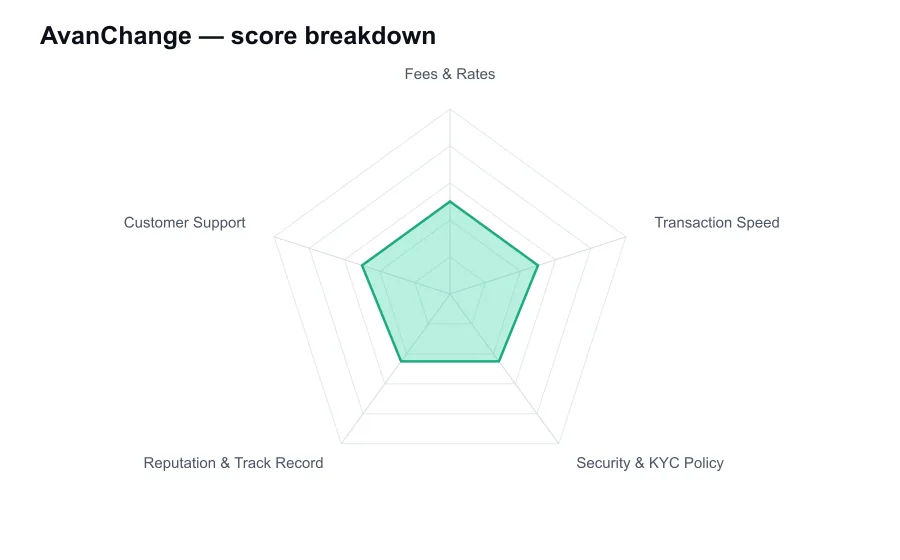
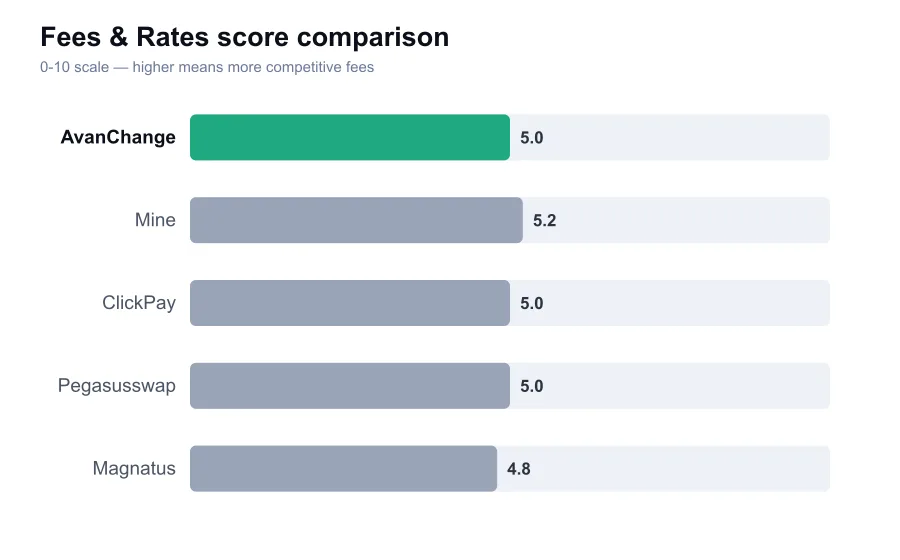
| Fees & Rates | 5.0 | Compare final payout, not fee claims alone |
| Transaction Speed | 5.0 | Timing depends heavily on the chosen route |
| Security & KYC Policy | 4.5 | Compliance and recovery terms need close review |
| Reputation & Track Record | 4.5 | Public track record is less documented than major brands |
| Customer Support | 5.0 | Pre-sale support testing is strongly advised |
AvanChange appears to operate in the online exchange-office segment, serving users who want to convert digital assets and, depending on the live offering, payment-system or bank-based funds without opening a full brokerage account. Services in this niche can be useful because they focus on individual exchange directions rather than forcing every customer through a conventional spot market. AvanChange is not a widely documented global brand, however, so the right starting point is careful verification rather than confidence borrowed from a polished interface.
A good exchange office earns its place by solving a real payment problem. Perhaps a customer needs a particular stablecoin on a particular network, wants to convert a regional payment method, or cannot use a large exchange for a straightforward one-off transfer. AvanChange may be relevant in those situations. It should not be judged as though it offers the same safeguards, liquidity, or disclosures as a major licensed exchange, because it is a different kind of service with a different risk profile.
Fees are most likely reflected in the exchange rate. That model is standard for direct exchangers, but it makes comparison work unavoidable. A visible service fee of zero does not mean the transaction is cheap. What matters is the amount that lands in your wallet or bank account after spread, blockchain fees, payment costs, and any minimum-order effect. For a small order, fixed network fees can distort the economics dramatically.
Before using AvanChange, open competing quotes for the exact same asset, network, and payment method. Do not compare a TRON-based USDT quote with an Ethereum-based USDT quote, and do not forget that withdrawal fees may differ by chain. If AvanChange gives a notably better return than established competitors, inspect the conditions rather than assuming you found a bargain. Superior rates can be legitimate, but they can also depend on a floating quote, a narrow reserve, or an order that requires manual approval.
A transparent provider distinguishes between fixed and floating rates. With a fixed rate, the customer usually gets a stated amount if payment arrives within a defined window and meets the stated terms. With a floating rate, the outcome follows market movement and may change between deposit and payout. Neither approach is inherently wrong. Floating execution is often cheaper in stable markets, while fixed execution offers more certainty. The issue is whether AvanChange makes the choice clear before it receives the funds.
Processing speed will vary with the selected route. Pure crypto swaps can be limited mostly by confirmations and liquidity, while fiat-related operations may depend on bank hours, payment verification, or staff review. A website can be available around the clock without every payout being fully automated around the clock. Customers should separate those concepts. If an order is needed urgently, ask support whether the precise direction is being processed now, not whether the site generally operates 24 hours a day.
The first transaction should be deliberately boring. Use a small amount, a mainstream asset, the correct network, and a wallet you control. Do not begin with an unusual token, a cross-chain destination, or a payment that depends on a specific arrival minute. Save the order number, transaction hash, and screenshots of the quoted amount. These records are useful if a payment must be traced, and they also reveal whether AvanChange communicates properly once an order enters its system.
Security at an exchange office is as much operational as technical. Strong encryption on a webpage cannot protect a user who sends money to a cloned domain or follows altered payment details from a fake support account. Type the address yourself or use a verified bookmark, enable wallet address whitelisting where available, and treat a request to continue an exchange in private messaging with suspicion. Never send an additional payment merely because somebody claims it will release a pending order.
The KYC position needs particular care. Some customers choose direct exchangers because they expect less friction than at large platforms. That expectation can be misleading. Anti-money-laundering screening, sanctions controls, stolen-funds detection, banking rules, and fraud flags can all lead to an identity request. AvanChange should be read on the basis of its current policy, not a forum post or an old advertisement. If your funds are not documentable, any service with a compliance clause can become a problem.
The important question is not simply whether KYC exists. It is whether the procedure is intelligible and proportionate. Can the service explain why an order is being reviewed, which documents are required, how they are protected, and what happens if verification is not completed? The absence of an obvious answer is a real security and consumer-protection concern. Users should avoid sending amounts that would be financially painful to have delayed while those questions are unresolved.
AvanChange's public reputation is difficult to assess at the level of a well-known international exchange. I would look for current third-party references, reviews that contain concrete transaction details, and evidence that the service deals with complaints publicly and professionally. Be cautious with anonymous praise that says only fast or reliable. A useful review states the exchange direction, approximate timing, and whether there was a problem. Recent negative feedback deserves attention too, especially if it describes the same route you plan to use.
Reputation monitoring should be ongoing, not a one-time checkbox. Payment providers change rules, blockchain networks become congested, and a formerly smooth direction can become difficult quickly. A service that was dependable last year may not have the same reserves or banking partners today. That is why I place AvanChange below better documented providers on track record, even if a current small order could be completed satisfactorily.
Support is the practical test of whether an exchange office is run seriously. Contact AvanChange before paying and ask something that cannot be answered by a bot, such as the handling of an incorrect memo, an underpayment, or a floating-rate order delayed by confirmations. A worthwhile reply should identify the relevant rule and give a concrete next step. If the response is generic, evasive, or solely pushes you to make a deposit, choose another provider.
For an experienced user, AvanChange could be a viable option for a limited, carefully checked conversion. Its likely advantage is flexibility rather than institutional strength. That distinction should shape expectations. Do not leave funds there, do not rely on it for deadline-critical settlement, and do not let a good-looking rate override missing policy information.
My final assessment is cautious. AvanChange may have a role for users who need an exchange-office route and are prepared to verify every detail themselves, but it has not earned the blind trust appropriate for large transfers. Test it with a modest amount, compare the net quote, and keep a clean record of the transaction. People who prioritize strong regulation, transparent ownership, deep liquidity, and predictable escalation should choose a larger named exchange instead.
| Pros | Cons |
|---|
AvanChange may suit experienced users who need a particular conversion route and are willing to compare live net quotes carefully. It is better approached with a small test order than a large first payment. New crypto users, businesses, and anyone requiring clearly documented regulatory protections should choose a more established exchange or payment provider.
Confirm this on the live order page. Direct exchangers may offer fixed or floating rates, and the final amount can differ if the payment arrives late or the market moves.
Potentially, yes. Compliance checks can be triggered by transaction patterns, payment-provider rules, or blockchain-risk screening. Read the current policy before depositing.
Use a small amount, a common asset, and the exact network shown in the order. Keep the transaction hash and screenshots, then assess both completion time and support quality.
| Alternative | Score |
|---|---|
| Mine Review | 4.7/10 |
| ClickPay Review | 4.9/10 |
| Pegasusswap Review | 4.6/10 |
| Magnatus Review | 4.4/10 |
| Tiendacrypto Review | 5.2/10 |
| YaObmen Review | 5.3/10 |