Editorial independence: our scores and rankings are produced using the fixed criteria above and are not influenced by advertisers. This is an independent ranking site and is not operated by, or affiliated with, any provider we list.
Affiliate disclosure: some links on this page may earn us a commission at no extra cost to you. This does not affect our rankings.
| Best for | Not for |
|---|
Magnatus is an instant cryptocurrency exchange service aimed at direct conversions between crypto assets. A user sends an asset to a generated address and expects the selected asset at a receiving wallet. It should not be confused with a full-service trading exchange.
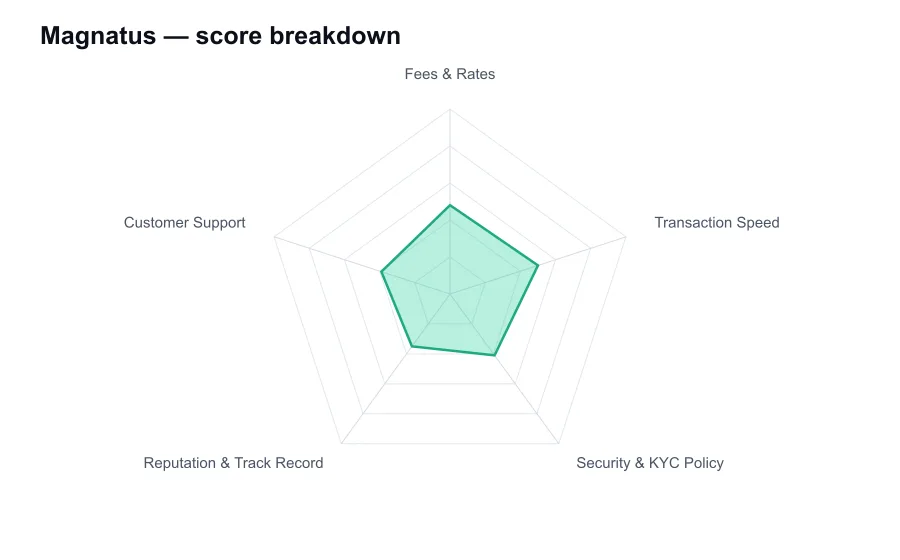
| Criterion | Score | Note |
|---|---|---|
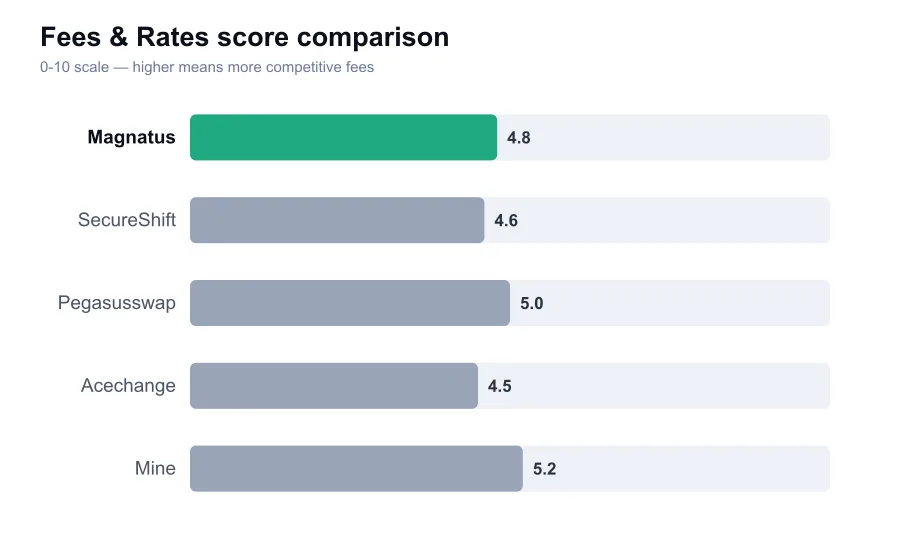
| Fees & Rates | 4.8 | Final payout must be checked quote by quote |
| Transaction Speed | 5.0 | Routine swaps may be quick, public evidence is thin |
| Security & KYC Policy | 4.1 | Limited verifiable disclosure on controls and reviews |
| Reputation & Track Record | 3.5 | Lacks a deep independent public record |
| Customer Support | 3.9 | Pre-sale support testing is strongly advised |
| Fact | Value | Source |
|---|---|---|
| Service model | Instant cryptocurrency swaps | - |
| Account style | Transaction-based swap flow | - |
| Public fee table | Not independently verified | - |
| Public disclosure | Limited verifiable operating detail | - |
| Compliance review | Possible on a transaction basis | - |
| Requirement | tiered |
|---|---|
| Notes | The initial swap flow may be account-light, but transaction monitoring can lead to an identity or source-of-funds request. |
Magnatus is presented as an instant cryptocurrency exchange service, a category built around speed and simplicity rather than the full feature set of a centralized exchange. The basic promise is familiar: choose a coin pair, fund a generated address, and wait for the payout. This can be a useful tool for a single conversion, especially for users who do not want to park assets on an exchange. It is also a business model where transparency separates the dependable operators from the ones a careful user should avoid.
Magnatus has not built the kind of readily verifiable public profile that lets me treat it like a first-tier exchange. It does not have the broadly documented history, extensive independent coverage, or easily auditable corporate material associated with names such as Kraken, Coinbase, or even larger instant exchangers such as ChangeNOW. That absence is not proof of misconduct. It does, however, limit how much confidence a reviewer can reasonably assign before testing the service with funds.
The platform's apparent role is narrow. It is not a venue for charting, passive yield, derivatives, or serious trade execution. Someone who needs those tools is looking in the wrong place. Magnatus should be judged as a transaction intermediary. Can it quote a fair conversion, identify the correct network, process the deposit promptly, and resolve an exception without disappearing behind generic email replies? Those are the standards that matter here.
Fees are the first area where a prospective customer needs to be disciplined. The instant exchange sector often packages its margin inside the quoted rate. That is not inherently improper, but it makes marketing claims about low fees almost meaningless unless the final payout compares well in real time. Magnatus does not provide enough easily verifiable public pricing detail for me to give it high marks for fee clarity. A customer should treat every quote as a fresh price and assess the actual output, including network costs.
For a small conversion, convenience can outweigh a slightly weaker rate. For a large conversion, it usually should not. A 1 percent or 2 percent shortfall is easy to miss if you only look at the source asset amount, and painful once the amount rises. Magnatus would need to show consistently competitive output against several established alternatives before I would consider using it beyond a test transfer. Do not let the word instant distract from basic price comparison.
Transaction speed follows the same pattern. The interface may be quick, but the exchange itself cannot make an incoming blockchain confirmation happen faster. Bitcoin transactions can wait for blocks, Ethereum and token transfers can be affected by gas and congestion, and outbound wallets may be temporarily unavailable. A responsible provider explains those dependencies before a customer sends funds. If Magnatus gives only a vague status page, that is less reassuring than a detailed tracker with transaction identifiers and clear stages.
The ideal instant exchanger gives a customer enough information to diagnose a delay without needing support. It should show that the deposit was detected, that required confirmations are pending or complete, that the conversion is underway, and that a payout has been broadcast. I could not establish a mature, well-documented operational record for Magnatus on that level. That pushes its speed score into the middle of the range. It may process routine swaps promptly, but the public evidence is too thin to call it reliably fast.
Security is not solely about whether a company holds long-term customer balances. Magnatus' swap model may reduce the risk of leaving coins on a platform for weeks, which is a real positive. Yet it creates a concentrated trust moment. The customer sends assets to an address controlled by the service and has to rely on the service, its partners, and its screening system to complete the other side. A short custody window is still custody.
I found insufficient publicly verifiable detail about technical controls, incident procedures, legal operator information, or how transaction monitoring decisions are handled. Those omissions matter most if something goes wrong. A site can look polished while leaving customers with no practical route to challenge a hold, recover a wrong-network deposit, or obtain a payout update. A serious operator should make these policies comprehensible before it receives funds, not only after a complaint is raised.
KYC may be a surprise for users who equate instant swaps with anonymous swaps. That assumption is risky. Providers in this category can apply risk screening to individual transfers and ask for identification or source-of-funds information. Magnatus should be treated as a service where verification may occur if the transaction triggers a review. If the sender cannot accept that possibility, the right answer is not to argue after depositing. The right answer is to choose a different transaction method beforehand.
Its reputation remains the central concern. There is simply less independent material with which to assess recurring user experience, dispute handling, or behavior during stressed market conditions. A platform needs more than a functioning homepage to earn trust. It needs a history of transparent communication, prompt resolutions, and public evidence that it has endured routine operational problems. Magnatus has not yet supplied enough of that evidence for me to put it in the same class as the better-known services in this market.
Support is consequently a make-or-break issue. Before any deposit, contact Magnatus and ask a question that requires a concrete answer, such as whether a specific stablecoin is accepted on a particular network or what happens to an underpaid deposit. If the response is quick and precise, that is a positive signal. If it is generic, evasive, or absent, do not proceed. A support desk cannot reverse a blockchain transaction, but it can demonstrate whether a company is capable of handling exceptions.
Magnatus may be usable for a small, non-urgent swap by a user who has checked the live quote and understands wallet operations. It is a poor choice for a first crypto transaction. New users tend to need help with networks, confirmation delays, and address validation, which are exactly the areas where limited public documentation becomes expensive. It is also not my pick for large stablecoin conversions, where the spread can cost more than a conventional exchange withdrawal.
My final assessment is cautious rather than hostile. Magnatus has the basic appeal of the instant-swap model, but it has not earned a high trust score because too much of the important information remains difficult to verify independently. The service may work as advertised for ordinary orders. That is different from demonstrating that it deserves a meaningful deposit. Compare its output, test it small, and prefer an operator with a deeper record if certainty matters more than a few clicks of convenience.
| Pros | Cons |
|---|
Magnatus may fit an experienced wallet user who needs a small, simple conversion and has already compared the final payout against other services. It is not a strong fit for beginners, high-value traders, or users who need predictable compliance and support processes. Those users should choose a better-documented instant exchanger or a licensed centralized exchange.
Magnatus is presented as an instant crypto swap service. It is not a conventional spot exchange with a visible order book, margin tools, or a full trading terminal.
A broadly verifiable fixed fee table is not established. Judge the service by the exact destination amount in its live quote, including the relevant network cost.
Yes, that possibility should be assumed. Instant exchanges can screen transfers and request KYC or source-of-funds material even where the initial flow does not require an account.
Ask about a specific asset and network, the treatment of an underpayment, and what happens if a transaction enters review. A useful answer should be concrete, not generic.
Deposits need blockchain confirmations, and delays can also arise from congestion, liquidity, wallet maintenance, an incorrect network, or compliance screening.
I would avoid using an insufficiently documented instant exchanger for a large first transaction. Compare several live quotes and use a provider with a stronger support record.
| Alternative | Score |
|---|---|
| SecureShift Review | 4.3/10 |
| Pegasusswap Review | 4.6/10 |
| Acechange Review | 4.2/10 |
| Mine Review | 4.7/10 |
| Transfer24 Review | 4.1/10 |
| AvanChange Review | 4.8/10 |