
Editorial independence: our scores and rankings are produced using the fixed criteria above and are not influenced by advertisers. This is an independent ranking site and is not operated by, or affiliated with, any provider we list.
Affiliate disclosure: some links on this page may earn us a commission at no extra cost to you. This does not affect our rankings.
| Best for | Not for |
|---|
Acechange is an instant crypto conversion provider that appears to facilitate direct swaps between wallet addresses. Customers choose a pair, transfer the deposit asset, and receive the selected asset. It is not the same as a full custodial exchange with an order book and advanced trading tools.
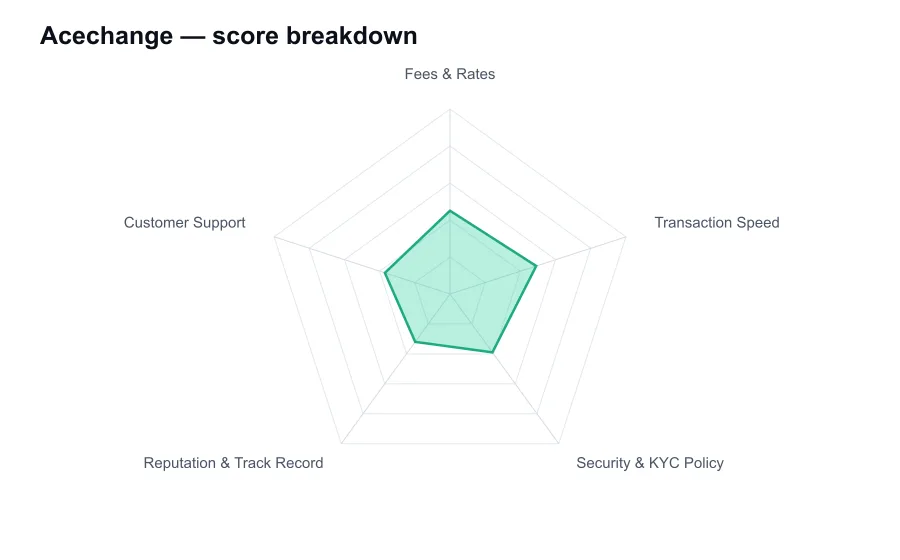
| Criterion | Score | Note |
|---|---|---|
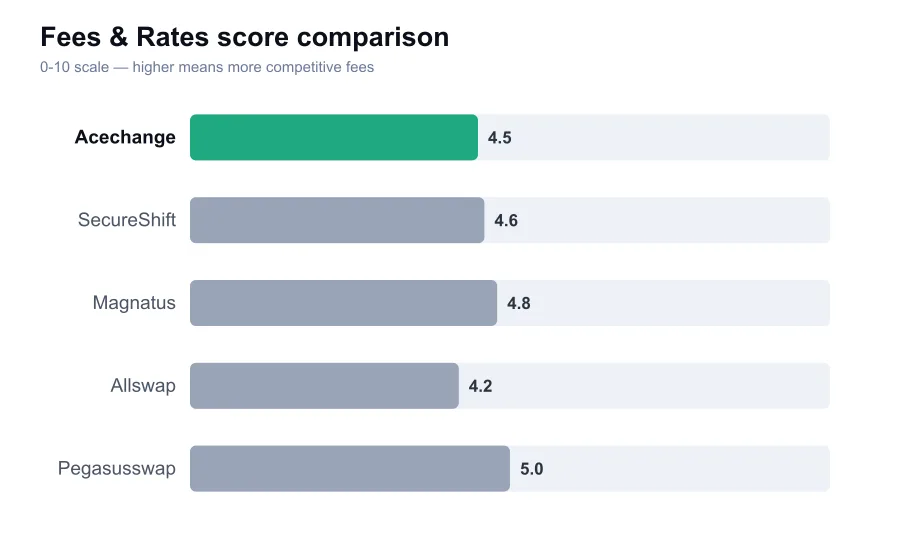
| Fees & Rates | 4.5 | Spread-based pricing is difficult to audit beforehand |
| Transaction Speed | 4.9 | Network timing and exception handling remain unclear |
| Security & KYC Policy | 3.9 | Wallet-to-wallet flow, but limited public assurance |
| Reputation & Track Record | 3.2 | Very limited independently verifiable track record |
| Customer Support | 3.7 | Support quality should be tested before depositing |
| Fact | Value | Source |
|---|---|---|
| Service model | Instant cryptocurrency conversion | - |
| Trade interface | No verified public order book | - |
| Pricing format | Quote-based output estimate | - |
| Public fee schedule | Not independently verified | - |
| Public reputation | Limited independently verifiable history | - |
| Requirement | tiered |
|---|---|
| Notes | The service should be assumed to have transaction-based compliance screening. An account-light flow does not guarantee that KYC will never be requested. |
Acechange appears in the instant-exchange segment, where the pitch is a direct cryptocurrency conversion without the account architecture of a mainstream trading platform. The concept is useful. Many people do not want to deposit coins into a custodial exchange, trade through an order book, then wait for a withdrawal. A swap service can reduce that friction. Yet it also asks for a concentrated act of trust, because the customer sends assets away before receiving the replacement asset.
That trust question is where Acechange needs more evidence than it currently offers publicly. It is not a household crypto name, and it does not have the extensive independent reporting, visible leadership, long-form policy archive, or widely tested reputation of a major platform. In this category, a modest public footprint is not automatically disqualifying. It does mean the burden shifts to the customer to verify the quote, the route, the contact method, and the operator's response before sending anything significant.
Acechange should not be evaluated as though it were Binance, Coinbase, or Kraken. There is no reason to expect deep liquidity disclosure, advanced trade controls, extensive fiat rails, or a mature account-security stack from a simple swap interface. The appropriate comparison is with smaller instant exchangers, where the decisive factors are execution quality, clarity about rate risk, compliance handling, and help when a transaction does not follow the happy path.
A clean-looking quote screen is not a fee schedule. That point deserves emphasis because instant swap sites often make fees difficult to isolate. The rate can contain the provider's margin, a liquidity partner's margin, and network costs. Acechange does not have a clearly verifiable public fixed-rate fee table that would let a buyer calculate the all-in cost in advance. The only meaningful way to measure it is to compare the amount received against several live alternatives at the same time.
That lack of fee clarity lowers my score more than a plainly disclosed higher fee would. I can decide whether a transparent 1 percent charge is fair. I cannot confidently assess a spread that changes without an explanation. If Acechange consistently produces the best output for a particular route, then it may be economical for that route. But a user should never assume that a quote is competitive because the site calls itself an exchanger or because no separate fee line appears.
Speed is similarly conditional. A provider can automate the steps after a deposit arrives, but it cannot skip the blockchain's confirmation rules. A BTC deposit, an ERC-20 transfer, and a token on a faster chain all have different timing and risk profiles. Rate changes can also matter. If Acechange offers a floating quote, market movement between deposit and execution can alter the final result. If it offers a fixed quote, the customer needs to understand the time window and what happens to a late or underpaid transfer.
For an ordinary, correctly sent transaction, Acechange may deliver the convenience its category promises. The issue is that I found too little independently verifiable material on its performance during exceptions. A robust service has public guidance for wrong tags, missing memos, duplicate deposits, token-contract confusion, and transactions that trigger screening. A site does not need to solve every error, but it should be honest about what is recoverable and what is not. Ambiguity at that stage is a serious weakness.
Security is often oversimplified in reviews of instant exchanges. The favorable case is that the customer is not maintaining a long-lived balance on a platform, so there is less exposure to an account takeover or a large exchange insolvency. The unfavorable case is that each swap involves a transfer to an intermediary whose custody, liquidity sources, security controls, and legal identity may be hard to inspect. Acechange gets some credit for the wallet-to-wallet format, but it does not earn a high security score without stronger public assurance.
The KYC question should be approached with realism. A service can advertise a low-friction transaction flow while retaining the ability to stop an order for anti-money-laundering review. That approach is common, and there are legitimate reasons for it. What matters is whether the customer is warned clearly, knows what may be requested, and can get a timely answer if a review starts. I could not verify enough detailed public material to say Acechange provides a particularly predictable process.
For users who prioritize privacy, the distinction between no mandatory upfront registration and no KYC ever is crucial. They are not the same claim. Sending an asset from a wallet into a swap order may expose the transaction to risk tools, and a request for documents can arrive after the deposit is already in the provider's control. Anyone unwilling or unable to provide identification should not send a meaningful amount on the assumption that the swap will stay outside compliance procedures.
Reputation is Acechange's weakest area. The service lacks the depth of independently auditable user feedback and long-running operational coverage that I would want before ranking it as dependable. Search results and short testimonial-style posts are not enough. What carries weight is detailed evidence from users who have dealt with delayed payouts, misrouted funds, transaction review, and support escalation. Without that, a reviewer can only give a cautious, provisional assessment.
Support becomes the practical test. Before placing an order, ask a narrow question that exposes whether the operator understands its own infrastructure. For example, ask which exact network should be used for a stablecoin, whether a destination tag is supported, or how a late fixed-rate deposit is handled. A capable team answers specifically. A weak one sends a canned reply or asks you to deposit first. The latter is a clear reason to choose a different service.
Acechange may be reasonable for an experienced user conducting a small test swap with assets and networks they already understand. It is not an attractive first stop for a novice buying their first crypto, moving a large treasury balance, or handling an urgent payment. Those users need stronger documentation, a proven escalation path, and predictable compliance handling. The apparent simplicity of a direct swap can hide a lot of operational complexity.
My final view is that Acechange is not proven enough to deserve blind trust. Its format has legitimate advantages, especially for a one-time wallet-to-wallet conversion, but its limited public transparency keeps it firmly below established providers. If you use it, compare the payout, keep the first transaction modest, and document every step. Until Acechange develops a clearer public record, it should be treated as an option to verify, not a service to rely on by default.
| Pros | Cons |
|---|
Acechange is only a plausible fit for experienced users who can verify networks, compare live quotes, and accept a small test transaction as part of due diligence. It is not a good choice for beginners, businesses, or anyone moving a large amount. Users who need strong support, published policies, and established reputation should look to larger providers.
No. Acechange appears to use an instant-conversion model, where the user sends one crypto asset and receives another rather than placing a visible market or limit order.
A broadly verifiable fixed percentage fee schedule is not established. Compare the final payout in the quote with competing services before submitting a deposit.
It should be considered possible. Account-free instant-swap flows can still apply transaction monitoring and request identity or source-of-funds documents.
A wrong-network transfer may be delayed, costly to recover, or unrecoverable. Confirm the chain and any memo or destination-tag requirement before sending funds.
Ask a specific pre-transaction question about a coin network, fixed-rate expiry, or an underpayment. Do not fund an order until the response is clear and useful.
Acechange has a limited independently verifiable operating record. A small test lets you assess the quote, tracking, payout, and support route with limited exposure.
| Alternative | Score |
|---|---|
| SecureShift Review | 4.3/10 |
| Transfer24 Review | 4.1/10 |
| Magnatus Review | 4.4/10 |
| Allswap Review | 4.0/10 |
| Pegasusswap Review | 4.6/10 |
| 1WM Review | 3.8/10 |