
Editorial independence: our scores and rankings are produced using the fixed criteria above and are not influenced by advertisers. This is an independent ranking site and is not operated by, or affiliated with, any provider we list.
Affiliate disclosure: some links on this page may earn us a commission at no extra cost to you. This does not affect our rankings.
| Best for | Not for |
|---|
Transfer24 is an online exchanger that appears to facilitate conversions involving cryptocurrencies and payment-system or fiat routes. It should not be confused with a globally regulated spot exchange. Users place an order, send funds to the public record, and receive the converted asset after processing.
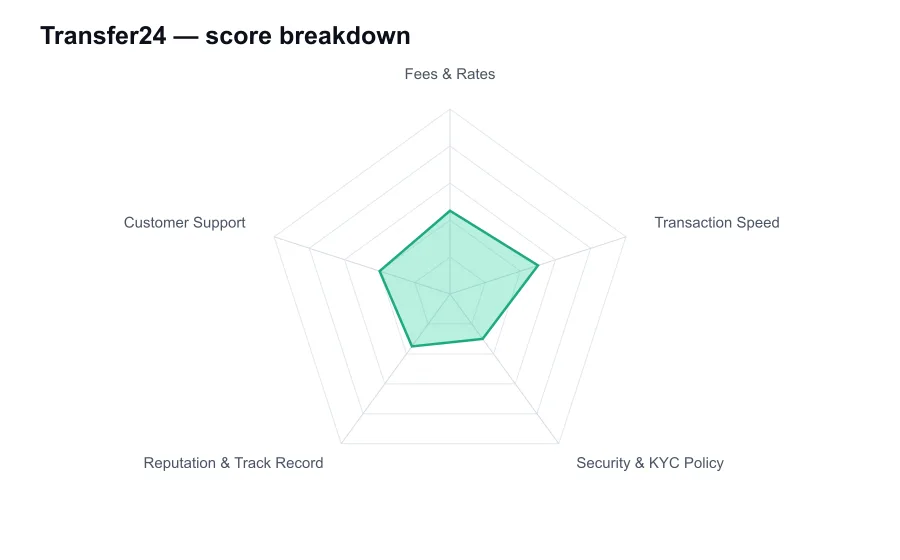
| Criterion | Score | Note |
|---|---|---|
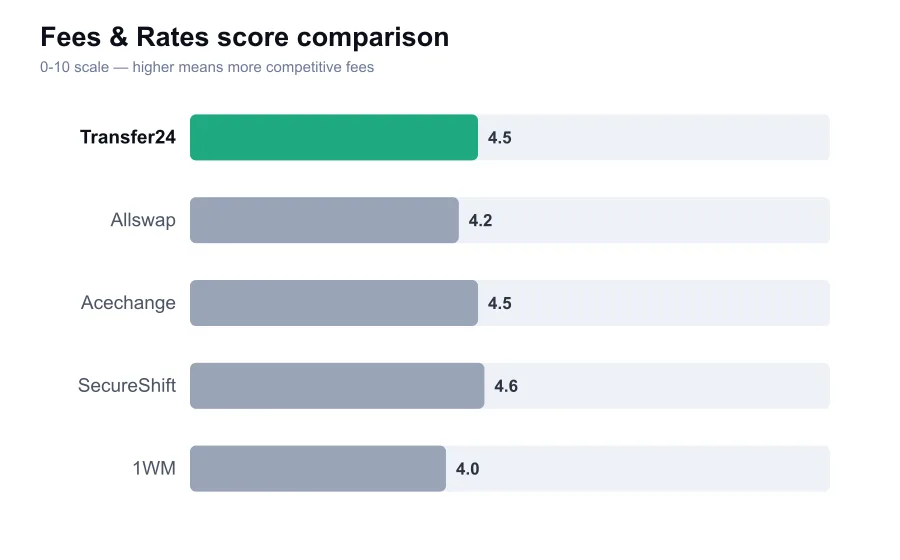
| Fees & Rates | 4.5 | Final-rate transparency is limited |
| Transaction Speed | 5.0 | Processing times are not clearly documented |
| Security & KYC Policy | 3.0 | Limited public security and policy disclosure |
| Reputation & Track Record | 3.5 | Small public track record |
| Customer Support | 4.0 | Support quality is hard to independently verify |
| Fact | Value | Source |
|---|---|---|
| Service model | Order-based online exchanger | - |
| Public fee schedule | Not independently verified | - |
| Security disclosure | Limited public detail | - |
| Requirement | optional |
|---|---|
| Notes | Public information does not clearly define a universal KYC threshold. Assume an order may be reviewed and identity or payment evidence may be requested. |
Transfer24 appears to be a small online exchange service aimed at users moving between cryptocurrencies, bank money, and electronic payment systems. It belongs to the long tail of exchanger-style businesses rather than the category of heavily regulated global platforms such as Kraken, Coinbase, or Bitstamp. That distinction matters. The service may be useful for a particular payment route, but it does not offer the public corporate visibility, product documentation, or independently verifiable operating history that serious users should expect before sending a large amount.
The first thing a prospective customer should notice is how little dependable public material is available about Transfer24. A small exchange can still be legitimate, responsive, and competitively priced. Lack of transparent information does not prove misconduct. It does, however, make risk assessment much harder. I would not treat an unfamiliar exchanger as interchangeable with an established exchange merely because both can complete a swap.
Fees are difficult to score generously here because Transfer24 does not have a widely documented public fee schedule that can be independently checked across routes. In this corner of the market, the advertised rate often contains the provider's margin. That means a transaction advertised as having no fee may still be expensive compared with the live market price. Users should compare the final amount received, not just the rate shown in large type.
That issue is especially important for bank transfers and electronic money routes. The apparent exchange rate can change with payment method, destination currency, liquidity, and the provider's exposure to chargebacks or reversals. A small rate difference can easily cost more than a visible service fee. Before funding a transfer, calculate the result against a liquid reference market, then compare at least two established alternatives for the same amount.
Speed is likely the main reason someone would consider a service like Transfer24. Exchanger businesses generally promise quick processing for straightforward, automated orders. Crypto transfers can settle in minutes if the receiving network is not congested and if the provider has reserve funds available. Fiat-facing orders are different. A bank transfer, manual payment confirmation, or anti-fraud review can turn a supposedly quick transaction into a wait measured in hours or longer.
The key practical question is whether Transfer24 clearly states which operations are automatic and which are handled manually. That information was not sufficiently documented in public material available for this review. This is not a minor usability detail. If you need funds for an urgent bill, an exchange that uses a manual cashier or waits for payment verification is a poor place to discover its actual processing schedule.
Security is the weakest area of the proposition, largely because public disclosure is thin. I could not independently verify detailed information about the company operating the service, its custody arrangements, external security audits, incident reporting procedures, or the exact circumstances in which accounts and orders can be reviewed. Major centralized exchanges are not risk-free, but most at least publish legal entities, security practices, and support channels that can be scrutinized.
Transfer24 should therefore be treated as a counterparty, not as a wallet. Send only the amount required for a specific exchange. Do not leave a balance with the service. If an order asks for identity documents or additional proof after payment, the customer may have limited leverage if the provider has not published a clear escalation process or a well-defined hold policy.
KYC is another area where buyers should seek a direct answer before placing an order. Small exchangers may market a simple process, yet reserve the right to request identity verification, proof of funds, or proof of payment if their compliance filters trigger. That is common in the industry. The concern here is that Transfer24's publicly accessible material does not provide enough detail to judge how predictable those reviews are.
Reputation is not built by a domain name, a rate widget, or a short list of customer comments. It is built through years of independently traceable operation, clear ownership, resolved complaints, and a record that survives periods of market stress. Transfer24 does not have the public footprint of well-known exchanges or the deep community record of larger exchange aggregators. I would regard it as an unproven service rather than a proven one.
That does not mean every transaction will go badly. Many smaller exchangers complete routine orders without incident. The problem is asymmetric risk. A successful small test order tells you that one transaction worked. It does not tell you how the operator handles a disputed payment, a blockchain delay, a compliance hold, or a large order that suddenly needs human review.
Customer support may be adequate for ordinary order questions, but there is not enough independently documented evidence to award a strong score. Support quality only becomes visible when something breaks. A good provider gives a ticket reference, explains the status of the funds, provides realistic time estimates, and has a route for escalation. A chat window alone is not the same thing as accountable customer service.
If you decide to use Transfer24, start with a small transaction that you can afford to have delayed. Save screenshots of the quoted rate, order ID, deposit address, transaction hash, and payment receipt. Confirm the destination network carefully. If the service cannot answer basic questions about rate calculation, processing time, verification triggers, or order cancellation before you pay, walk away.
My view is simple. Transfer24 may suit a user who has independently verified the operator and needs a narrowly specific exchange route, but it has not earned the trust premium needed for large or time-sensitive transfers. The absence of strong public disclosure weighs more heavily than a potentially attractive quote. For meaningful sums, use a provider with identifiable ownership, published policies, and a reputation that can be checked outside its own marketing.
| Pros | Cons |
|---|
Transfer24 is best approached only by experienced users who have independently checked the operator and are testing a small, specific payment route. It may fit a low-value conversion where alternatives do not support the same pair. Businesses, first-time buyers, and anyone sending savings or urgent funds should use a better documented exchange or regulated payment provider instead.
No. Public information is too limited to justify treating Transfer24 as a high-trust venue. Use a small test transaction first and keep records of the order ID and blockchain transaction hash.
A widely verifiable public percentage fee schedule was not available for this review. Compare the exact amount you will receive against at least two alternatives before paying.
Yes. Any exchanger can delay an order for payment confirmation, blockchain congestion, reserve issues, or a compliance review. Ask about its review and cancellation process before funding.
No. Treat an exchanger as a transaction counterparty, not long-term storage. Withdraw received crypto to a wallet you control as soon as the order is complete.
Save the quoted amount, order ID, deposit address, payment receipt, transaction hash, timestamps, and any support conversation. These records matter if an order needs investigation.
| Alternative | Score |
|---|---|
| Allswap Review | 4.0/10 |
| Acechange Review | 4.2/10 |
| SecureShift Review | 4.3/10 |
| 1WM Review | 3.8/10 |
| Changee Review | 3.8/10 |
| Magnatus Review | 4.4/10 |