Editorial independence: our scores and rankings are produced using the fixed criteria above and are not influenced by advertisers. This is an independent ranking site and is not operated by, or affiliated with, any provider we list.
Affiliate disclosure: some links on this page may earn us a commission at no extra cost to you. This does not affect our rankings.
| Best for | Not for |
|---|
1WM is a small online service for exchanging cryptocurrencies and payment-system balances through individual orders. Customers select an available direction, pay to the public record, and wait for the converted funds. It should be assessed as a counterparty for a single transaction rather than as a place to keep money.
| Criterion | Score | Note |
|---|---|---|
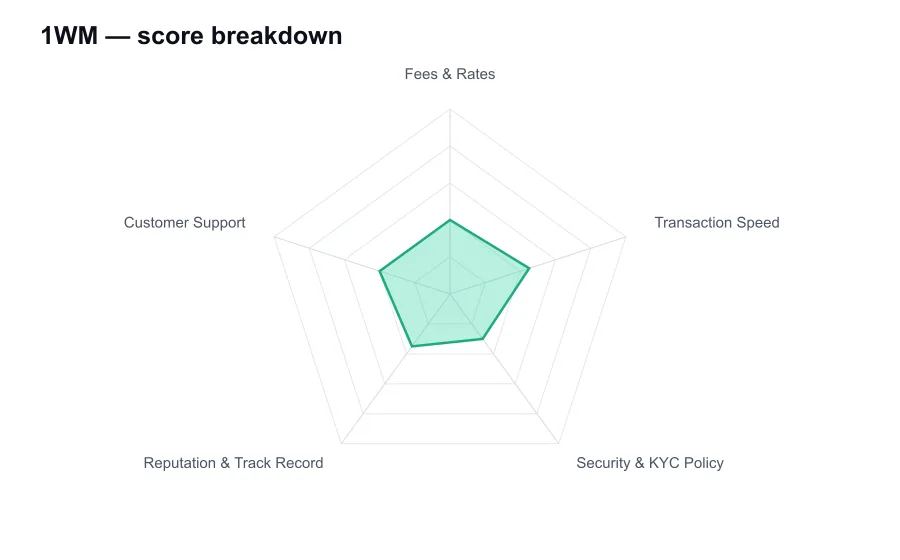
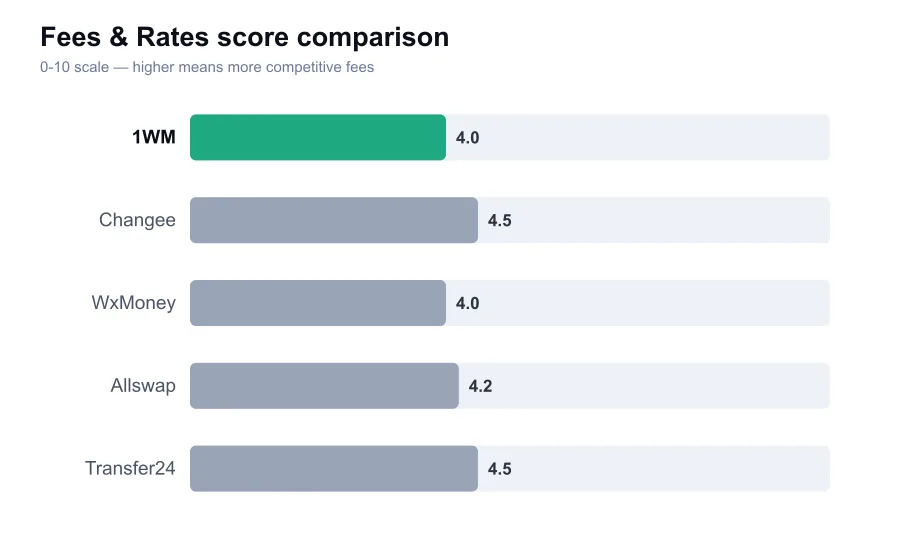
| Fees & Rates | 4.0 | Rate margin is not clearly standardized |
| Transaction Speed | 4.5 | Actual processing standards are unclear |
| Security & KYC Policy | 3.0 | Little independently verifiable disclosure |
| Reputation & Track Record | 3.5 | Limited auditable public history |
| Customer Support | 4.0 | No clear public escalation framework |
| Fact | Value | Source |
|---|---|---|
| Service model | Online order-based exchanger | - |
| Fee transparency | No verified standard public schedule | - |
| Recommended use | Small, tested conversions | - |
| Requirement | optional |
|---|---|
| Notes | A clear universal threshold was not independently verified. Assume that anti-fraud screening can result in document or payment-source requests. |
1WM is a small exchange service operating in the crypto and electronic-money conversion segment. This is a very different proposition from using a major centralized exchange. Rather than offering deep order books, broad institutional disclosures, and an extensive compliance framework, services of this type generally focus on completing a specific conversion order. That can be convenient, but it places much more importance on the operator's transparency and on the user's own precautions.
The public information available for 1WM is not strong enough to support a high-confidence assessment of its corporate structure, reserves, fee model, or dispute process. That is a serious limitation for an editorial review. A provider does not become reliable because it has a polished order form. Trust depends on whether customers can identify who runs it, understand its rules before payment, and verify how complaints are handled.
Price should be judged by the actual payout, not a headline claim about low commissions. Exchangers often embed their compensation in the rate. That can be reasonable, particularly where a route involves payment-system risk or thin liquidity, but customers need to see it clearly. I could not identify a broadly published and independently verifiable 1WM fee table that would let users predict the spread before checking an individual order.
For a routine small exchange, that may be manageable. Put the same transaction through a reputable comparison source and at least one established exchange, then compare net proceeds. For larger transactions, the absence of transparent pricing becomes much more uncomfortable. A small hidden margin on a four-figure or five-figure payment is not a minor inconvenience. It is the difference between a fair conversion and an expensive one.
Speed is also hard to assess from public documentation alone. A crypto-to-crypto order can move quickly once the deposit has confirmations and the provider has enough liquidity. Fiat-linked directions may require a person to confirm payment, check sender details, or release funds manually. Those steps are normal, but 1WM does not have the highly visible status reporting and operational reporting that makes larger services easier to trust during delays.
I would not use 1WM for an exchange tied to a deadline. If you are paying a merchant, moving funds for a property deposit, or reacting to a volatile market, a provider with unclear processing standards is the wrong tool. The advertised exchange window means little if there is no accessible written explanation of what happens after an order is flagged or a payment arrives from a different account.
The security picture is similarly thin. I could not independently establish detailed information about custody architecture, external penetration tests, reserve reporting, named legal entities, or a formal security incident record. Smaller exchangers do not need to imitate every feature of a public company, but a trustworthy service should make basic operational responsibility visible.
KYC and anti-fraud checks deserve particular caution. Users sometimes assume that an exchanger with a lightweight signup process will never request documents. That is unsafe. A provider may ask for identification, proof of payment, wallet-source information, or other evidence if an order triggers a risk rule. With 1WM, I would seek written confirmation of those conditions before sending funds, especially if the payment comes from another person's account.
The reputation score is restrained because 1WM lacks the easily auditable, long-running public record of better known exchange brands. That does not establish that the service is unsafe or dishonest. It means there is less external evidence for a customer to rely on when a transaction does not go as planned. For financial services, unverified confidence is not enough.
Support is where smaller services can sometimes outperform large exchanges. A human operator may respond quickly to a simple order issue. Yet there is a difference between prompt chat and reliable resolution. I found insufficient public evidence of published service standards, formal escalation channels, or a complaint process that gives a customer a clear route if an order becomes disputed.
Users should be alert to a common operational problem in this category. Sending the wrong asset, selecting the wrong network, or using a payment reference incorrectly can make recovery difficult or impossible. Do not assume staff can reverse a blockchain transfer. Confirm whether the quoted destination is for the exact asset and network selected, then make sure the sender name and transfer amount match the order instructions.
I would also avoid using 1WM as a cash-management account. Order-based exchangers are meant to receive, convert, and send funds. They are not designed to safeguard idle balances. Once an order is settled, move crypto to a self-custody wallet or send fiat to an account in your own name.
For customers who have a precise route, a modest amount, and a verified recommendation from a trusted source, 1WM may be workable. The key is to keep the transaction small enough that a delay or dispute would not cause financial stress. The available public evidence does not justify assuming the same protections found at a well-regulated, established exchange.
My assessment is cautious rather than hostile. 1WM may complete ordinary orders, but it has not supplied enough public transparency to earn a strong score on security, reputation, or fee clarity. Its best use case is a carefully tested niche conversion. For larger orders, recurring business payments, or anyone who needs a documented compliance and support structure, choose a better established provider.
| Pros | Cons |
|---|
1WM may suit experienced users completing a small, carefully checked conversion that is unavailable through their usual provider. It is not a sensible first exchange for new crypto users. Businesses, high-value traders, and people who need clear KYC rules, formal complaints handling, or predictable settlement should look to established regulated platforms.
1WM should be treated as an order-based exchange service. It is not a substitute for a self-custody wallet or a major exchange with visible order books and published custody controls.
A broadly verifiable fixed percentage schedule was not available for this review. Check the final payout amount, because the provider's margin may be incorporated into the quoted rate.
Do not assume it will be accepted. Third-party payments commonly trigger checks at exchangers. Ask 1WM before payment and use an account in your own name where possible.
Possibly not. Blockchain recovery depends on the asset, network, and the provider's technical access. Verify the selected network before sending, then make a small test transfer if permitted.
Keep the order number, receipt, transaction hash, and screenshots of the original quote. Ask support for the specific document required and a written estimate for the review.
| Alternative | Score |
|---|---|
| Changee Review | 3.8/10 |
| WxMoney Review | 3.7/10 |
| Allswap Review | 4.0/10 |
| Transfer24 Review | 4.1/10 |
| Acechange Review | 4.2/10 |
| SecureShift Review | 4.3/10 |