Editorial independence: our scores and rankings are produced using the fixed criteria above and are not influenced by advertisers. This is an independent ranking site and is not operated by, or affiliated with, any provider we list.
Affiliate disclosure: some links on this page may earn us a commission at no extra cost to you. This does not affect our rankings.
| Best for | Not for |
|---|
WxMoney is an online exchanger intended for converting crypto and payment-system balances through individual orders. The user selects a route, sends the requested funds, and receives a converted payout after processing. It is not a conventional trading venue or a long-term custody solution.
| Criterion | Score | Note |
|---|---|---|
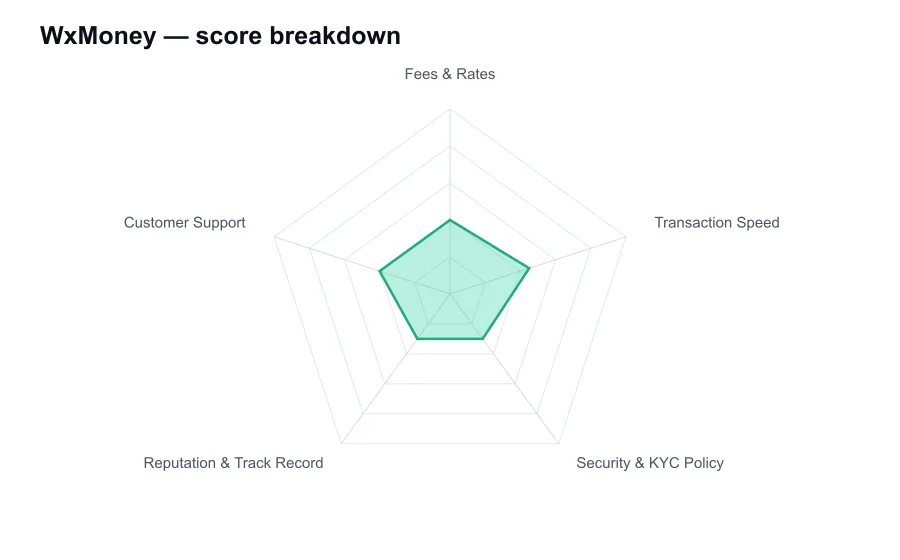
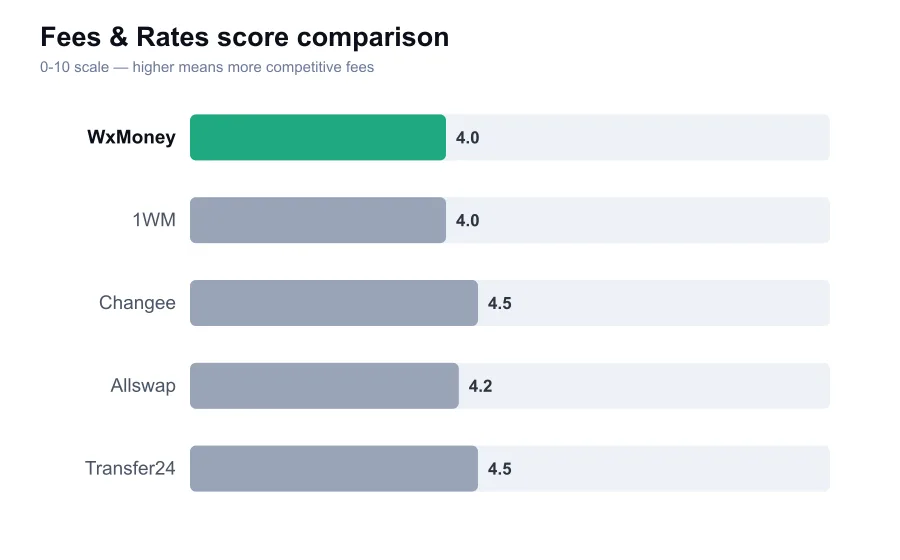
| Fees & Rates | 4.0 | Quoted-rate margin is not fully transparent |
| Transaction Speed | 4.5 | No clearly verified service-level timings |
| Security & KYC Policy | 3.0 | Limited public security information |
| Reputation & Track Record | 3.0 | No deep independently verified record |
| Customer Support | 4.0 | Escalation and response standards are unclear |
| Fact | Value | Source |
|---|---|---|
| Service model | Order-based online exchange | - |
| Fee model | Likely reflected in quoted rate | - |
| Public operating detail | Limited independently verified detail | - |
| Requirement | optional |
|---|---|
| Notes | A universal KYC rule was not independently verified. Users should assume the provider can request identity, payment, or source-of-funds evidence for a reviewed order. |
WxMoney appears to operate in the same practical category as many smaller online exchangers, helping users convert between cryptocurrencies, electronic money, and potentially fiat-related payment routes. It is not a broad consumer exchange with the visibility of Binance, Coinbase, Kraken, or Bitstamp. That does not automatically make it unsuitable. It does mean a customer should judge it by a stricter standard of transparency before trusting it with more than a small transaction.
The central issue with WxMoney is not a lack of appealing exchange directions. Small exchangers often serve payment pairs that big platforms ignore. The issue is whether the customer can independently verify the operating company, the pricing method, the support process, and the rules applied when an order is delayed. Publicly available material did not provide enough reliable detail to answer all of those questions with confidence.
Fees are often disguised by design in this sector. The page may show a single exchange rate rather than a line-item fee, while the actual cost is the difference between that rate and the tradable market price. This is normal for market-making services, but it becomes problematic when the margin is not explained and changes materially with order size. WxMoney does not earn a high fee score because a clear, widely verifiable fee policy was not available.
Users should compare what lands in the destination account. A BTC exchange that claims zero commission can still be expensive if the provider pays out less BTC than competitors after applying its rate. The same applies to fiat or electronic-money orders, where an intermediary cost may be absorbed into the quote. Take screenshots before payment because the displayed rate may have a short validity period.
Speed can be very good for an automated crypto order, but it is not something I would assume from a generic promise of fast exchange. The sender's transaction needs to reach the correct network and obtain the confirmations required by the provider. A manual payment check, bank transfer, reserve shortage, or compliance flag can change a quick conversion into a long wait. WxMoney's public processing standards are not sufficiently clear to make it a strong choice for urgent transfers.
This matters most for users who are moving money between traditional payment rails and crypto. Bank payment timing is outside the exchanger's control, but a professional provider should state what it can control: the confirmation threshold, working hours for manual orders, the status of reserve balances, and what happens if an order cannot be completed. I could not independently verify those details for WxMoney.
Security and customer protection are where an established brand has an advantage. Larger platforms publish identifiable corporate information, terms, compliance notices, security pages, and usually several account protection tools. With WxMoney, the available public disclosure appears limited. I could not verify detailed custody controls, independently audited security claims, or a publicly documented incident-response process.
That should change how users behave. Do not send an amount that would be financially painful to lose or have frozen for several days. Do not treat the service as a deposit account. Keep proof of the payment and all correspondence. A small provider can have perfectly honest staff, but an honest staff member cannot instantly solve a mistaken blockchain transfer or an external banking dispute.
Verification policy is another uncertain area. An exchanger can ask for KYC or source-of-funds documents on a particular order even if the user did not expect it. This is especially likely where there are unusual transaction patterns, third-party payers, or payment information that does not match the order. WxMoney should make those possibilities clear before a customer commits funds. Without a clear written policy, the customer bears too much uncertainty.
Reputation has to be earned in public. An exchange's own testimonials and social channels are weak evidence because they cannot show how difficult cases were handled. I was unable to establish the kind of long, independently traceable record that would support a high reputation score for WxMoney. That makes it an unproven option rather than a provider I would recommend by default.
Support may still be useful for basic questions. Before placing an order, ask a specific operational question: whether a payment from your bank or wallet type is accepted, how long a selected direction normally takes, and what happens if the exact payment amount differs slightly. The quality and precision of the reply will tell you more than a generic promise of 24-hour assistance.
A smart first test should be boring. Pick a common asset, use the correct network, send a small amount, and make sure you can receive it in a wallet you control. Do not test the service with a complicated cross-border payment, a token on an obscure chain, or funds needed for a same-day obligation. Complexity is where vague procedures become costly.
WxMoney may make sense where it offers a route that is genuinely unavailable elsewhere and the amount is modest. It does not make sense as a shortcut around due diligence. The customer should demand clear answers about rate validity, payment matching, verification, cancellation, and support before sending anything.
My judgment is reserved. WxMoney may be operationally useful, but insufficient public transparency prevents it from ranking well against established exchanges or even against smaller providers with clearer published policies. Use it only as a limited transaction service after a test order. For significant sums, choose a venue with a documented record and a more accountable operating structure.
| Pros | Cons |
|---|
WxMoney is a possible option for experienced users who need a small, specific conversion and have verified the order terms themselves. It is a poor fit for newcomers, high-value transactions, and payments with a firm deadline. Users who want predictable compliance treatment and strong account protections should use an established exchange or licensed payment provider.
Small exchangers commonly build their compensation into the displayed exchange rate. Compare the final destination amount with alternatives, rather than looking only for a separately stated fee.
No. Crypto confirmation, manual payment checks, bank timing, liquidity, and compliance reviews can all delay a transaction. Use a provider with documented timing if the deadline matters.
Yes. A mismatch can trigger a review or rejection at many exchange services. Use an account in your own name and ask first if a third-party payment is unavoidable.
Recovery may be impossible or may require manual work that the service does not offer. Check the asset and network twice before sending, then retain the transaction hash.
Ask how long that exact direction normally takes, whether it is automatic or manual, the accepted payment sender name, and the cancellation process if payment is not received.
| Alternative | Score |
|---|---|
| 1WM Review | 3.8/10 |
| Changee Review | 3.8/10 |
| Allswap Review | 4.0/10 |
| Transfer24 Review | 4.1/10 |
| Acechange Review | 4.2/10 |
| XGram Review | 3.2/10 |