Editorial independence: our scores and rankings are produced using the fixed criteria above and are not influenced by advertisers. This is an independent ranking site and is not operated by, or affiliated with, any provider we list.
Affiliate disclosure: some links on this page may earn us a commission at no extra cost to you. This does not affect our rankings.
| Best for | Not for |
|---|
XGram is presented as a crypto conversion provider, allowing users to send one digital asset and receive another. It appears closer to an instant swap service than a traditional centralized exchange. Its public operating record is limited, so users should verify current terms before funding an order.
| Criterion | Score | Note |
|---|---|---|
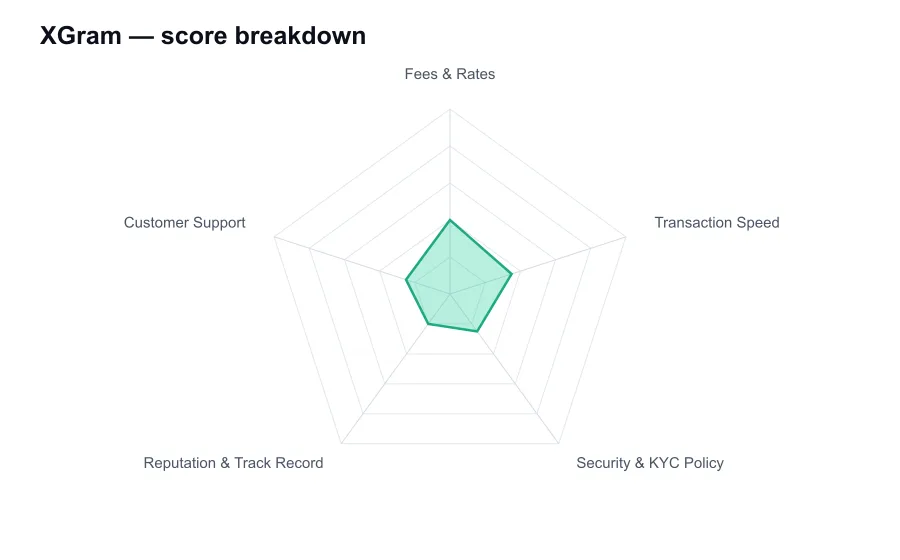
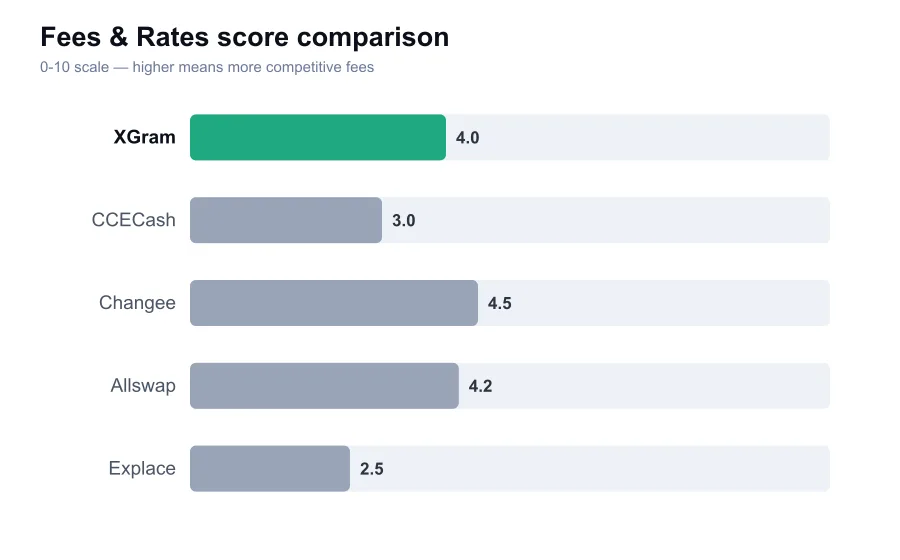
| Fees & Rates | 4.0 | Quoted pricing may be available, but fee disclosure is limited. |
| Transaction Speed | 3.5 | No independently established completion-time record. |
| Security & KYC Policy | 2.5 | Limited verifiable public security and compliance detail. |
| Reputation & Track Record | 2.0 | Little long-running independent reputation evidence. |
| Customer Support | 2.5 | Support performance is not well documented publicly. |
| Fact | Value | Source |
|---|---|---|
| Service type | Instant crypto conversion service | - |
| Custody model | Temporary transaction custody | - |
| Public order book | Not established | - |
| Public fee schedule | Not independently verified | - |
| Public track record | Limited independently verifiable evidence | - |
| Requirement | tiered |
|---|---|
| Notes | The exact verification rules could not be independently confirmed. Assume compliance checks and document requests may occur for flagged transactions. |
XGram appears to position itself as a lightweight crypto conversion service rather than a full exchange with order books, margin products, custody accounts, or a mature trading terminal. That distinction matters. A simple swap service can be useful for moving from one asset to another quickly, but it asks users to place a great deal of trust in a company during a short, irreversible transaction. XGram has not established the public footprint that experienced crypto users usually expect before sending meaningful sums.
The first issue is not necessarily that a small provider exists. New services have to start somewhere. The issue is whether a customer can independently establish who runs it, where it is incorporated, what its operating history looks like, and what happens if a transfer goes wrong. With XGram, those answers are not readily supported by a substantial body of public documentation, third party reporting, long-running customer discussion, or identifiable company records.
That makes fee comparison difficult from the beginning. Established instant exchangers such as ChangeNOW, SimpleSwap, FixedFloat, and StealthEX publish pair-specific quotes before the customer sends funds. Some also explain the difference between a fixed-rate conversion and a floating-rate conversion. XGram may present a quoted output amount during its transaction flow, but a quote alone is not enough to judge cost unless the service clearly distinguishes its own spread from network fees and market movement.
For a small transaction, a vague quote can be tolerable if you are deliberately testing a service. For a larger swap, it is a poor basis for a decision. A user needs to know whether the quoted rate is locked, how long it is locked for, what happens if the deposit arrives late, and whether the provider can recalculate the payout after receiving the funds. Without a plainly stated pricing policy, XGram's fee score has to remain modest even if an individual quote looks competitive.
Speed is similarly hard to rate generously. The underlying blockchains set part of the timetable. Bitcoin deposits may need confirmations, Ethereum transfers can be delayed by congestion, and a cross-chain payout requires liquidity on the receiving side. Those are normal constraints. The provider's contribution is its ability to detect deposits, perform the conversion, release the payout, and communicate clearly when a transaction cannot be automated.
XGram does not have a sufficiently documented record of average completion times, service-level commitments, or transparent transaction-status reporting to earn confidence here. A fast result on one low-value swap does not prove reliable operational speed. Customers should assume that an apparently instant exchange can take longer if a deposit requires additional confirmations, if the selected asset has thin liquidity, or if the transfer is reviewed manually.
Security is where the lack of public evidence becomes more serious. An instant exchanger does not need to hold an account balance for months to create risk. It temporarily controls the customer's deposited coins, and a payout delay can be financially painful during a volatile market. A responsible service should make its company identity, compliance policy, privacy terms, support process, and handling of suspicious transactions easy to inspect before a customer deposits.
I could not verify a detailed public security program for XGram, such as external audits, reserve reporting, a named security team, regulated custody arrangements, or a detailed incident history. Those features are not mandatory for every exchange service, but their absence leaves the customer with very little basis for trust. It is also unclear from the available public footprint how consistently identity verification is applied and how funds are handled if a transaction is flagged.
A no-account or low-friction exchange flow is sometimes marketed as privacy friendly. That should never be confused with a guarantee that no compliance review can occur. Crypto conversion services can request information or halt a payout when they identify risk, source-of-funds concerns, sanctions exposure, or a mismatch in transaction data. Before using XGram, a customer should find and read its current rules on holds, refunds, requested documents, and the time frame for resolving a compliance case.
Reputation is XGram's weakest area. I do not see the level of independent, long-running scrutiny that would let a reviewer treat it as a proven peer of established exchange brands. A provider does not need celebrity recognition, but it should leave a trail: years of customer reports, visible leadership, credible industry references, documented policies, and responses to disputes. Sparse information makes it impossible to separate a young but legitimate service from one that has simply not earned attention.
That does not mean every XGram transaction will fail. It means a prospective user cannot reasonably infer safety from a polished web page or a favorable advertised rate. Crypto has a long history of short-lived services using familiar language about speed, privacy, and low fees. The sensible approach is to judge the evidence available, rather than filling gaps with optimism.
Support is another practical concern. With an instant exchange, support quality matters most precisely when the service has failed to feel instant. A deposit may arrive without being credited, a payout can be sent on the wrong network if the customer made an error, or a transaction can become stuck during a market move. In those moments, users need a traceable ticket, a human response, and a clear explanation of next steps.
XGram has not built enough publicly verifiable support history for me to give it credit for dependable issue resolution. Before depositing, test its contact channel with a specific pre-sale question, save the response, and confirm that the service provides a transaction identifier and a support route that does not rely solely on an anonymous chat widget. If support cannot explain a basic operational question before receiving funds, it is unlikely to improve after a dispute begins.
My view is straightforward: XGram belongs in the experimental category, not the default-provider category. It may be suitable for a very small, disposable test transaction by someone who understands blockchain transfers and can verify every address independently. It is not a sensible first choice for a newcomer, a time-sensitive conversion, or any amount whose temporary loss would matter. Until its corporate information, pricing rules, compliance process, and customer record are easier to verify, stronger known alternatives deserve preference.
| Pros | Cons |
|---|
XGram is only suitable for experienced users testing a very small amount that they can afford to have delayed. It may appeal to people who want a simple conversion flow rather than an exchange account. Beginners, businesses, and users converting meaningful sums should use a provider with a documented company identity, clear fee rules, and a longer public record.
XGram appears to be a conversion-focused service rather than a conventional exchange with visible order books, margin trading, or a public custody platform.
No. Its public reputation and operating record are not sufficiently established for a large first transfer. Test only with an amount you can afford to have delayed.
A clearly verifiable public policy explaining fixed-rate timing, repricing, and late deposits was not available in the material reviewed for this assessment.
Keep the deposit transaction hash, the receiving address, the quoted order details, and screenshots. Contact support through the provider's documented channel before sending repeated transfers.
Its exact current verification practice could not be independently confirmed. Users should assume a transaction can be reviewed and documents may be requested.
Usually no. Blockchain deposits are generally irreversible once confirmed, so check the asset, network, and destination address before approving the transfer.
| Alternative | Score |
|---|---|
| CoinDrop Review | 2.9/10 |
| CryptoVortex Review | 2.8/10 |
| WxMoney Review | 3.7/10 |
| CCECash Review | 2.7/10 |
| 1WM Review | 3.8/10 |
| Changee Review | 3.8/10 |