
Editorial independence: our scores and rankings are produced using the fixed criteria above and are not influenced by advertisers. This is an independent ranking site and is not operated by, or affiliated with, any provider we list.
Affiliate disclosure: some links on this page may earn us a commission at no extra cost to you. This does not affect our rankings.
| Best for | Not for |
|---|
| Criterion | Score | Note |
|---|---|---|
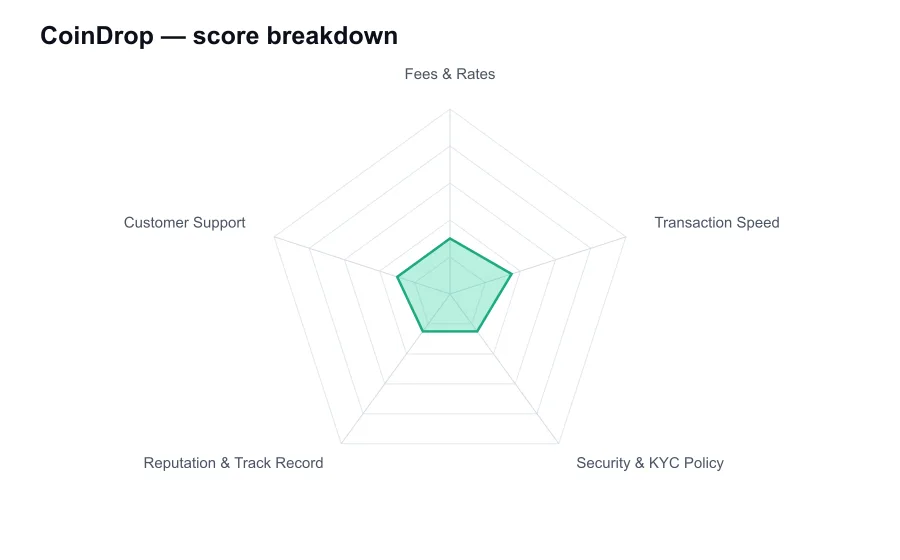
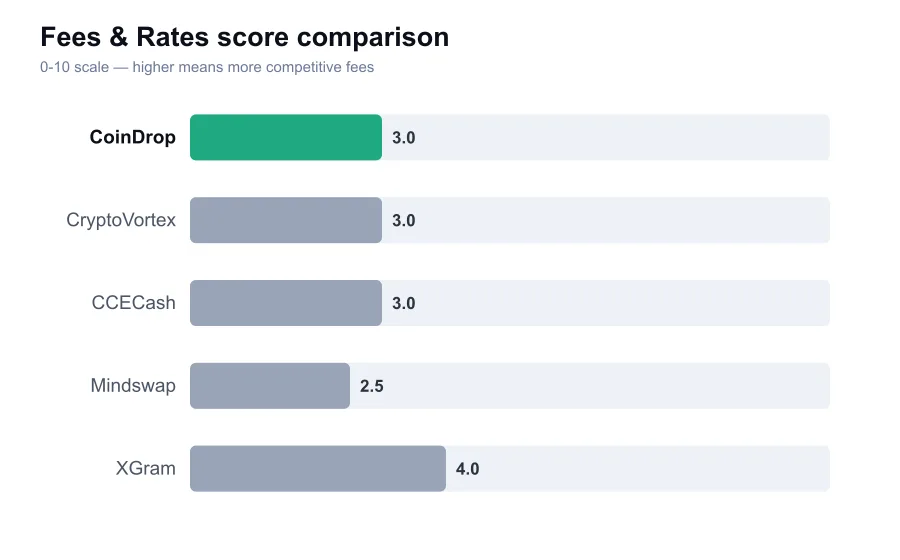
| Fees & Rates | 3.0 | Transparent all-in pricing is not established |
| Transaction Speed | 3.5 | Public settlement performance is limited |
| Security & KYC Policy | 2.5 | Limited verifiable custody disclosures |
| Reputation & Track Record | 2.5 | No substantial independent operating record |
| Customer Support | 3.0 | Test support before transferring funds |
CoinDrop is a name that can sound more established than the available public evidence supports. It occupies the crowded space of crypto services promising simple access to digital assets, a market where recognizable branding and a clean interface often mask major differences in custody, pricing, compliance, and support. Before treating CoinDrop as an exchange, users should first establish exactly what service it provides and who legally operates it.
That distinction matters because CoinDrop is not a name with the widely documented history of Gemini, Kraken, Coinbase, Bitstamp, or other long-running platforms. There is not enough clearly verifiable information to rate it as a proven venue for significant customer funds. A small provider can still be legitimate, but legitimacy should be evidenced through transparent terms, identifiable ownership, security disclosure, and a record that survives more than a marketing cycle.
The fee picture is not strong. I could not verify a standard public schedule setting out CoinDrop's trading fees, conversion spread, withdrawal charges, or treatment of blockchain costs. That makes advertised simplicity potentially expensive. In crypto, a provider can charge no visible commission while taking a sizable margin in the exchange rate. Customers who only look at a percentage label can miss the real cost entirely.
A responsible buyer should compare the final output, not the promise. Put the same amount of BTC, ETH, or USDT into CoinDrop and into several established quote sources at the same time. Check the destination amount, network, confirmation requirement, and whether the quote is fixed or floating. If CoinDrop cannot produce those details clearly before you commit, do not assume a favorable result after the transaction starts.
CoinDrop therefore has a poor fee score, though not because a specific percentage has been proven excessive. It scores poorly because users cannot confidently measure the cost. Transparent pricing lets customers make an informed choice even if a service is not the cheapest. Opaque pricing removes that choice, particularly on small swaps where minimums, spreads, and network deductions can consume a surprising share of the transaction.
Speed also remains unproven. A conversion service can only control part of the journey, and honest providers say so. They explain that incoming deposits must confirm, liquidity must be obtained, and outgoing transfers need network propagation. A reliable platform also gives customers a status page or order tracker that separates those stages. CoinDrop does not have a well-established public execution history showing this level of operational clarity.
For a low-value transaction, a reasonable expectation is that the service provides a visible order identifier, detects the incoming transfer after normal confirmations, and broadcasts the outgoing transaction with a traceable hash. If an order takes longer, support should explain why in concrete terms. Generic references to technical issues are not sufficient where prices move quickly and the customer cannot reverse the transfer.
Security is the area where a less-known service must work hardest to earn confidence. CoinDrop does not have a broadly recognized public record of proof-of-reserves attestations, external security audits, insurance disclosures, detailed cold-storage arrangements, or a mature bug-bounty program. No single one of those items is mandatory for every business. Together, however, they are the kind of evidence that separates a trusted operator from an unknown counterparty.
Users should also read any identity-verification rules with care. Minimal onboarding is not a binding promise of no KYC. Automated screening can trigger requests for identity documents, proof of address, transaction history, or source-of-funds material. That may be legitimate under anti-money-laundering controls, but CoinDrop should state what it can request, how it handles data, and whether an order can be refunded if verification is not completed.
Do not deposit funds based on an assumption that customer support will solve a problem later. Test the support route first with a question that demands a factual response, such as supported networks for USDT or the process for an incorrect memo. Strong support answers with specific procedures. Weak support replies with sales language, avoids written commitments, or pushes users toward a deposit before giving details.
CoinDrop's reputation score is held back by the same lack of durable independent evidence. A few positive comments, website badges, or social accounts do not prove dependable execution. A worthwhile exchange record includes years of user discussion, known management, transparent incident response, and visible handling of difficult cases. CoinDrop has not accumulated that kind of public trust signal in a way that supports a high rating.
This does not mean every user will encounter a problem. It means a completed small transaction cannot tell you how the provider behaves during market congestion, a compliance review, a wrong-network deposit, or a large withdrawal. Those are precisely the moments where policies and operational maturity matter. Crypto users often learn that lesson after the funds are already beyond their control.
CoinDrop might be considered only by an experienced person making a very small test conversion, using a personal wallet and independently checking the on-chain result. It is a poor match for beginners, people buying crypto with money needed for bills, merchants, and investors seeking a platform to hold assets. Anyone who values formal accountability should choose a provider with a known corporate and regulatory presence.
My take is cautious rather than charitable. CoinDrop has not earned confidence through transparent pricing, verifiable security practices, or a substantial reputation. There is no compelling reason to accept that uncertainty when established alternatives offer clear fees, deeper liquidity, and much more visible support structures. If CoinDrop wants to be treated as a serious exchange, it needs to provide serious evidence. Until then, keep your funds elsewhere.
| Pros | Cons |
|---|
CoinDrop may only fit experienced self-custody users who want to test a tiny transaction and can verify an on-chain withdrawal themselves. It is not a good choice for new users, high-value transfers, businesses, or people who need documented customer protections. Investors looking for recurring purchases or tax reporting should choose a mature exchange. Anyone uncomfortable with uncertain KYC handling should look elsewhere.
I could not verify a detailed, widely established public fee schedule. Compare the final received amount with several alternatives before confirming any transaction.
Potentially. Many crypto services may request identity or source-of-funds information after risk screening, so read the written policy before sending funds.
No. Use a self-custody wallet for assets you intend to hold. CoinDrop does not have enough transparent public custody information to justify leaving a balance there.
| Alternative | Score |
|---|---|
| CryptoVortex Review | 2.8/10 |
| CCECash Review | 2.7/10 |
| Mindswap Review | 2.6/10 |
| XGram Review | 3.2/10 |
| Explace Review | 2.4/10 |
| ETZ Review | 2.3/10 |