
Editorial independence: our scores and rankings are produced using the fixed criteria above and are not influenced by advertisers. This is an independent ranking site and is not operated by, or affiliated with, any provider we list.
Affiliate disclosure: some links on this page may earn us a commission at no extra cost to you. This does not affect our rankings.
| Best for | Not for |
|---|
Explace appears to be referenced as a crypto exchange or conversion provider, but its exact current official operation cannot be established with sufficient confidence from public material. Users therefore cannot easily verify its rates, ownership, custody, or support standards. It is a high-caution option, not a documented mainstream exchange.
| Criterion | Score | Note |
|---|---|---|
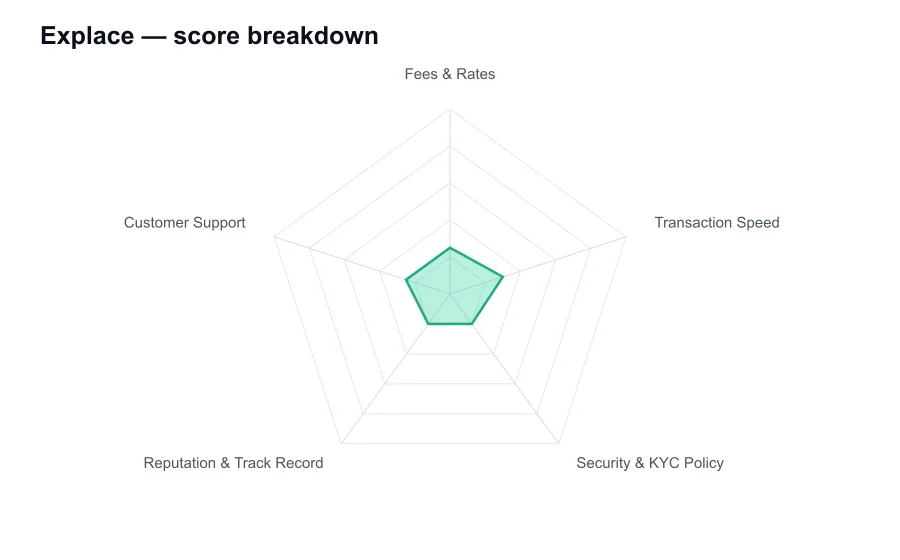
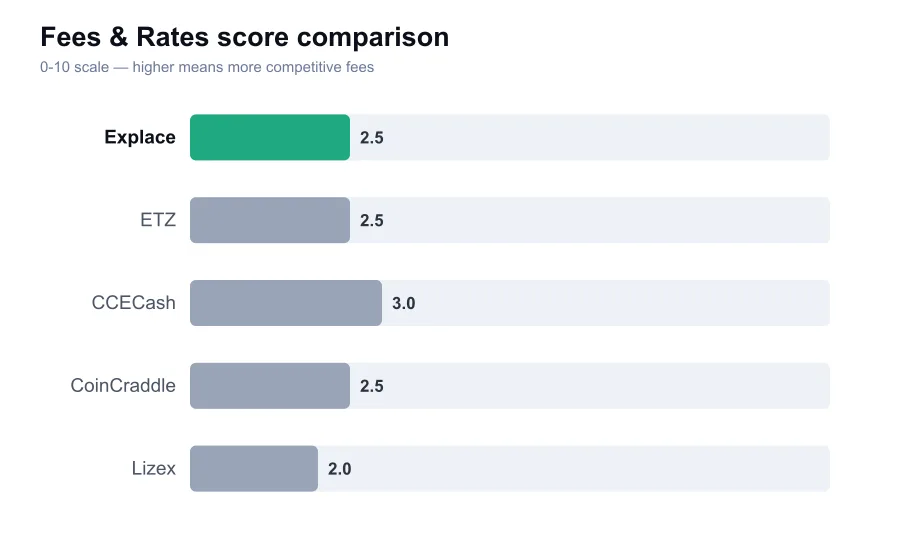
| Fees & Rates | 2.5 | Rate and fee model cannot be reliably confirmed |
| Transaction Speed | 3.0 | No dependable evidence on payout handling |
| Security & KYC Policy | 2.0 | Limited verifiable custody and policy disclosure |
| Reputation & Track Record | 2.0 | Insufficient independent operating history found |
| Customer Support | 2.5 | Support quality cannot be independently established |
| Fact | Value | Source |
|---|---|---|
| Operator identity | Could not be reliably verified | - |
| Rate type | Could not be reliably verified | - |
| Published limits | Could not be reliably verified | - |
| Independent history | Insufficient public evidence | - |
| Support score | 2.5/10 | - |
| Requirement | tiered |
|---|---|
| Notes | No reliable detailed policy was found. Users should expect that compliance screening may trigger a document request or transaction delay. |
Explace is a name that sounds like a conventional crypto exchange, but the available public evidence does not support treating it like one of the industry's established venues. A credible exchange is more than a trading screen or an exchange calculator. It needs a verifiable operator, intelligible terms, clear custody arrangements, and a customer record that lets users judge how it behaves when something goes wrong.
I could not confidently connect Explace to a well documented official crypto exchange with a substantial independent history. The name may be used in different contexts, and that ambiguity is a problem in itself. Before assigning trust, a reviewer needs to identify the exact domain, company, and service. If those basics are unclear, every claimed feature becomes harder to verify.
This review therefore focuses on the risk created by missing information rather than making unsupported accusations. There is no value in inventing a fee percentage, asset count, settlement time, or licensing status to make a review look complete. For prospective users, honest uncertainty is more useful than false precision. Explace has not provided enough verifiable detail for a positive recommendation.
Pricing is the first practical concern. Exchange users need to know whether they pay a trading commission, a conversion spread, a network charge, or some combination of all three. A fixed-rate swap can cost more but offers certainty. A floating-rate transaction may be cheaper initially but can deliver less if the market moves or if the deposit is confirmed slowly. I could not independently verify Explace's pricing rules well enough to assess either model.
That leaves a user exposed to one of the oldest problems in crypto conversion services: the rate displayed before payment might not be the amount paid after funds arrive. Some platforms explain this clearly and show a refreshed quote. Others bury the distinction in terms. Never assume a rate is locked unless the actual order page and conditions say so in plain language.
Transaction speed cannot be judged solely by an advertised processing estimate. Network confirmations are outside the exchange's direct control, but payout liquidity and internal review are not. A reliable provider will tell users how many confirmations it needs, what happens during congestion, and how to contact support if the payout is late. I could not verify that Explace has a well established record of handling those situations consistently.
Security is not something a customer can inspect from a logo. The relevant questions are whether the company identifies itself, whether it explains how customer funds are managed, whether it publishes security practices, and whether users can see a credible response to past incidents. Explace does not have enough publicly verifiable material on these points for a strong score.
The same applies to KYC. A service may permit a user to start without registration, but that does not necessarily mean the transfer is free from compliance review. Blockchain tracing, sanctions screening, and risk controls can lead to a request for documents. That can be reasonable, but users deserve advance notice and a predictable process. I could not confirm Explace's detailed policy for reviews, frozen orders, or declined verification.
Reputation is the hardest category to repair quickly. It takes years to build a history of ordinary successful transactions and visible, competent handling of exceptional cases. It can be lost in a week through unexplained holds or absent support. I found insufficient independent evidence to say Explace has earned that history. This is why its reputation score remains low despite the possibility that individual users may have had successful interactions.
Customer support is not an optional extra for a service handling irreversible payments. A customer who sends on the wrong network, omits a memo, or sees a confirmed deposit without a payout needs more than an automated acknowledgment. They need a reachable team that can identify an order and explain the next step. There is no strong public basis for assuming Explace offers that standard.
Potential users should be cautious with claims that Explace is a new exchange offering better rates than recognized competitors. New companies can compete, but low prices alone are not a safety signal. If a platform cannot explain its fees, operator, and support process, the apparent discount may simply be the price of taking more counterparty risk.
A safer research process starts with the exact domain. Read the service terms, identify the legal entity, and search for the domain alongside words such as complaint, withdrawal, delayed, verification, and scam. Look for dated evidence rather than freshly created review profiles. Check whether the support address, legal terms, and social accounts all point to the same organization.
For regular buying, selling, or trading, established exchanges with transparent account controls are a better fit. For a one-off conversion, a documented swap provider with public rate rules and years of user feedback is the sensible baseline. Explace has not cleared that baseline based on information that can be independently checked.
My take is that Explace belongs in the caution category, not the recommendation category. The lack of verifiable detail makes it impossible to judge its true costs or its ability to resolve a problem. That is unacceptable for a service receiving customer crypto. Until Explace builds a traceable public identity and a convincing operational record, users should keep their distance.
| Pros | Cons |
|---|
Explace is not appropriate for users who need a dependable trading venue, merchant settlement, or a place to hold funds. It may only be considered for independent research and a very small technical test after verifying the exact domain. Beginners and users moving valuable assets should choose a provider with a known operator and public support history.
I could not reliably establish Explace as a well documented centralized exchange with a clearly verifiable current operator. Its entity classification is best treated as an uncertain exchange or swap service.
A dependable public rule could not be verified. Do not assume a displayed quote is locked until the order page explicitly states fixed-rate terms.
There is too little verifiable disclosure about its operator, custody model, controls, incident response, and transaction-review policy to score it higher.
A floating-rate service may do so if its terms permit it and the market moves before execution. Check whether the order is fixed-rate and save the quoted output.
Verify the exact domain, named legal entity, pricing terms, KYC conditions, support contact details, and dated independent reviews that refer to that domain.
Do not assume recovery is possible. Contact verified support with the transaction hash, but never pay a third-party recovery agent or share wallet credentials.
| Alternative | Score |
|---|---|
| ETZ Review | 2.3/10 |
| Mindswap Review | 2.6/10 |
| CCECash Review | 2.7/10 |
| CryptoVortex Review | 2.8/10 |
| CoinDrop Review | 2.9/10 |
| CoinCraddle Review | 1.9/10 |