
Editorial independence: our scores and rankings are produced using the fixed criteria above and are not influenced by advertisers. This is an independent ranking site and is not operated by, or affiliated with, any provider we list.
Affiliate disclosure: some links on this page may earn us a commission at no extra cost to you. This does not affect our rankings.
| Best for | Not for |
|---|
CoinCraddle appears to be a cryptocurrency conversion provider rather than a conventional trading venue. Users would generally choose a pair, provide a receiving address, and send crypto for a payout in another asset. Public information is too limited to treat it as a well-established exchange.
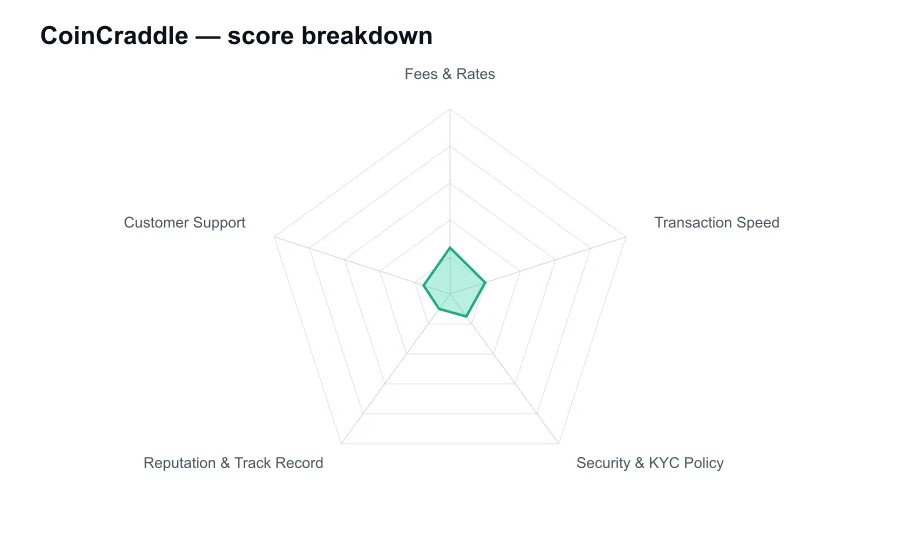
| Criterion | Score | Note |
|---|---|---|
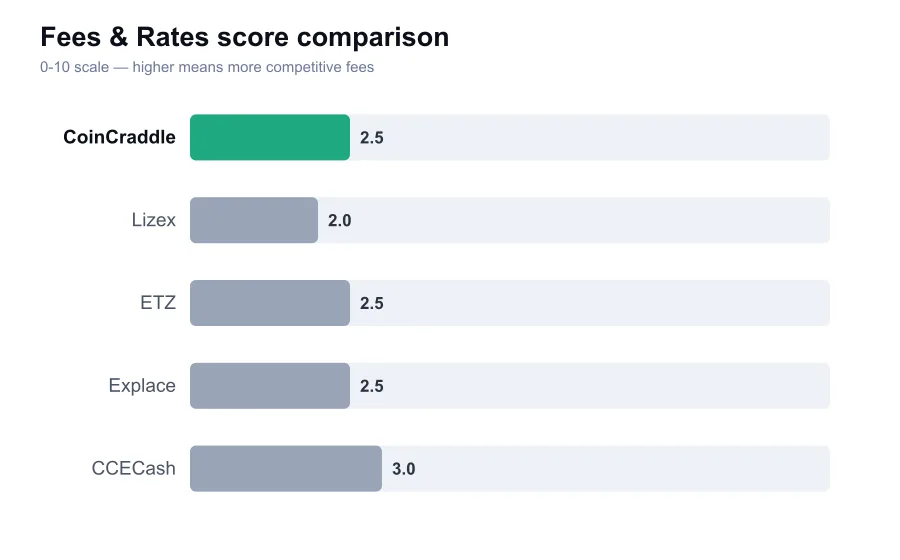
| Fees & Rates | 2.5 | No well-established public fee and spread disclosure. |
| Transaction Speed | 2.0 | Completion speed lacks a strong independent record. |
| Security & KYC Policy | 1.5 | Public security, ownership, and hold procedures are unclear. |
| Reputation & Track Record | 1.0 | Very limited independently verifiable track record. |
| Customer Support | 1.5 | Public evidence of effective dispute resolution is thin. |
| Fact | Value | Source |
|---|---|---|
| Service type | Instant crypto conversion service | - |
| Public order book | Not established | - |
| Public fee schedule | Not independently verified | - |
| Company disclosure | Limited publicly verifiable detail | - |
| Reputation evidence | Limited independently verifiable history | - |
| Requirement | tiered |
|---|---|
| Notes | No reliably verified blanket KYC rule was available. Users should assume that suspicious or manually reviewed transactions can trigger document requests. |
CoinCraddle is one of those crypto providers that requires more scrutiny than enthusiasm. It appears to offer a straightforward crypto exchange or conversion proposition, but it has not developed the visible market presence, published documentation, or independent reputation that would make it easy to recommend. That is a major disadvantage in a category where the customer must often send irreversible funds before receiving anything in return.
Small exchange services are not automatically unsafe. Some are simply new, regional, or deliberately narrow in scope. Still, a serious reviewer needs more than a claim of convenience. There should be an identifiable operating company, durable contact information, clear terms, a privacy policy that says who controls customer data, and enough independent user history to reveal how the business behaves when a transaction is disputed.
CoinCraddle does not offer enough verifiable public evidence on those points for me to treat it as a mature provider. The service may work as advertised for some users. That is not the standard for a recommendation. The real question is whether a customer can assess the risk before depositing coins, and the available information does not give a convincing answer.
Fees are especially difficult to judge in this situation. Many crypto conversion sites advertise a good rate while hiding their margin inside the exchange rate. That practice is not necessarily deceptive if the final quote is honored and the terms are clear. It becomes a problem when the customer cannot tell whether a lower payout came from blockchain fees, a market move, a provider spread, or a discretionary repricing after the deposit landed.
CoinCraddle has not supplied a broadly verifiable, detailed fee framework that lets users compare it cleanly with established services. A prospective customer should price the exact same small swap against multiple providers at the same moment. Compare the amount received, the network fee, whether the rate is fixed, and the expiration period for the quote. If CoinCraddle's offer is only marginally better, the saving is rarely enough to justify its weaker reputation.
Speed claims should also be treated carefully. A swap service can be technically fast while the blockchain deposit is slow. It can also show an attractive status page while a transaction is actually waiting for liquidity, manual review, or a compliance decision. Experienced users look for clear milestones: deposit detected, confirmations received, exchange processing, payout broadcast, and transaction hash for the outgoing transfer.
I could not verify a consistent public record of CoinCraddle completing orders at a predictable pace. This does not prove slow execution. It means there is not enough independent evidence to give it a strong speed score. If you decide to test it, use a liquid asset on a network with ordinary confirmation times, and avoid a conversion that depends on a strict market window.
Security is where CoinCraddle falls behind services with established histories. A customer needs to know where the business is based, what laws it says govern the relationship, how it treats personal data, and how it handles funds that are delayed or flagged. Security is not limited to two-factor authentication or a padlock in the browser. It includes governance, disclosure, incident communication, and an accountable process for returning funds.
No sufficiently detailed, independently verifiable security program or compliance procedure was available for this review. I also could not establish a robust public record showing how CoinCraddle resolves frozen orders or customer complaints. That uncertainty should materially change the amount anyone is willing to risk. It is not prudent to assume that an obscure conversion provider has the same controls as a larger exchange merely because both accept the same coins.
The KYC question deserves particular care. Some instant exchangers say they do not require registration, while reserving the right to seek identification on a transaction-by-transaction basis. That arrangement can be legitimate, but only if the trigger conditions and possible outcomes are disclosed. If a provider cannot explain whether it can hold a deposit, which documents it may request, and how long review may take, privacy-minded users should look elsewhere.
CoinCraddle's public reputation is simply too thin to offset those concerns. I found no substantial body of long-term third party discussion that would demonstrate dependable service through busy periods, price spikes, or support disputes. Review widgets hosted by a provider are not enough. Anonymous praise without transaction details is not enough either. In crypto, trust comes from evidence accumulated over time.
Customer support may be adequate, but it is not documented well enough to receive the benefit of the doubt. Before sending money, ask a practical question that requires a specific answer, such as how an incorrect network deposit is handled or whether a late deposit receives the original rate. The quality, speed, and precision of that reply tell you more than a generic promise of round-the-clock support.
A cautious user should also avoid sending multiple deposits to a single order unless the provider explicitly permits it. Do not assume a memo-less transfer, token contract swap, or unsupported network will be recoverable. These are common sources of loss even at respectable services. At a provider with little public accountability, recovery prospects are worse.
My recommendation is blunt: CoinCraddle is not a service I would choose for meaningful funds. It may be considered only for a very small test by an advanced user who has independently checked its current terms and understands the possibility of delay. Anyone who values transparent fees, known support channels, and an established reputation should choose a better documented exchange instead. CoinCraddle has too much to prove before it earns broader trust.
| Pros | Cons |
|---|
CoinCraddle is a poor fit for first-time buyers, businesses, and anyone sending funds that matter to them. An advanced user could test the mechanics with a minimal amount after independently checking its current policies. Users wanting a fixed-rate swap, clear compliance rules, or a proven support record should select a more established instant exchanger or regulated exchange.
There is very limited independently verifiable evidence of a long-running customer record, publicly documented dispute handling, or established company history.
Yes. Compare the exact final amount received, rate-lock period, and network fee against established alternatives at the same time before sending any deposit.
Yes. Instant exchangers can review transactions and request documents even if they do not require an account at the start of the order.
Keep the order ID, quoted payout, deposit address, deposit transaction hash, receiving address, timestamps, and every support message.
Do not do so unless CoinCraddle explicitly confirms it. Multiple or partial deposits can complicate automated processing and refund requests.
Use a small amount, a common asset, a correctly matched network, and a wallet you control. Do not use funds needed for a deadline or payment.
| Alternative | Score |
|---|---|
| Lizex Review | 1.8/10 |
| ETZ Review | 2.3/10 |
| Bitok777 Review | 1.5/10 |
| Explace Review | 2.4/10 |
| Mindswap Review | 2.6/10 |
| CCECash Review | 2.7/10 |