
Editorial independence: our scores and rankings are produced using the fixed criteria above and are not influenced by advertisers. This is an independent ranking site and is not operated by, or affiliated with, any provider we list.
Affiliate disclosure: some links on this page may earn us a commission at no extra cost to you. This does not affect our rankings.
| Best for | Not for |
|---|
Lizex is presented in some crypto exchange contexts as an exchange or swap service, but reliable public information about its current operating entity and product is limited. That makes it difficult to judge custody, pricing, support, and compliance practices. It should be treated as a high-caution provider rather than an established exchange.
| Criterion | Score | Note |
|---|---|---|
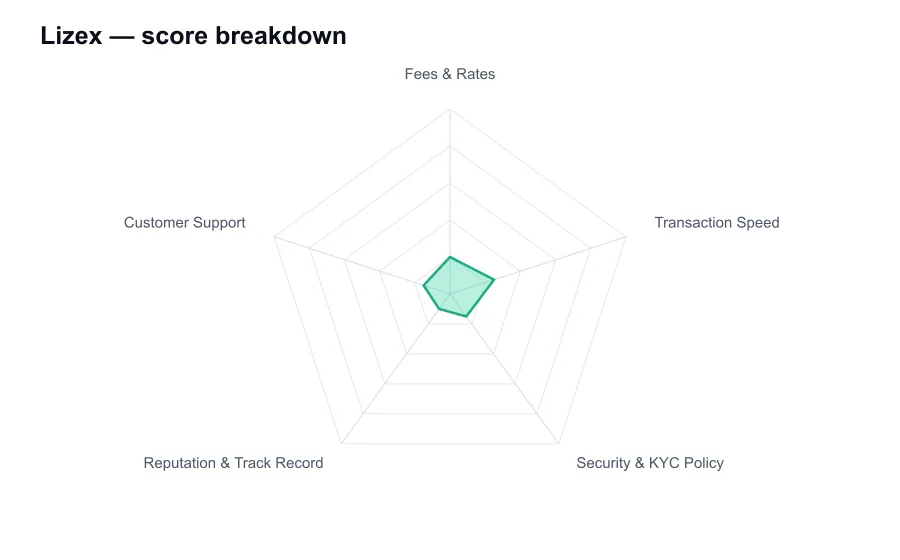
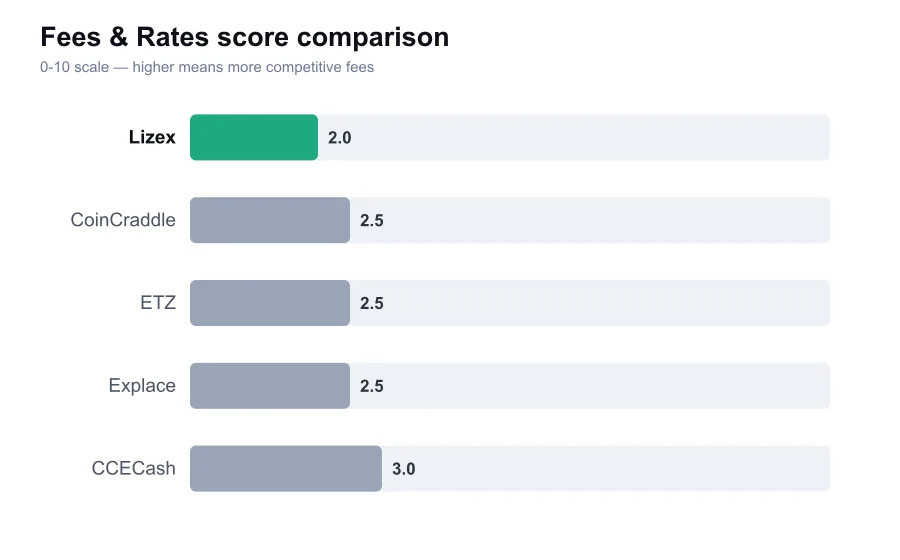
| Fees & Rates | 2.0 | No dependable public pricing evidence located |
| Transaction Speed | 2.5 | No independently supported settlement record |
| Security & KYC Policy | 1.5 | Custody, controls, and KYC rules are unclear |
| Reputation & Track Record | 1.0 | Very limited verifiable public track record |
| Customer Support | 1.5 | No proven escalation or support quality |
| Fact | Value | Source |
|---|---|---|
| Legal operator | Could not be reliably verified | - |
| Fee schedule | Could not be reliably verified | - |
| KYC policy | Could not be reliably verified | - |
| Public track record | Insufficient independent evidence | - |
| Security score | 1.5/10 | - |
| Requirement | tiered |
|---|---|
| Notes | No dependable public policy was verified. Users should assume identity checks can be requested if a transaction is flagged by compliance screening. |
Lizex is another crypto exchange name for which the public evidence is far thinner than a customer should accept before sending funds. A functioning website, a polished interface, or a listing on a comparison page is not enough. Crypto transfers are usually final, and an exchange's credibility depends on clear ownership, terms, support channels, and a history that can be checked outside its own promotional material.
I could not reliably identify a current, established official exchange operation under the Lizex name. That is the central finding here. There may be services using a similar name, old references, or sites that present themselves as exchanges, but I could not connect Lizex to a confidently verifiable legal entity and a durable public operating record. That uncertainty should shape every decision a potential user makes.
Some readers will see a low score and assume it means a service has been proven fraudulent. That is not what this review says. The issue is narrower and more useful: there is not enough dependable evidence to recommend Lizex. Responsible reviews should distinguish between confirmed allegations and missing verification. Missing verification is still enough to make a platform unsuitable for meaningful deposits.
A platform's fee policy is where opacity becomes expensive. On a transparent spot exchange, users can normally inspect trading fees, withdrawal charges, and any discount conditions before placing an order. On a swap site, the service should explain whether a rate is fixed or floating and whether mining fees are included. I could not verify a stable, public Lizex fee schedule with enough confidence to tell a reader what they would actually pay.
That means a quoted exchange amount cannot be treated as a bargain without comparison. Check the output against the prevailing market price and the withdrawal cost at an established venue. A service can claim zero fees while taking a substantial spread. There is nothing unusual about earning a spread, but hiding it behind vague marketing gives users no basis for judging the deal.
Speed cannot be assessed well either. Fast processing requires more than a claim that orders are automatic. Deposits need confirmations, wallets need working liquidity, and compliance tools can interrupt supposedly instant orders. Without a reliable body of recent, independent user reports and clear service documentation, there is no reason to assume Lizex will process a delayed or unusual transaction quickly.
The security picture is not reassuring because essential questions remain unanswered. Who controls customer deposits? Is the service custodial? Does it use a hot-wallet system? Are there published safeguards, external security assessments, withdrawal controls, or incident disclosures? A smaller provider does not need to reveal every technical detail, but it should give customers more than a generic assurance that funds are safe.
KYC ambiguity is a recurring trap with little-known exchange brands. No-account access is sometimes described as private, yet the actual terms may allow an operator to stop a payout and ask for identification after receiving funds. Compliance screening is normal in the sector. What separates a responsible provider from a risky one is whether it states the trigger, required documents, expected review process, and treatment of a declined verification. I could not verify those protections for Lizex.
Reputation is where Lizex scores poorest. Mature providers have a visible trail: reviews spanning years, technical announcements, known staff or corporate filings, customer issues handled in public, and records that survive beyond a single marketing cycle. Lizex does not have enough of that evidence. A small number of anonymous reviews cannot substitute for a reputation earned over time.
Support is equally difficult to credit. A contact form or chat bubble is not proof that someone will resolve a stuck transaction. The real test is response quality during a wallet outage, a wrong-network deposit, or a compliance hold. I found no dependable basis for saying Lizex has a responsive support organization with published service standards or effective escalation.
The danger is magnified by social engineering. Unknown exchanges are often promoted through channels promising unusually favorable rates, investment returns, recovery services, or exclusive access. None of those claims should influence a decision. Do not install software, share a seed phrase, or grant wallet permissions because a Lizex-branded representative asks. Legitimate exchange support never needs a recovery phrase.
If you are researching a live Lizex site, verify the domain and company details before you create an account. Look for coherent legal terms, a specific governing entity, a privacy policy that names the controller, and a support record that extends beyond social media. Then search for complaints using the exact domain, not merely the brand name. That extra step catches many lookalike and temporary operations.
For practical crypto trading, users have stronger options. A regulated or widely scrutinized centralized exchange gives account holders clearer recourse, even though KYC may be more extensive. For occasional swaps, choose a provider with published terms, longstanding public feedback, and a clear explanation of rate changes and transaction reviews. Lizex has not supplied enough evidence to compete on trust.
My recommendation is to avoid Lizex for any amount that matters. It is possible that a particular transaction will work, but a service should not need a customer to gamble in order to establish basic confidence. The absence of verifiable facts affects fees, speed, security, reputation, and support all at once. Until Lizex develops a clear and independently traceable record, caution is the only defensible stance.
| Pros | Cons |
|---|
Lizex does not fit beginners, active traders, merchants, or holders transferring meaningful balances. Experienced researchers may inspect a current site and conduct a token-sized test, but that is not a recommendation to trust it. Anyone who needs clear pricing, documented KYC rules, and support that can be held accountable should choose a known provider.
A long, independently traceable operating history and clearly verifiable operator could not be established. Anonymous or isolated review claims are not enough to support a higher score.
I could not verify a dependable public fee schedule. Compare any final quote with a liquid exchange, because a hidden spread can cost more than an explicit trading fee.
A reliable public KYC and hold policy could not be confirmed. Assume a transaction may be reviewed and do not send funds you cannot afford to have delayed.
Do not provide identity documents or meaningful funds until you have independently verified the exact domain, operator, privacy policy, and support channels.
Search using the exact domain, compare legal pages across sources, avoid ad links and direct messages, and never trust a site solely because it has a padlock icon.
Keep the order ID, deposit address, transaction hash, timestamps, and screenshots. Contact the service only through a verified support channel and never share a seed phrase.
| Alternative | Score |
|---|---|
| CoinCraddle Review | 1.9/10 |
| Bitok777 Review | 1.5/10 |
| ETZ Review | 2.3/10 |
| Explace Review | 2.4/10 |
| Mindswap Review | 2.6/10 |
| CCECash Review | 2.7/10 |