
Editorial independence: our scores and rankings are produced using the fixed criteria above and are not influenced by advertisers. This is an independent ranking site and is not operated by, or affiliated with, any provider we list.
Affiliate disclosure: some links on this page may earn us a commission at no extra cost to you. This does not affect our rankings.
| Best for | Not for |
|---|
ETZ appears in crypto exchange listings as a possible exchange or swap provider, but its exact current operator and product cannot be reliably established from public information. That makes it a poor candidate for users who need a documented, accountable service. Treat any use as high risk until the official identity is independently confirmed.
| Criterion | Score | Note |
|---|---|---|
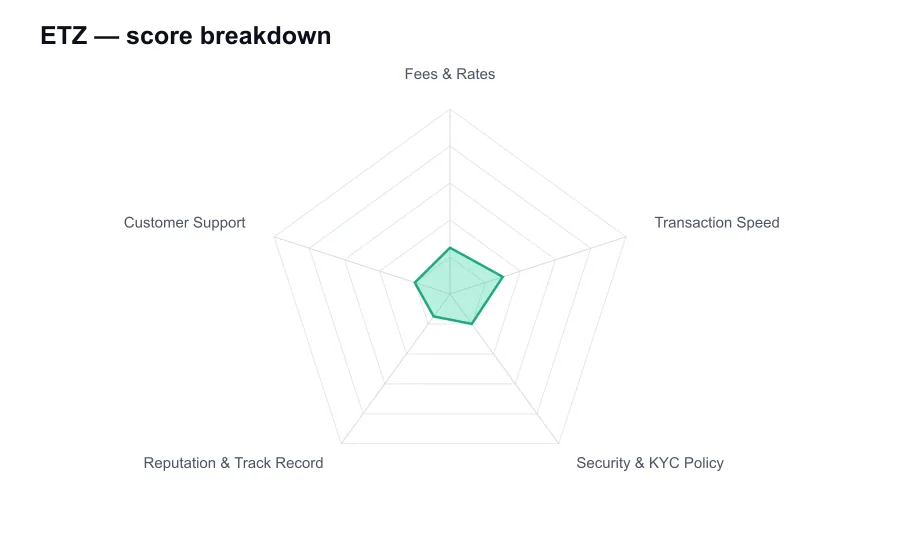
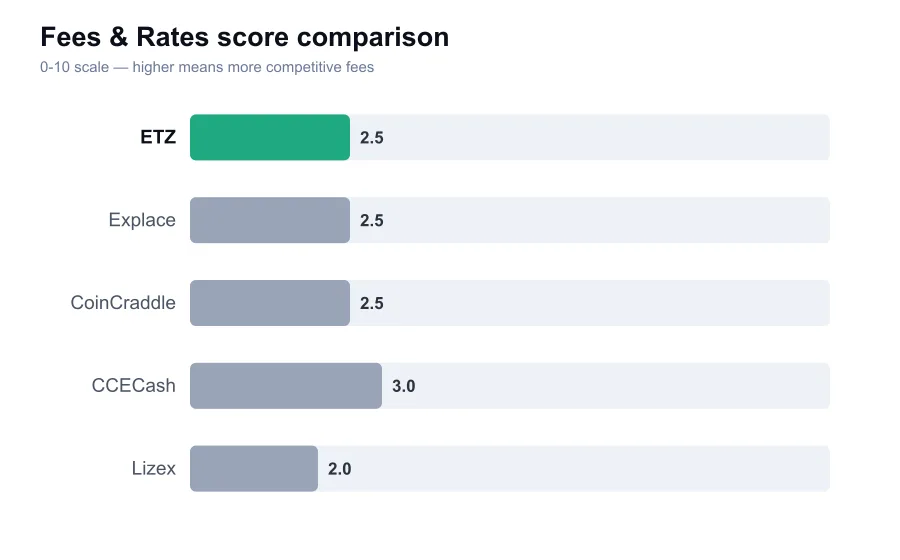
| Fees & Rates | 2.5 | No reliably verifiable public fee schedule |
| Transaction Speed | 3.0 | Settlement performance cannot be independently confirmed |
| Security & KYC Policy | 2.0 | Limited verifiable security and KYC disclosure |
| Reputation & Track Record | 1.5 | Insufficient independently traceable operating record |
| Customer Support | 2.0 | No dependable evidence of accountable support |
| Fact | Value | Source |
|---|---|---|
| Public operator verification | Could not be reliably established | - |
| Published fee schedule | Could not be reliably verified | - |
| Independent track record | Insufficient public evidence | - |
| Recommended transfer size | Small test only | - |
| Reputation score | 1.5/10 | - |
| Requirement | tiered |
|---|---|
| Notes | A reliable published policy could not be verified. Users should assume compliance checks and identity requests may occur on a flagged transaction. |
ETZ is one of those names that appears in exchange directories and referral lists more often than it appears in serious independent reporting. That distinction matters. A small exchange can be perfectly legitimate, but a platform asking users to send irreversible crypto needs to make its ownership, operating history, fee model, and security practices easy to verify. ETZ does not have the public footprint I would expect from a provider competing for meaningful user balances.
The first problem is basic identity. I could not reliably establish a single current official service, operating company, regulated entity, or well documented product under the ETZ name that clearly matches a mainstream crypto exchange. The name is short and ambiguous, and that creates real impersonation risk. Search results for short crypto brands are often polluted by unrelated businesses, copied listings, and expired domains.
That does not automatically prove misconduct. It does mean a careful reviewer cannot responsibly treat ETZ as comparable to established instant exchangers or centralized exchanges with public legal pages, named executives, and years of independently traceable operations. In crypto, lack of verifiable information is itself a practical risk factor. If something goes wrong, users need to know who is holding the funds and where a complaint can be directed.
Fees are impossible to score generously where published pricing cannot be independently confirmed. A swap service may advertise a rate that looks attractive, then earn through a spread between its quoted rate and the market rate, network-fee padding, or a changed quote after the deposit arrives. That business model is common and not inherently improper. The issue is whether the provider clearly shows the rate source, its service charge, network fee, and what happens if the deposit arrives late.
With ETZ, I would not send a meaningful amount based solely on a headline rate or a directory claim. Before even considering a test transaction, compare the quoted output against a liquid venue such as Kraken, Coinbase Exchange, Binance, or an established swap service. Check the quote again immediately before payment. If the difference cannot be explained by a visible fee and a normal spread, walk away.
Speed is another area where hard promises are cheap. A true instant exchanger can generate a deposit address, detect a transaction after the necessary blockchain confirmations, and send the payout rapidly if it has inventory and automated risk controls. The practical waiting time still depends on the network, fee paid by the sender, asset liquidity, and whether the order is flagged for review. ETZ provides too little dependable public evidence for me to treat any claimed settlement time as proven.
The security case is weaker than the marketing case because security is demonstrated through disclosure and resilience, not slogans. I could not verify a meaningful record of third-party security audits, a public incident history, a clear custody explanation, or a detailed privacy and anti-money-laundering policy tied to an identifiable operator. That leaves users unable to judge whether funds are held temporarily, how private keys are protected, or whether manual intervention is likely.
KYC is especially important with obscure swap providers. A site may advertise an account-free exchange, then request identity documents after receiving a deposit. Risk checks are common throughout the industry, particularly for sanctions screening and blockchain tracing. The responsible approach is to state those conditions before users send funds, explain the document process, and publish a path for resolving a hold. I could not verify that ETZ gives customers that level of clarity.
Reputation should not be confused with a handful of favorable review snippets. A credible track record includes dated discussion across independent communities, consistent user reports over multiple market cycles, visible responses to complaints, and a business identity that can be checked. I was unable to find enough reliable material to establish that kind of record for ETZ. That puts it far below established brands, even if a few individual transactions may have succeeded.
Customer support carries extra weight at a swap service because there is no order book a user can simply cancel against. Once coins reach a deposit address, the user needs an actual person or a well documented automated process to handle delayed confirmations, wrong memo tags, failed payouts, and compliance questions. ETZ does not offer enough independently verified evidence of responsive, accountable support for me to score it well.
A prospective user should also be alert to domain-level risks. Do not rely on links from Telegram, direct messages, paid ads, or lookalike social accounts. Type a verified domain yourself after checking multiple reputable references. A short brand name makes phishing much easier, because an attacker can register a visually similar address and claim to be the same exchange.
If you still intend to test ETZ, make the test genuinely small, use an asset with a cheap and well understood network, and preserve screenshots of the quote, address, transaction hash, and all correspondence. Do not split a large balance into several transfers in the hope that this reduces risk. It often makes a dispute harder to reconstruct, especially if each transfer generates a separate order.
There are better choices for users who need transparency. Centralized exchanges such as Kraken are more appropriate for people comfortable with account verification and wanting clearer controls. Established noncustodial swap providers may fit users who need a simpler exchange flow, though each still deserves rate comparison and careful attention to its compliance policy. ETZ has not earned the benefit of the doubt that those services gained through a public record.
My view is blunt. ETZ may represent a functioning service, but the available verifiable information is too thin to recommend it for ordinary users, and certainly not for large transfers. Its biggest problem is not a single documented failure. It is the absence of the evidence a customer needs before taking counterparty risk. Until ETZ can be tied to a clear operator, transparent terms, and a substantial independent history, I would treat it as a high-caution option and choose a better documented provider instead.
| Pros | Cons |
|---|
ETZ is not a sensible first choice for beginners, businesses, or anyone moving meaningful value. At most, experienced users who can independently verify the live domain might consider a very small test. Users needing predictable support, documented compliance rules, or strong public accountability should use an established exchange instead.
I could not establish a sufficiently clear public operator, official service identity, or long independent operating record for ETZ. Its reputation score is 1.5 out of 10 for that reason.
No. The review found too little verifiable information about custody, support, pricing, and dispute handling. If you test it at all, keep the amount small enough to lose.
Do not assume so. Compare its final quoted output with a liquid exchange and check for spread, network charges, and changed-rate terms before sending funds.
A dependable KYC policy could not be verified. Users should assume a transaction can be reviewed or held for compliance checks until ETZ publishes clear terms.
Short names are easier to imitate through typo domains, fake social profiles, and paid-ad links. Verify the exact website through more than one trusted source.
Save the quote, deposit address, order identifier, transaction hash, timestamps, and support messages. Those records are essential if a payout is delayed or disputed.
| Alternative | Score |
|---|---|
| Explace Review | 2.4/10 |
| Mindswap Review | 2.6/10 |
| CoinCraddle Review | 1.9/10 |
| CCECash Review | 2.7/10 |
| Lizex Review | 1.8/10 |
| CryptoVortex Review | 2.8/10 |