Editorial independence: our scores and rankings are produced using the fixed criteria above and are not influenced by advertisers. This is an independent ranking site and is not operated by, or affiliated with, any provider we list.
Affiliate disclosure: some links on this page may earn us a commission at no extra cost to you. This does not affect our rankings.
| Best for | Not for |
|---|
Mindswap was a wallet-connected DeFi project associated with Polygon token swaps and yield features. It is separate from Minswap on Cardano. Because current activity and maintenance are not dependable, it should be approached as a legacy protocol rather than a recommended exchange.
| Criterion | Score | Note |
|---|---|---|
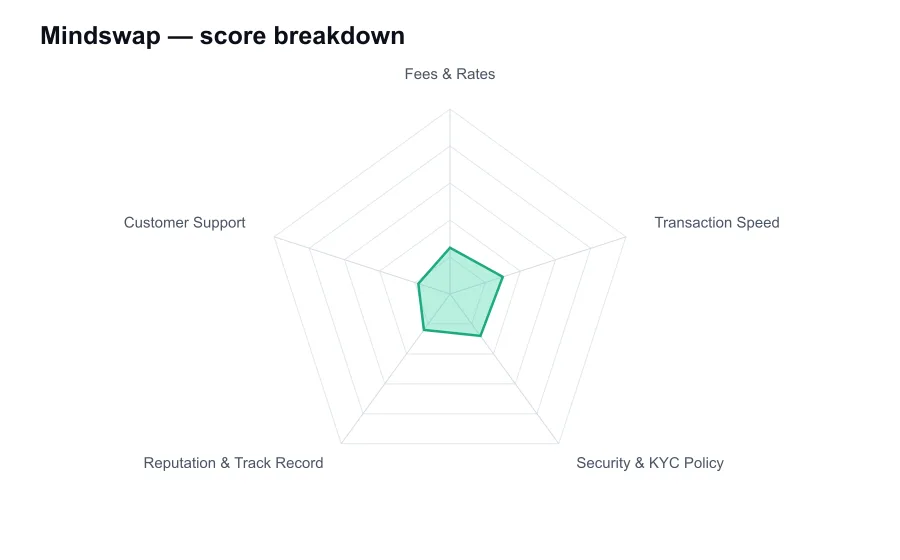
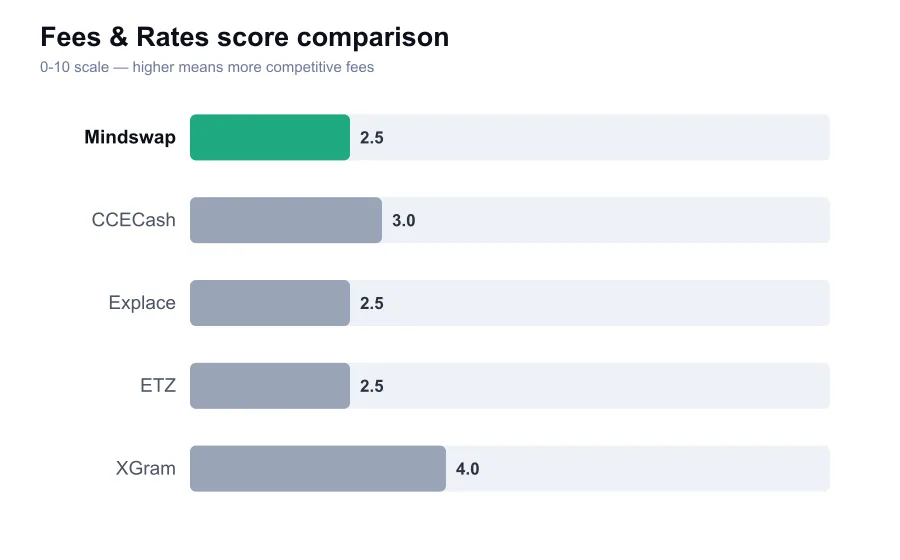
| Fees & Rates | 2.5 | No dependable current fee and liquidity picture |
| Transaction Speed | 3.0 | Polygon is fast, but current protocol usability is unclear |
| Security & KYC Policy | 2.8 | Legacy-project risk and irreversible wallet transactions |
| Reputation & Track Record | 2.4 | Limited evidence of a sustained current operating record |
| Customer Support | 1.8 | Do not rely on unofficial groups for legacy-project support |
| Requirement | none |
|---|---|
| Notes | The wallet-based DeFi model did not use conventional account KYC. This does not create a recovery process or remove smart-contract risk. |
| Notable Coins | MIND, MATIC |
|---|---|
| Networks | Polygon |
Mindswap was a decentralized finance project associated with token swapping and yield products, primarily in the Polygon ecosystem. It should not be confused with Minswap, the active Cardano decentralized exchange with a very similar name. That distinction is important because the two projects have different chains, communities, products, and operational histories. A reader looking for Cardano trading should go to Minswap, not assume that Mindswap is a spelling variation.
The original Mindswap proposition was familiar to anyone who used DeFi in 2021. Users connected a browser wallet, swapped supported tokens through smart contracts, and could access liquidity or yield-oriented products. It aimed to reduce dependence on centralized exchanges by keeping assets in the user's wallet until a contract interaction occurred. That is an attractive model in principle, but the safety and usability of any DEX depend far more on its current contracts, liquidity, and development activity than on the slogan of decentralization.
Mindswap's present status is the key problem. The project has not maintained the kind of sustained public activity, liquidity depth, and accessible product documentation expected from a dependable current exchange. In crypto, dormant interfaces and abandoned social channels are not harmless cosmetic issues. They can mean an old frontend, unsupported wallet connections, thin pools, stale token approvals, or a token that has effectively lost its market function.
For that reason, I would not score Mindswap as a normal active DEX competing with Uniswap, QuickSwap, Sushi, or the current Minswap protocol. It belongs more in the category of legacy DeFi projects that require careful verification before any interaction. If you encounter a site, app, or token using the Mindswap name, verify the contract addresses through independent chain explorers and authoritative project records. Search ads and copied social accounts are particularly dangerous around inactive brands.
The fee picture is difficult to judge responsibly because reliable current fee schedules and active pools are not readily established. A DEX can advertise a low swap fee while costing users far more through price impact, failed transactions, or a wide gap between displayed and executable value. Thin liquidity is a harsher cost than a visible 0.3 percent pool fee. It can turn a small trade into an awful one and make a larger trade effectively impossible.
Polygon itself can offer fast confirmations and inexpensive transactions compared with Ethereum mainnet. That technical advantage does not make an inactive protocol fast in a meaningful user sense. A swap transaction can confirm quickly while delivering poor execution, or a frontend can fail before it reaches the chain. Network speed is useful only after you establish that the contract, route, and liquidity pool are active and safe.
The security model also demands more from the user than an instant exchanger or centralized exchange. DeFi users must protect their wallet seed phrase, inspect token approvals, distinguish a real contract from a copy, and understand that a signed transaction is usually irreversible. If the project is no longer actively maintained, there is less confidence that vulnerabilities, misleading interfaces, or integration failures will be noticed and addressed.
Mindswap did not provide the conventional KYC flow of a centralized exchange because wallet-based DeFi protocols generally do not ask users for identity documents. That is a privacy advantage, but it is not a consumer-protection program. No KYC also means no account recovery desk, no chargeback process, and no human who can reverse a mistaken transfer. The relevant question is whether the contract is still trustworthy, not whether the signup form is absent.
Reputation is where Mindswap falls furthest behind current DeFi venues. A project can launch with promising tokenomics, farming incentives, and social attention, then fade after liquidity incentives end. That pattern was common during the DeFi boom. Durable protocols build long-term liquidity, transparent governance, recurring audits, active developer communications, and a user base that remains after rewards decline. Mindswap has not demonstrated that kind of continuing track record.
Support is also a serious concern. A current DEX should have documentation that matches the deployed product, visible developer channels, and a way for users to report a genuine contract or interface issue. With a legacy project, the real danger is that users mistake an unofficial Telegram group for support. Anyone asking for a seed phrase, remote device access, or an upfront recovery payment is trying to steal from you.
There is a narrow reason researchers may still care about Mindswap. It is a case study in an earlier Polygon DeFi cycle, and holders may need to identify historical contracts or understand an old wallet interaction. That is very different from recommending it for new deposits. Historical relevance does not make an old protocol a suitable place to trade today.
If you hold an old MIND token or see a Mindswap token in a wallet, do not immediately approve a migration link or connect to a random site promising recovery. First identify the exact chain and contract through a block explorer, check whether there is meaningful verified liquidity, and use a separate wallet for investigation. A token balance can be real on-chain while still being economically worthless or unsafe to trade.
For practical Polygon swaps, established alternatives with active liquidity and current documentation are the obvious choice. For users seeking a Cardano DEX, Minswap is the distinct project they probably mean. For beginners, a regulated centralized exchange may be safer because it provides account controls, support, and clearer execution records, even though it introduces custody and identity requirements.
My judgment is blunt: Mindswap is not a provider I would recommend for fresh funds. The absence of a credible current operating record matters more than any historical DeFi feature list. It may remain relevant for forensic checks on old transactions, but that is not the same as being a usable exchange. Treat the name with caution, verify every contract independently, and choose an actively maintained venue for any real trade.
| Pros | Cons |
|---|
Mindswap is only relevant to experienced users researching historical Polygon transactions or identifying an old MIND token position. It is not suitable for beginners, active traders, or anyone looking for a current DEX. Use active protocols such as Uniswap or QuickSwap for Polygon trading, and use Minswap if you meant the Cardano exchange. Do not send fresh funds merely because an old Mindswap interface appears online.
No. Mindswap and Minswap are distinct projects. Minswap is the Cardano DEX, while Mindswap was associated with earlier DeFi activity in the Polygon ecosystem.
No. There is not a dependable current record of active product maintenance, deep liquidity, and support that would justify sending fresh funds.
Its wallet-based DeFi model did not use conventional identity verification. That does not provide account recovery or protection from irreversible wallet mistakes.
Verify the exact token contract on the relevant chain explorer before interacting with it. Do not approve a migration or recovery site without independent verification.
Polygon can confirm transactions quickly, but speed does not verify a contract, guarantee liquidity, or protect against a malicious approval.
Usually no. Smart-contract and wallet transactions are generally irreversible, and unofficial groups offering recovery commonly target victims.
| Alternative | Score |
|---|---|
| CCECash Review | 2.7/10 |
| CryptoVortex Review | 2.8/10 |
| Explace Review | 2.4/10 |
| CoinDrop Review | 2.9/10 |
| ETZ Review | 2.3/10 |
| XGram Review | 3.2/10 |