
Editorial independence: our scores and rankings are produced using the fixed criteria above and are not influenced by advertisers. This is an independent ranking site and is not operated by, or affiliated with, any provider we list.
Affiliate disclosure: some links on this page may earn us a commission at no extra cost to you. This does not affect our rankings.
| Best for | Not for |
|---|
Allswap is a crypto swap-oriented service with a limited public profile compared with major DEX aggregators and established exchanges. It should be treated as a higher-risk option until a user independently verifies its fees, transaction model, contracts and support process.
| Criterion | Score | Note |
|---|---|---|
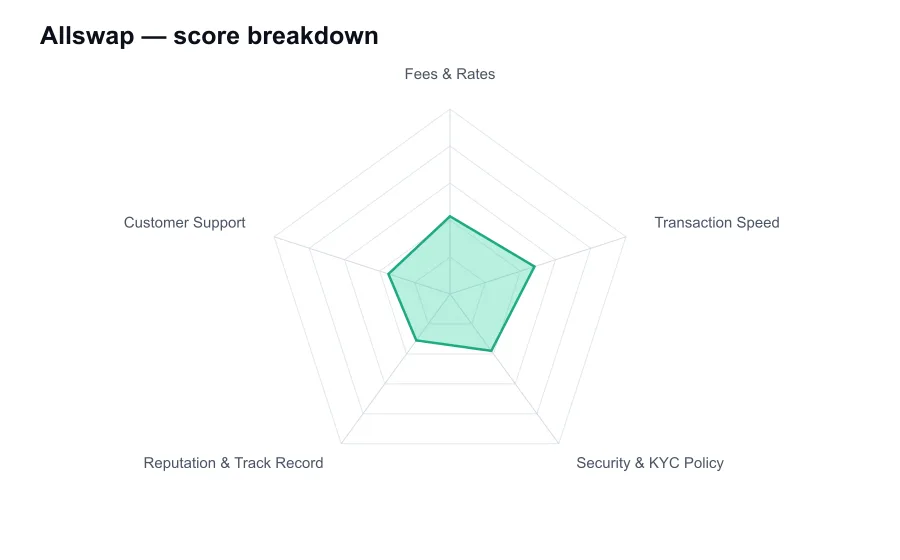
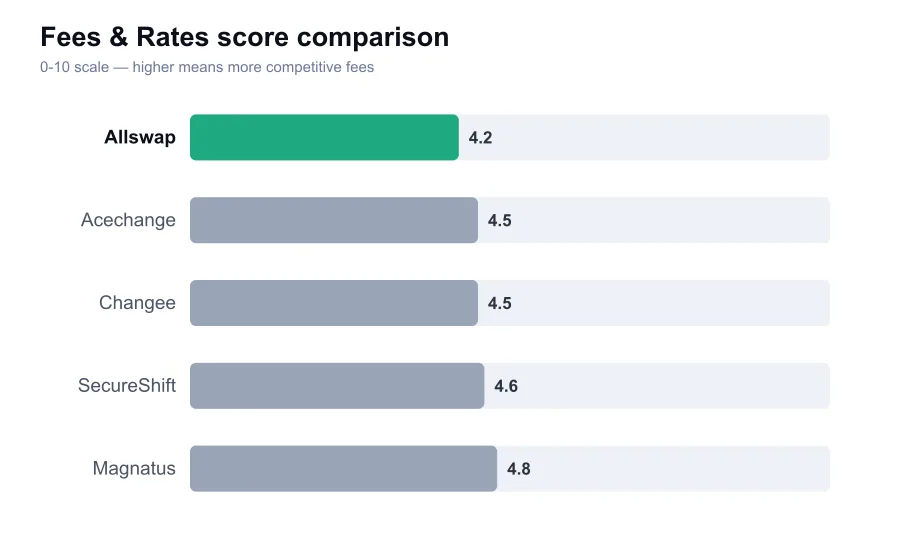
| Fees & Rates | 4.2 | Fee and route transparency is too limited for confidence. |
| Transaction Speed | 4.8 | Settlement claims are hard to verify independently. |
| Security & KYC Policy | 3.8 | Insufficient public assurance for meaningful balances. |
| Reputation & Track Record | 3.1 | Very limited widely documented operating track record. |
| Customer Support | 3.5 | Support visibility and escalation information are limited. |
| Fact | Value | Source |
|---|---|---|
| Service type | Crypto swap service | - |
| Public track record | Limited independently documented history | - |
| Recommended use | Small test transactions only | - |
| Key risk | Low transparency around operations | - |
| Large transfers | Not recommended | - |
| Requirement | optional |
|---|---|
| Notes | Do not assume a no-KYC claim is unconditional. Crypto swap services may apply compliance checks or request information in specific circumstances. |
Allswap is a far more obscure name than the major decentralized exchange aggregators and cross-chain swap platforms. That lack of visibility matters. In crypto, a service can present a clean swap widget and still give users little basis for judging the team, smart contracts, liquidity sources, business continuity, or customer recourse. Allswap appears to position itself around token swapping rather than operating as a mainstream regulated exchange, but its public footprint is thin enough that I would approach it as an unproven venue.
That is not a claim that every lesser-known protocol is unsafe. Small projects sometimes ship useful tools before they gain broad recognition. The problem is that users need evidence, not optimism. With Allswap, it is difficult to find the depth of public documentation, independent analysis, long-running liquidity data, and transparent governance that would justify assigning the same confidence one might give 1inch, Uniswap, CoW Swap, or established bridges.
The first issue is pricing transparency. A swap service can charge fees through a displayed service charge, spread, route selection, referral arrangement, or the difference between a quoted rate and the actual market rate. Unless Allswap shows the exact fee, estimated network fee, slippage setting, and expected output before confirmation, users cannot make a sound cost comparison. A cheap-looking headline rate is not enough.
This matters most for retail users, who are often drawn to a quick-swap interface precisely because it avoids the complexity of DEX routing. Convenience can be worthwhile, but a simple screen should not remove your ability to inspect execution. A reliable service should make clear whether it is using fixed or floating rates, whether it takes custody during the transaction, and what happens if a route cannot settle. If those answers are vague, the platform has not earned a large transaction.
Allswap's fee score is therefore low, not because I can demonstrate an unusually high published percentage, but because verifiable fee disclosure and route-level transparency are weaker than they should be. That distinction is important. Unknown is not the same as expensive. Unknown is still a risk, especially when alternative providers publish quotes, liquidity sources, and transaction information much more clearly.
Speed is similarly difficult to rate generously. Any swap provider can claim quick execution, but actual completion time depends on block confirmations, the asset pair, external liquidity, wallet approval, and any intermediary process. A non-custodial on-chain swap can settle as quickly as its underlying network. A routed exchange service may take longer. Without a strong public record of completed volume and independently visible transaction performance, I would not rely on Allswap for time-sensitive trades.
Security is the central concern. A provider handling crypto swaps must explain whether user funds remain in a wallet until a smart contract transaction, whether coins are sent to a deposit address, whether contracts have been audited, and who can upgrade or pause those contracts. These are not niche technical questions. They determine whether a user faces wallet-level smart contract risk, counterparty risk, or both.
I have not found enough well-established public evidence to treat Allswap as a high-confidence security choice. That does not prove wrongdoing. It means the burden of proof remains unmet. A project seeking deposits or token approvals should provide easily accessible audit reports, contract addresses, clear terms, incident information, and a documented support path. If a prospective user cannot independently verify those basics, they should choose a better-documented service.
The same skepticism applies to KYC and privacy claims. Some crypto swap providers advertise no-account or no-KYC transactions while reserving the right to request information, delay a payout, or apply compliance screening in specific circumstances. Users should never infer an unconditional privacy guarantee from a simple interface. If Allswap uses third-party liquidity or compliance tools, its effective policy can be more complicated than a slogan suggests.
Reputation is where Allswap falls furthest behind. A credible track record is built through years of reliable operation, public technical material, visible user communities, transparent handling of problems, and references from independent researchers. Allswap does not have the widely documented history of established DeFi protocols. It also lacks the brand accountability of larger centralized exchanges, for better and worse.
Customer support is unlikely to compensate for that gap. With a small or poorly documented provider, the usual support experience is limited to a contact form, email, or social channel. That can work for a straightforward question. It is not enough reassurance if a transaction is stuck, a token was sent on the wrong network, or a payout requires manual review. Non-custodial services have practical limits, but good providers still publish clear escalation and status procedures.
The sensible way to assess Allswap is to test, not trust. If you are determined to try it, use a wallet containing only the amount needed, select a liquid major asset, send the smallest practical test transaction, and verify the actual received amount. Do not grant unlimited approvals if a limited approval is available. Do not send funds from an exchange withdrawal until you have checked the destination chain and contract details.
There are better alternatives for most users. For on-chain swaps, 1inch, Matcha, CoW Swap, Uniswap, and PancakeSwap offer substantially more public information, depending on the chain. For cross-chain movement, established bridge aggregators and bridge protocols provide clearer routing and documentation. That does not mean those alternatives are risk-free. It means they are easier to inspect and have a more meaningful public record.
My verdict on Allswap is blunt: it has not earned trust commensurate with handling significant funds. It may be usable for an experimental micro-transaction by someone capable of verifying the exact contracts and flow independently. It is not a platform I would recommend to newcomers, nor would I route a meaningful portfolio transfer through it. In crypto, obscurity is not automatically disqualifying. Poor verifiability is.
| Pros | Cons |
|---|
Allswap is only suitable for technically confident users testing a very small amount after independently checking the actual transaction flow. It is not a sensible first exchange service for newcomers. Anyone moving substantial funds, seeking audited infrastructure, or needing dependable support should use a better-established DEX aggregator, bridge, or regulated exchange instead.
No. Allswap does not have the broad public profile, independently documented volume history or established reputation associated with major exchanges and leading DEX aggregators.
No. Its public security, fee and operational information is too limited to justify routing a significant balance through the service.
You should only proceed if you can locate official contract addresses and credible audit material yourself. Do not rely on unverified social posts or search advertisements.
Use a fresh or low-balance wallet, trade a liquid major asset, approve only the required amount where possible, and start with the smallest practical transaction.
No. Compare the final quoted amount, network cost and price impact against 1inch, Matcha or a direct DEX before confirming.
Usually no. Blockchain transfers are generally irreversible, particularly if assets are sent to the wrong chain or an incorrect address.
| Alternative | Score |
|---|---|
| Transfer24 Review | 4.1/10 |
| Acechange Review | 4.2/10 |
| 1WM Review | 3.8/10 |
| Changee Review | 3.8/10 |
| SecureShift Review | 4.3/10 |
| WxMoney Review | 3.7/10 |