
Editorial independence: our scores and rankings are produced using the fixed criteria above and are not influenced by advertisers. This is an independent ranking site and is not operated by, or affiliated with, any provider we list.
Affiliate disclosure: some links on this page may earn us a commission at no extra cost to you. This does not affect our rankings.
| Best for | Not for |
|---|
SecureShift is an instant cryptocurrency conversion service. It is designed for users who want to swap one digital asset for another by sending funds from a wallet and receiving the result in a wallet. It does not appear to be a full trading exchange.
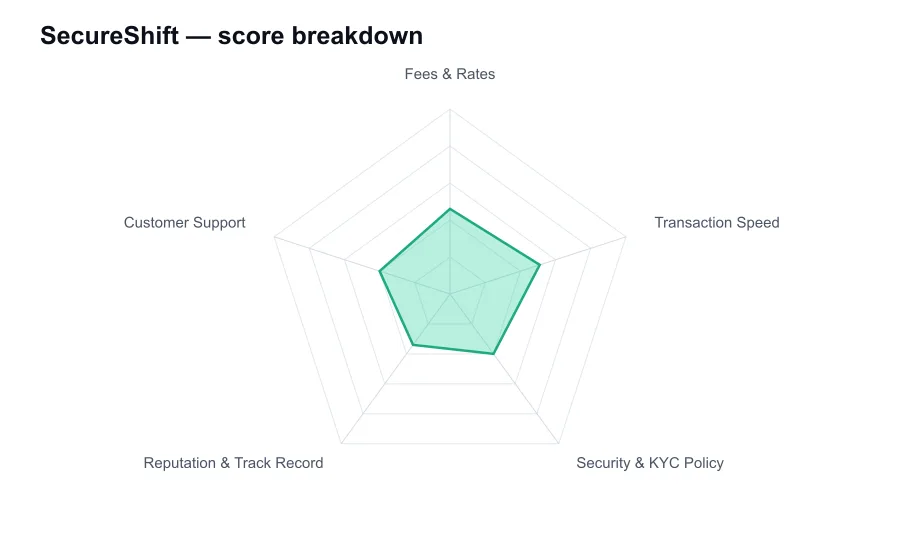
| Criterion | Score | Note |
|---|---|---|
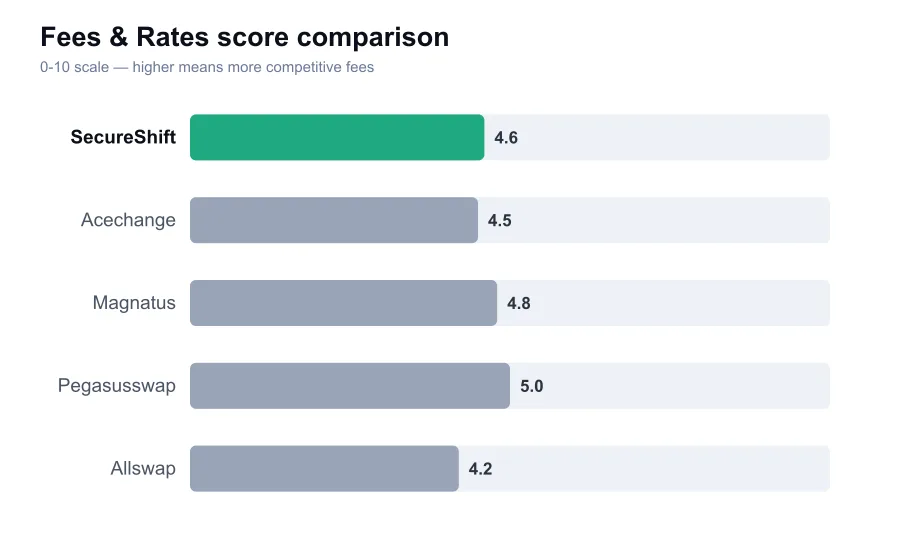
| Fees & Rates | 4.6 | Quote-based spread is harder to assess than a fee table |
| Transaction Speed | 5.1 | Normal swaps depend on confirmations and provider routing |
| Security & KYC Policy | 4.0 | No long-term balance helps, disclosure remains limited |
| Reputation & Track Record | 3.4 | Insufficient independently visible operating history |
| Customer Support | 4.0 | Verify responsiveness with a specific pre-sale question |
| Fact | Value | Source |
|---|---|---|
| Service model | Instant cryptocurrency swaps | - |
| Settlement method | Deposit then payout to external wallet | - |
| Fee visibility | Quote-based, no verified fee table | - |
| Standing balance | Not the core product model | - |
| Public operating record | Limited independently verifiable detail | - |
| Requirement | tiered |
|---|---|
| Notes | Treat KYC as possible on a transaction basis. A low-friction initial flow does not prevent an order from being screened or paused for documents. |
SecureShift is positioned in the instant crypto swap category, a part of the market that sells speed, low friction, and a simpler alternative to opening a full exchange account. The broad idea is sound. A user chooses an asset pair, sends crypto, and receives a different asset in a personal wallet. For a straightforward conversion, that can be more convenient than depositing, trading, and withdrawing from a centralized exchange. The question is whether SecureShift has done enough to earn trust beyond that basic promise.
My answer is that it remains difficult to verify. SecureShift does not have the visible public operating record of larger instant exchange providers, and it is far from the disclosure standard of major regulated exchanges. There is limited independent material on its ownership, security processes, liquidity arrangements, dispute history, or customer outcomes. A lack of headlines is not the same as a clean bill of health. It can simply mean there is not enough public evidence to make a confident judgement.
That matters more here than it would for a simple software product. In an instant swap, the provider receives the customer's funds before sending the output asset. The customer may only face that exposure for minutes or hours, but it is real. If the transaction proceeds normally, the service feels effortless. If it does not, the user depends on the operator's ability and willingness to investigate, communicate, and release funds. This is why a polished website should never substitute for a documented reputation.
SecureShift's pricing should be treated as quote-based rather than assumed to be cheap. Instant exchangers commonly show the expected amount received instead of breaking out a straightforward service fee. The gap between a reference market rate and the quote can include spread, liquidity-provider compensation, network fees, and volatility protection. SecureShift does not provide enough easily verifiable public fee detail for a high fee-transparency rating. The right metric is always the final amount that reaches your wallet.
That is especially important with stablecoin pairs and large transactions. A user may see USDT, USDC, or another familiar asset and assume the conversion is close to one-to-one. It may not be, once chain choice and provider spread are included. Check at least two or three quotes at the same time, then include the cost of moving the result onward if that is part of your plan. A conventional exchange can be cheaper for planned, sizeable conversions even after withdrawal fees.
Speed is often a genuine advantage of the model, but it needs to be described honestly. SecureShift cannot control block production, the confirmation threshold of an incoming transfer, chain congestion, or downtime at an external liquidity source. A fast chain can make a routine swap feel nearly immediate. A congested network or an asset in wallet maintenance can make it much slower. I would not rely on SecureShift for a time-critical payment unless I had already tested the exact pair and network successfully.
What I want from a swap provider is a transparent status process. It should distinguish between waiting for a deposit, waiting for confirmations, exchanging, and broadcasting the payout. It should also provide a transaction reference that support can use. SecureShift may offer a basic transaction flow, but I could not establish a broad public record showing how consistently it resolves delayed or unusual orders. That leaves its speed score around average rather than strong.
The name SecureShift naturally invites a higher security expectation, but names are not evidence. Security should be measured through verifiable controls and operational behavior: clear legal identity, secure infrastructure disclosures where appropriate, sensible handling of suspicious activity, responsive incident communication, and an established record. I could not verify sufficient public detail in those areas. The fact that users may not leave a persistent account balance on the service is helpful, but it does not eliminate the counterparty risk of the swap itself.
A customer also needs to understand the difference between self-custody before and after a swap, and custody during it. Your wallet controls the sending asset before you transfer it. Once sent to the generated address, the provider controls the process until it delivers the payout. If SecureShift or a connected liquidity source pauses the transaction, the customer does not have the same unilateral control they would have in a decentralized on-chain swap. That is the essential risk trade-off.
KYC is another area where assumptions can hurt users. Registration-light instant exchange services may still use transaction monitoring. SecureShift should be treated as capable of applying a compliance check, requesting documentation, or pausing an order if it flags the transfer. That is not unusual for the category. It becomes problematic only when the policy is unclear, the review process is opaque, or support cannot give a realistic timeline. I found too little detailed public evidence to treat its procedure as predictable.
The service's reputation score is therefore low, even though I have not identified a specific verified failure that would justify calling it closed or fraudulent. Scoring is not a reward for a lack of allegations. It is an assessment of evidence. SecureShift has not accumulated the independently visible record that would allow a reviewer to be confident about its behavior over multiple market cycles. Larger rivals have years of public support discussions, review trails, product documentation, and business information. SecureShift does not offer that same reassurance.
Support is the final practical safeguard. Do not wait until funds are stuck to discover whether the contact channel works. Ask before your first transaction about the precise network for your asset, how a wrong amount is handled, and whether a rate can change after the deposit is confirmed. The quality of that reply will tell you more than a marketing page. If SecureShift cannot answer a simple operational question promptly, it has not earned the right to handle your deposit.
SecureShift could suit a knowledgeable user making a low-value, non-urgent swap after a careful quote comparison. It does not suit an institution, a beginner, or anyone who needs firm settlement expectations. It is also a poor fit for users who cannot accept a possible KYC review after depositing. There are established alternatives with more public scrutiny, and in crypto that scrutiny has real value.
My final take is that SecureShift has a plausible use case but insufficient public proof. The wallet-to-wallet swap model is convenient, and the absence of a long-term exchange balance is a practical benefit. Still, limited fee clarity, sparse security disclosure, and a thin reputation record outweigh that convenience for serious use. Treat it as a provider to test cautiously with a small amount, not a trusted route for funds you cannot afford to have delayed.
| Pros | Cons |
|---|
SecureShift may fit experienced self-custody users who want to test a small, non-urgent crypto swap and can independently verify the destination network. It is not suited to first-time buyers, large conversions, businesses, or urgent payment flows. Users who need transparent policies and a tested support route should choose a larger instant exchanger or established centralized exchange.
SecureShift is presented as an instant crypto swap provider. Users select an asset pair, send a deposit to a generated address, and receive the selected payout asset in a wallet.
A broadly verifiable public percentage fee table is not established. The useful comparison is the exact amount received in SecureShift's quote versus other providers.
That possibility should be assumed. Instant exchanges can apply transaction monitoring and may request KYC or source-of-funds material after a deposit is sent.
A small test exposes you to less risk while you verify quote quality, network handling, status tracking, payout timing, and support responsiveness.
Confirm the asset ticker, blockchain network, receiving address, any required memo or tag, and the final quoted payout. A correct ticker on the wrong network can still cause loss.
No provider in this category can guarantee a universal settlement time because confirmations, congestion, liquidity, and possible reviews can delay the payout.
| Alternative | Score |
|---|---|
| Acechange Review | 4.2/10 |
| Magnatus Review | 4.4/10 |
| Transfer24 Review | 4.1/10 |
| Pegasusswap Review | 4.6/10 |
| Allswap Review | 4.0/10 |
| Mine Review | 4.7/10 |