Editorial independence: our scores and rankings are produced using the fixed criteria above and are not influenced by advertisers. This is an independent ranking site and is not operated by, or affiliated with, any provider we list.
Affiliate disclosure: some links on this page may earn us a commission at no extra cost to you. This does not affect our rankings.
| Best for | Not for |
|---|
Mine is an instant cryptocurrency swap provider. Rather than maintaining a conventional trading account, a customer chooses a pair, sends crypto to a generated address, and receives the exchanged asset. Its public operating detail is limited compared with major swap services.
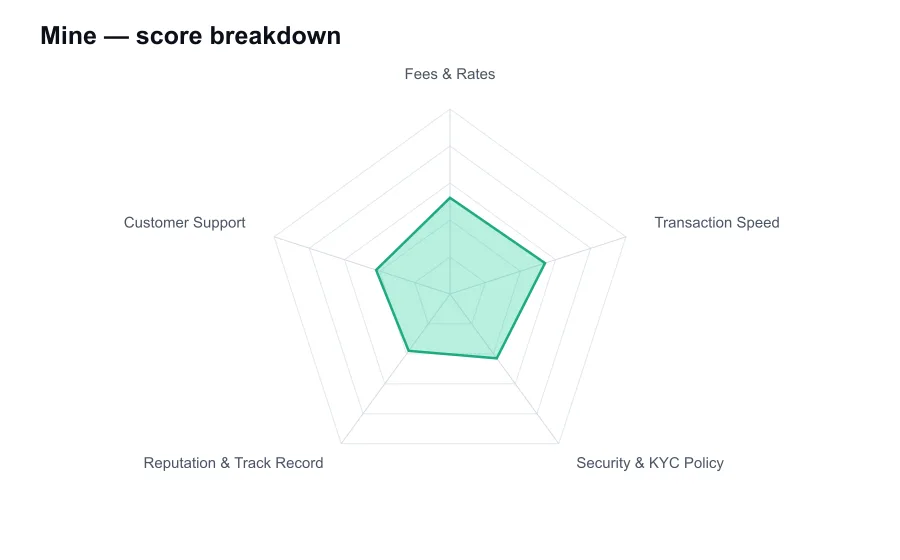
| Criterion | Score | Note |
|---|---|---|
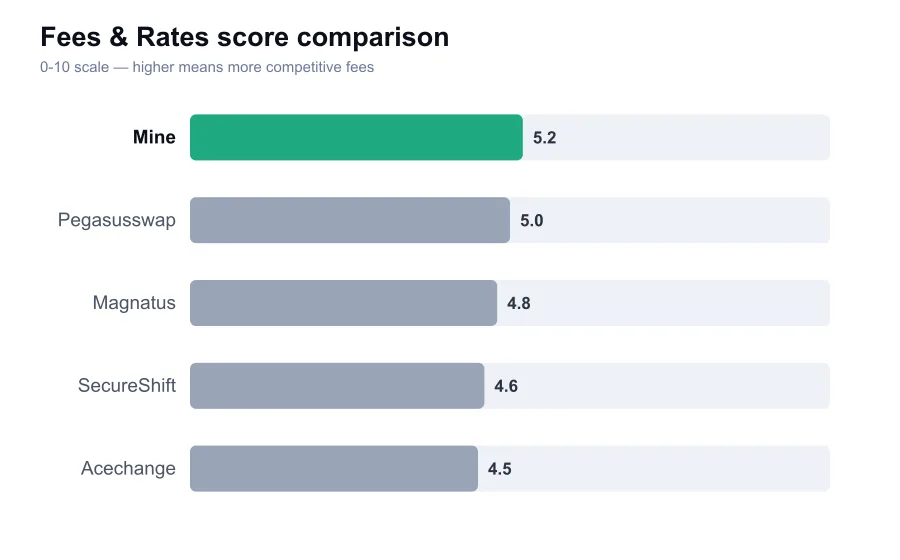
| Fees & Rates | 5.2 | Quote-based pricing lacks a clear public fee schedule |
| Transaction Speed | 5.4 | Completion depends on network confirmations and liquidity |
| Security & KYC Policy | 4.3 | Limited public detail on controls and review procedures |
| Reputation & Track Record | 3.8 | Small independently verifiable public track record |
| Customer Support | 4.2 | Test support before committing funds |
| Fact | Value | Source |
|---|---|---|
| Service model | Instant cryptocurrency swaps | - |
| User flow | Send asset, receive converted asset | - |
| Fee disclosure | Quote-based, no verified public fee table | - |
| Public track record | Limited independently verifiable history | - |
| KYC position | Possible transaction-based review | - |
| Requirement | tiered |
|---|---|
| Notes | No-account swap flows do not rule out KYC. A transaction can be reviewed and documents may be requested under compliance procedures. |
Mine presents itself as an instant crypto exchange rather than a full custodial trading venue. That distinction matters. You are not opening an account to keep a portfolio on the platform, placing limit orders, or accessing a deep order book. The intended flow is simpler: select an asset pair, send one coin, and receive another. It sits in the same broad category as ChangeNOW, SimpleSwap, and SwapSpace, though Mine has a far smaller public footprint than any of those established names.
The attraction of this kind of service is obvious. A user who wants to turn BTC into ETH, or exchange a stablecoin without creating a conventional exchange account, may prefer a direct swap page over a multi-step spot trade. Mine's appeal depends heavily on that convenience. It is not a product for someone who needs sophisticated execution, recurring purchases, margin, derivatives, or a transparent institutional-grade trading interface.
The first difficulty is transparency. Mine does not have the volume of independently documented company information, public reporting, fee schedules, leadership material, and widely discussed user history that I would expect from a mature exchange business. That does not prove the service is fraudulent or unsafe. It does mean a customer has to make a decision with less evidence than they would have at a better-known competitor. In crypto, that is a material drawback, not a minor branding issue.
Pricing is particularly hard to assess before a transaction. Instant exchangers commonly embed their service margin in the quoted conversion rate instead of charging a plainly displayed trading fee. Mine appears to follow the broad industry model of presenting an output estimate rather than a simple maker and taker table. The practical question is not whether a page says there is no fee. It is how the final quote compares with the market price, network cost, and quotes available elsewhere at the same moment.
That can make Mine acceptable for a small, urgent conversion, but it is not where I would start with a large order. A percentage difference that looks modest on a $100 swap can become expensive on a five-figure transaction. Before sending funds, I would open at least two comparison tabs and check the exact amount received, not just the advertised exchange rate. ChangeNOW, Exolix, and SimpleSwap often make it easier to compare fixed and floating-rate options. Mine needs to compete on the actual destination amount, because it does not have enough public trust capital to command a premium.
Speed is also quote-dependent. A swap can be quick after the incoming transaction gets the confirmations required by the relevant network, but no instant exchanger can control Bitcoin congestion, Ethereum gas conditions, wallet maintenance, or a liquidity provider's delay. Anyone promising a precise universal completion time would be overstating the case. Mine should be judged by whether it provides a transaction identifier, clear status updates, and a useful explanation when a transfer stalls.
For common pairs on fast networks, the experience may be reasonably straightforward. The problem begins when a deposit arrives late, a coin is sent on the wrong network, an amount falls below a provider's practical processing threshold, or the outgoing asset enters maintenance. Those are the moments that reveal whether a swap desk is competently run. Mine has too little independently verifiable public operational history for me to rank it with services that have handled a visible volume of support cases over several market cycles.
The KYC issue deserves a cautious reading. Many instant swap providers market themselves as low-friction or registration-light, yet reserve the right to request identity documents or source-of-funds information if their transaction monitoring flags a transfer. That is common in this segment. It also means that no customer should interpret a lack of account creation as an absolute promise of anonymity. If Mine requests verification after it has received a deposit, the user may face a hold without having understood that possibility in advance.
That policy risk is more important than the usual slogan about privacy. A reasonable compliance process should explain what triggered a review, what documents are needed, how long a case is likely to take, and what options exist if a customer cannot complete verification. I could not find enough durable, detailed public policy material to conclude that Mine handles those cases especially well. A reader who cannot tolerate a potential temporary freeze should use a self-custody route with transparent on-chain execution instead.
Security claims should be treated with the same restraint. Instant exchangers reduce some custodial exposure because users generally do not leave balances sitting in an account, which is a genuine advantage over keeping coins on a small centralized exchange. Still, the user is sending assets to a service-controlled address and trusting it to make the return transfer. That is counterparty risk. The relevant questions are ownership, operating history, security disclosures, reserves, incident handling, and support responsiveness, and Mine offers limited public evidence on those points.
Reputation is where Mine falls furthest behind the better-known instant exchange brands. A smaller profile can be fine for a niche service, but it gives prospective customers fewer independent signals. There are fewer long-running discussions, fewer detailed third-party tests, and less evidence of how the operator behaves during network disruptions or market volatility. I would not confuse a clean search result with an established track record. Sometimes it simply means there has not been enough activity to generate a reliable record.
Customer support therefore carries unusual weight. Before using Mine, I would test the published contact route with a narrow pre-sale question: ask which network is required for a particular token, whether a quote is fixed or floating, and what happens if compliance screening interrupts the order. A useful reply should be specific and timely. A vague response, or silence, is a reason to walk away before funds are involved. Support is not an optional extra for an instant exchanger, it is the only recourse when an automated swap breaks.
Mine may suit a technically competent user making a modest transaction after independently checking the quote and the destination address. It does not suit someone seeking audited security practices, a long public history, highly predictable pricing, or robust account features. There are too many unanswered questions for me to recommend it as a default venue. The service might complete a routine swap perfectly well, but routine success is a low bar in this category.
My view is blunt: Mine belongs in the watch-and-verify tier, not the trusted default tier. Use it only if its live quote clearly beats better-known alternatives and you are comfortable with the possibility of a compliance review or support delay. Keep the first transaction small, preserve screenshots of the quote and transaction details, and never send funds from an unsupported network. Until Mine provides stronger public disclosure and earns a deeper record of independently verifiable customer experience, caution is the sensible position.
| Pros | Cons |
|---|
Mine is best approached by experienced self-custody users making a small one-off swap after comparing its live quote with established alternatives. It may fit users who understand confirmations, token networks, and the risk of a manual review. Beginners, large-ticket users, and anyone who needs documented service standards should use a larger instant exchanger or a regulated exchange instead.
No. Mine appears to operate as an instant-swap service, where a user sends one asset and receives another, rather than as a full spot exchange with an order book.
A simple public maker and taker fee schedule is not clearly established. Compare the final amount you will receive against at least two competing live quotes.
Potentially. Instant exchangers commonly reserve compliance-review rights even when an account is not required. Do not assume a registration-light flow guarantees no KYC request.
Use a small amount first, verify the exact network at both ends, save the quoted output and transaction ID, then confirm the received asset in your own wallet.
Common causes include blockchain confirmations, network congestion, wallet maintenance, liquidity delays, incorrect network selection, or a transaction review.
I would not make it a first choice for a large transfer because its public fee disclosure, company information, and independent operating record are limited.
| Alternative | Score |
|---|---|
| AvanChange Review | 4.8/10 |
| Pegasusswap Review | 4.6/10 |
| ClickPay Review | 4.9/10 |
| Magnatus Review | 4.4/10 |
| SecureShift Review | 4.3/10 |
| Tiendacrypto Review | 5.2/10 |