
Editorial independence: our scores and rankings are produced using the fixed criteria above and are not influenced by advertisers. This is an independent ranking site and is not operated by, or affiliated with, any provider we list.
Affiliate disclosure: some links on this page may earn us a commission at no extra cost to you. This does not affect our rankings.
| Best for | Not for |
|---|
1inch is a decentralized exchange aggregator that searches multiple on-chain liquidity sources to route token swaps. Users connect a self-custody wallet and keep control of assets until they approve a transaction. It also offers Fusion, limit-order and wallet-related tools.
| Criterion | Score | Note |
|---|---|---|
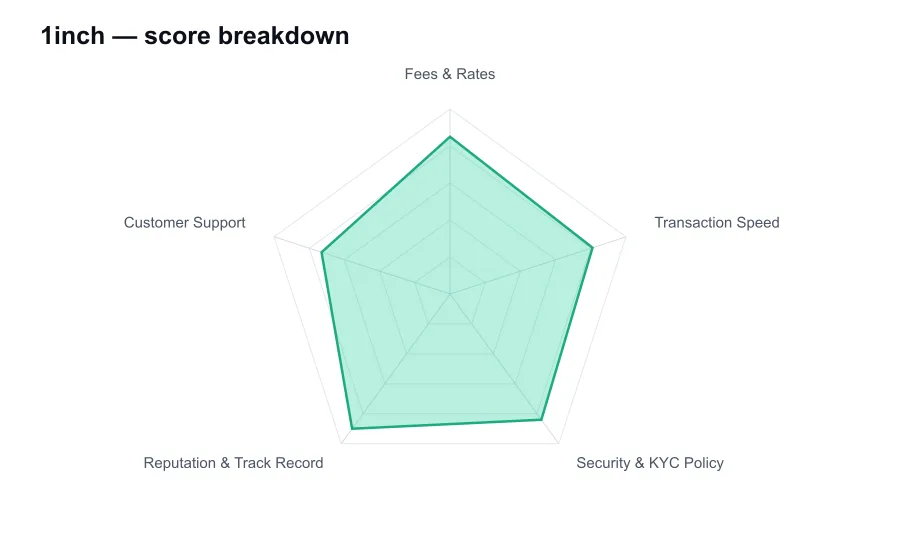
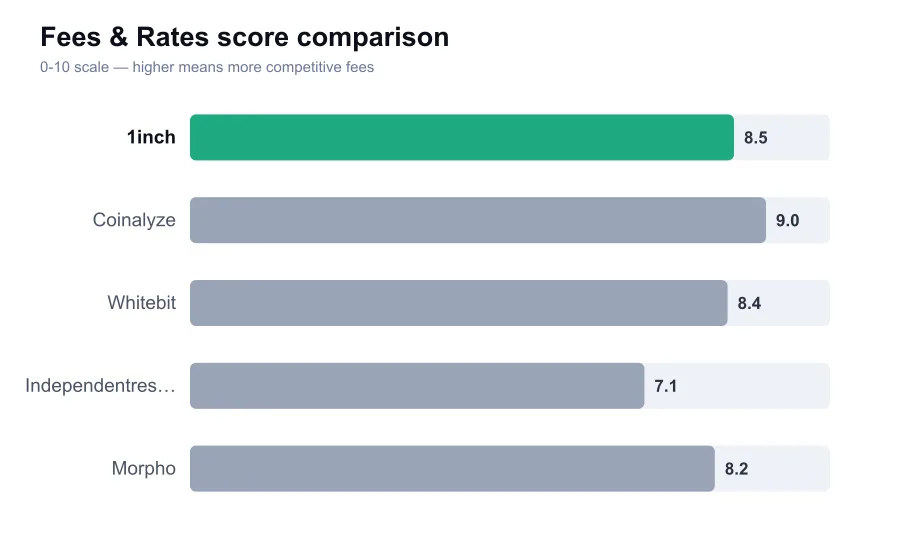
| Fees & Rates | 8.5 | No standard aggregator fee, but gas and pool costs apply. |
| Transaction Speed | 8.1 | Fast on low-cost chains, dependent on network confirmation. |
| Security & KYC Policy | 8.4 | Mature non-custodial protocol with public security work. |
| Reputation & Track Record | 9.0 | Leading DEX aggregator since 2019. |
| Customer Support | 7.3 | Strong documentation, limited by self-custody finality. |
| Requirement | none |
|---|---|
| Notes | Core 1inch DEX use is wallet-based and does not normally require a conventional KYC account. Frontend availability can vary by jurisdiction. |
| Notable Coins | ETH, WETH, USDC, USDT, DAI, WBTC, UNI, 1INCH, LINK, AAVE |
|---|---|
| Networks | Ethereum, Arbitrum, Base, Optimism, Polygon, BNB Chain, Avalanche |
| iOS | Yes |
|---|---|
| Android | Yes |
| Notes | 1inch provides the 1inch Wallet mobile app for iOS and Android. Download only through official store links published by 1inch. |
1inch is one of the most recognizable decentralized exchange aggregators in crypto. Rather than operating a single pool like Uniswap, it searches across supported decentralized exchanges and liquidity sources to find a route for a token swap. In practical terms, it is a price-comparison and routing engine for DeFi, with additional products around limit orders, Fusion swaps, wallet tools, and cross-chain functionality. It is a serious piece of infrastructure, not a simple swap website.
The central appeal is execution quality. A direct swap on one DEX can be convenient, but it may leave better prices elsewhere. 1inch can split an order across multiple pools and platforms, selecting routes that would be tedious to construct manually. On liquid pairs, the savings may be small. On fragmented markets or larger trades, intelligent routing can make a meaningful difference. This is where 1inch has historically earned its reputation.
Its fee model needs context. 1inch generally does not charge a standard platform fee for ordinary aggregation swaps. Users still pay the underlying liquidity-provider fees, price impact, and network gas. Those costs are real, and on Ethereum they can dominate the economics of a smaller trade. Calling a swap free because the aggregator itself has no obvious fee would be misleading.
The interface is better than most at making route details inspectable. It shows expected output, estimated gas, price impact, and the exchanges or pools involved in a route. That helps users compare execution rather than blindly accepting a quote. Still, people should not assume the displayed route is permanently optimal. Markets move between quote and confirmation, and a high gas estimate can erase a slight price advantage over a direct trade.
1inch's Fusion mode is one of its more distinctive features. Fusion lets users submit an order that can be filled by resolvers, with the design aiming to spare the user from directly paying gas for the swap in the familiar way. The economic cost does not vanish. It is reflected in the execution arrangement and resolver competition. For users who dislike keeping native gas tokens ready for every transaction, Fusion can be very convenient. For users who demand immediate certainty, standard swaps may feel more direct.
Speed is good for ordinary on-chain trading, but it is not a centralized exchange. A standard swap settles according to the source chain's block production and confirmation conditions. On networks such as Arbitrum, Base, Polygon, Optimism, or BNB Chain, that often feels quick. Ethereum can be slower and more expensive during busy periods. Fusion orders may also take a variable amount of time because a resolver must accept and execute them.
That difference matters in volatile markets. If you are trying to catch a rapidly moving token, waiting for a favorable Fusion fill may not fit the trade. A normal on-chain swap with an appropriate slippage setting gives more immediate control, although it exposes you to gas and potential MEV concerns. 1inch's tools improve execution mechanics, but they cannot change the fact that public blockchain transactions exist in a competitive and sometimes hostile environment.
Security is a relative strength. 1inch is non-custodial, so users trade from their own wallets instead of depositing funds with the platform. The protocol has a long operating history, public smart contracts, audits, bug bounty activity, and a large technical community. Those are meaningful positives. It has also developed its own wallet and supporting infrastructure, which gives the project more depth than a thin frontend sitting on top of third-party APIs.
But non-custodial does not mean risk-free. The main hazards include signing malicious approvals, visiting a fake site, interacting with a counterfeit token, setting excessive slippage, and using smart contracts that may have undiscovered vulnerabilities. The 1inch brand is frequently impersonated in phishing campaigns because it is so well known. Users should type or bookmark the official domain and never trust an unsolicited support message asking for a seed phrase.
KYC is not normally required to use the core decentralized exchange aggregator from a self-custody wallet. There is no conventional account balance maintained by 1inch for a standard swap. Geographic access can nevertheless be affected by frontend restrictions, third-party infrastructure, or local rules. More importantly, no-KYC access does not make a user invisible. Public blockchain activity remains traceable, and sanctioned-address screening can affect DeFi access across the sector.
1inch has one of the strongest reputations in its category. Founded in 2019, it has operated through bull markets, bear markets, congested Ethereum periods, and the migration toward lower-cost chains. It competes directly with Matcha, Paraswap, Odos, CoW Swap, and native DEX interfaces, yet remains a default comparison point for serious DeFi users. Its token's market performance is less relevant than the protocol's continuing utility, which remains substantial.
Support is good by DeFi standards, though that qualification matters. 1inch provides documentation, help resources, community channels, and technical guidance, but it cannot reverse a signed on-chain transaction or restore a compromised wallet. Users expecting centralized-exchange style account intervention will be disappointed. Users who understand self-custody will find the available materials and transaction visibility more useful than what many smaller DEXs provide.
The mobile wallet improves accessibility, though it also creates another security decision. A mobile wallet can be convenient for day-to-day swaps, portfolio tracking and token approvals. For larger holdings, I still prefer a hardware wallet and a browser wallet configured carefully. Convenience has a habit of winning until the day it creates an expensive mistake.
My assessment is straightforward: 1inch is among the best choices for decentralized token swaps, especially for users who compare prices and understand gas. It is not always the cheapest route, and it is not the right venue for every trade. For a simple stablecoin swap on one chain, a native DEX may be just as good. For multivenue routing, larger on-chain swaps, and users who want a mature aggregator with real technical credibility, 1inch belongs near the top of the list.
| Pros | Cons |
|---|
1inch suits self-custody users who want to compare DEX liquidity without manually checking several exchanges. It is especially useful for larger on-chain swaps, fragmented liquidity and multi-chain DeFi users. Beginners can use it if they understand token approvals and gas, but should begin with small transactions. Users wanting fiat deposits, guaranteed customer intervention, or custodial account recovery should choose a regulated centralized exchange.
1inch generally does not charge a standard fee for ordinary aggregator swaps. Users still pay underlying DEX liquidity fees, price impact and blockchain gas.
Core wallet-based 1inch swaps generally do not require conventional KYC. Users connect a self-custody wallet rather than open a custodial trading account.
Fusion is an order-based swap mode filled by resolvers. It can reduce the need for users to pay gas directly in the standard transaction flow.
Gas estimates, route complexity, changing pool prices and trade size can make a direct pool more efficient for a particular transaction. Compare final output, not labels.
No. 1inch is non-custodial and completed blockchain transactions are generally irreversible. Verify recipient addresses and network selection before signing.
1inch supports multiple networks, including Ethereum, Arbitrum, Base, Optimism, Polygon, BNB Chain and Avalanche, subject to product availability.
No. Fusion depends on resolver execution and may take variable time. A standard swap can be preferable when immediate on-chain execution matters.
| Alternative | Score |
|---|---|
| Coinalyze Review | 8.2/10 |
| Defillama Review | 8.7/10 |
| Whitebit Review | 8.1/10 |
| Independentreserve Review | 7.7/10 |
| Morpho Review | 7.7/10 |
| LetsExchange Review | 7.7/10 |