Editorial independence: our scores and rankings are produced using the fixed criteria above and are not influenced by advertisers. This is an independent ranking site and is not operated by, or affiliated with, any provider we list.
Affiliate disclosure: some links on this page may earn us a commission at no extra cost to you. This does not affect our rankings.
| Best for | Not for |
|---|
LetsExchange is a cryptocurrency exchange service for direct wallet-to-wallet swaps. It sources exchange liquidity for a large range of assets and offers fixed or floating quotes. Standard swaps do not require users to maintain a custodial trading account.
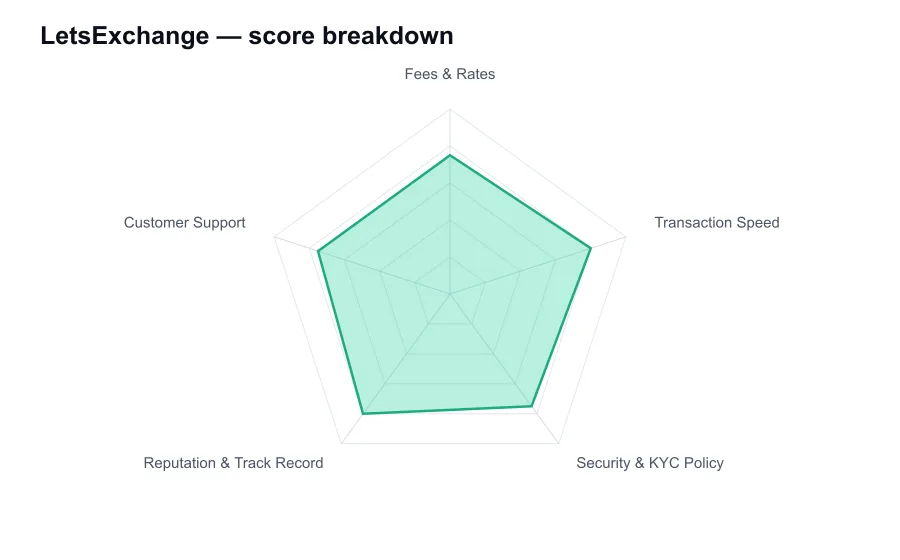
| Criterion | Score | Note |
|---|---|---|
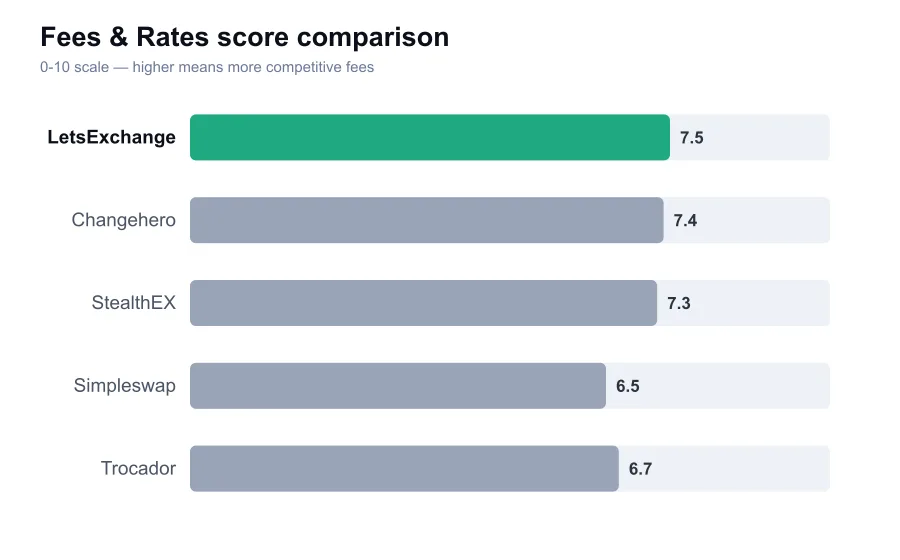
| Fees & Rates | 7.5 | Competitive quotes, but costs are embedded in rates. |
| Transaction Speed | 8.0 | Efficient execution after required confirmations. |
| Security & KYC Policy | 7.5 | No routine KYC, with AML reviews for flagged orders. |
| Reputation & Track Record | 8.0 | One of the more established instant-exchange brands. |
| Customer Support | 7.5 | Order tracking and established support channels. |
| Fact | Value | Source |
|---|---|---|
| Founded | 2020 | Source |
| Service type | Instant cryptocurrency exchange | Source |
| Rate modes | Fixed and floating | Source |
| Account model | No account required for standard swaps | Source |
| Business product | Exchange API | Source |
| Pricing model | Costs included in exchange quote | Source |
| Requirement | optional |
|---|---|
| Notes | Standard exchanges are generally accountless. LetsExchange applies anti-money-laundering controls and can request documents or source information for a flagged transaction. |
| Notable Coins | Bitcoin, Ethereum, Tether, USD Coin, Solana, BNB, Litecoin, Monero, Polygon, Avalanche |
|---|---|
| Networks | Bitcoin, Ethereum, Tron, BNB Smart Chain, Solana, Polygon, Avalanche |
LetsExchange is one of the more substantial names in the instant-exchange category. It is a non-custodial-style swap interface that connects users to liquidity for thousands of cryptocurrency pairs, with fixed and floating exchange options. It is designed for wallet users, not for people looking for leveraged trading or fiat banking.
The distinction matters. LetsExchange does not ask customers to leave a standing balance on a trading account for normal swaps. You select a pair, provide a receiving address, send the deposit, and receive the output. That is cleaner than using a centralized exchange for a one-off conversion, although the service still takes temporary control of the deposited funds while executing the swap.
Its strongest feature is breadth. LetsExchange supports a very large selection of assets and networks, including mainstream coins, stablecoins, and many tokens that are awkward to find on regulated centralized exchanges. For portfolio cleanup, chain migration, or converting a lesser-known token into BTC, ETH, USDT, or USDC, that coverage is genuinely useful.
The rates are offered as floating or fixed. Floating rate can provide the better initial price, but the final result changes with the market and with the execution path. Fixed rate gives a stated output if the deposit arrives within the conditions shown in the order. That choice makes LetsExchange more practical than services offering only an ambiguous live quote.
There is no simple maker and taker fee table because LetsExchange is not an order-book exchange. The spread, partner-liquidity cost, service margin, and network fee are reflected in the quote. That can feel opaque, but the right comparison is still simple. Compare the exact receive amount with competitors for the same input and network.
LetsExchange often performs well on common pairs, but it is not consistently the cheapest source for every route. A pair involving a thin token, a high-fee chain, or an unusual network can produce a noticeably wider spread. That is not unique to LetsExchange. It is a structural feature of instant-exchange services that source liquidity on demand.
Speed is usually good after the deposit confirms. On a fast network, an uncomplicated order can reach the destination wallet quickly. Bitcoin deposits, Ethereum congestion, wallet maintenance, and partner execution can add time. A service cannot bypass the confirmation rules of the blockchain receiving your funds.
One advantage over a smaller swap site is operational maturity. LetsExchange has a long-running public presence, visible partner integrations, and an API product for businesses. That doesn't make every individual order risk-free, but it gives the service more credibility than a fresh domain with no documented product history.
Security requires more realism than marketing copy allows. The service does not normally require KYC before every ordinary swap, which is useful for privacy and speed. Yet it runs anti-money-laundering procedures and can put an order into review. If an address or transaction pattern creates a compliance concern, funds may be held while information is requested.
That is a recurring complaint category across the instant-exchange industry, and users should plan accordingly. Do not send money needed for an immediate bill, do not use questionable source funds, and do not assume that a large order will receive the same automated treatment as a small test transaction. The lack of a user account does not remove counterparty risk.
Support is one of LetsExchange's better areas. Its website provides customer contact options and order tracking, and its established scale means there is a clearer support structure than at many anonymous-looking competitors. Still, support quality is most visible during exceptions, so retain every detail rather than relying on a vague description of the problem.
The platform also deserves credit for making network selection visible, though users remain responsible for getting it right. USDT can exist on several chains, and confusing ERC-20, TRC-20, BNB Smart Chain, or other versions is one of the fastest ways to create a preventable recovery case.
LetsExchange is not a replacement for a regulated exchange if you need recurring fiat purchases, tax reports, margin products, or a formal account relationship. It is better seen as a conversion layer between self-custody wallets. In that role, it is among the stronger mainstream options.
My verdict is favorable, with limits. LetsExchange has better coverage, product maturity, and public standing than most instant exchangers, while its fixed-rate option solves a real problem for users who need certainty. It still deserves the caution applied to any intermediary that receives your crypto mid-swap. Compare the quote, confirm the network, and avoid treating a convenient tool as a zero-risk vault.
| Pros | Cons |
|---|
LetsExchange is a strong fit for self-custody users, token holders consolidating portfolios, and businesses that need an exchange API. It is particularly useful for people who need a fixed quote across a supported wallet-to-wallet route. Traders seeking limit orders, fiat deposits, or robust reporting should choose a centralized exchange, while users moving very large sums may prefer an institution with direct account support.
Routine swaps generally do not require a conventional account KYC process. LetsExchange can request verification or transaction information if compliance screening flags an order.
A fixed-rate order aims to preserve the stated output under its listed conditions. A floating-rate order can change as markets move during confirmations and execution.
It is designed for wallet-to-wallet swaps rather than a standing trading balance. It does temporarily receive funds while executing an exchange.
USDT exists on multiple networks, including Ethereum and Tron. You must send on the exact deposit network specified in the order.
Yes. LetsExchange offers an API intended for partners and businesses that want to integrate cryptocurrency exchange functionality.
Use the order-tracking tools and provide the order ID plus deposit transaction hash. These identify the transaction far more reliably than an email description alone.
| Alternative | Score |
|---|---|
| Independentreserve Review | 7.7/10 |
| Morpho Review | 7.7/10 |
| Kamino Review | 7.7/10 |
| Liquity Review | 7.5/10 |
| Sanctum Review | 7.5/10 |
| Changehero Review | 7.5/10 |