Editorial independence: our scores and rankings are produced using the fixed criteria above and are not influenced by advertisers. This is an independent ranking site and is not operated by, or affiliated with, any provider we list.
Affiliate disclosure: some links on this page may earn us a commission at no extra cost to you. This does not affect our rankings.
| Best for | Not for |
|---|
Kamino is a Solana DeFi platform offering lending, borrowing, leverage tools and automated liquidity vaults. Users deposit assets into on-chain pools or borrow against collateral through a self-custody wallet. Rates and borrowing capacity change with pool conditions and market parameters.
| Criterion | Score | Note |
|---|---|---|
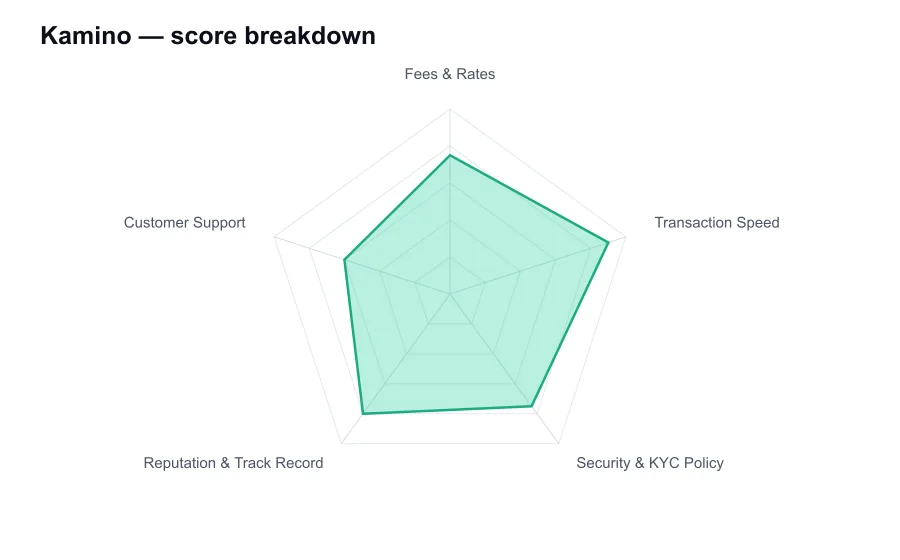
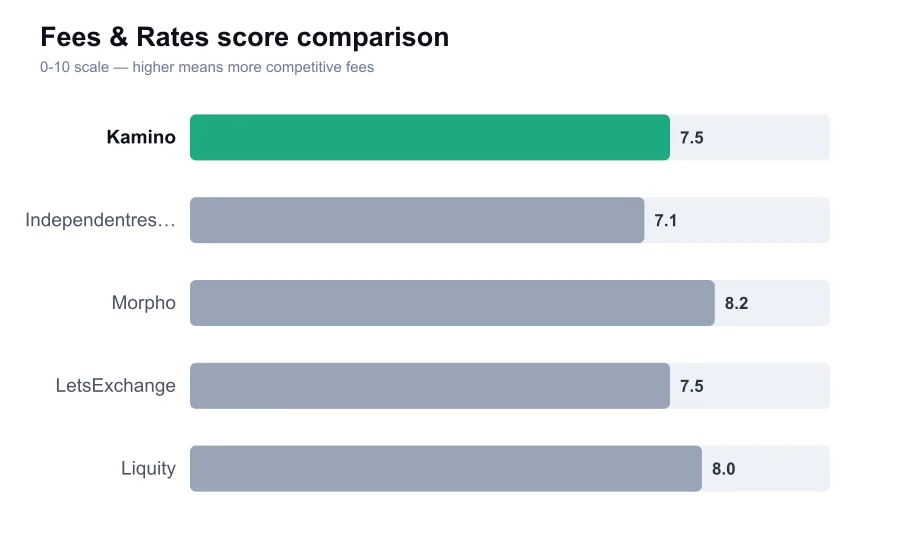
| Fees & Rates | 7.5 | Low network costs, but borrow rates change with utilization. |
| Transaction Speed | 9.0 | Solana lending actions usually confirm within seconds. |
| Security & KYC Policy | 7.5 | Audited DeFi design, still exposed to contract and liquidation risk. |
| Reputation & Track Record | 8.0 | A leading, established Solana lending venue. |
| Customer Support | 6.0 | Good documentation and community help, no reversal service. |
| Requirement | none |
|---|---|
| Notes | Kamino's permissionless app uses wallet signatures rather than conventional customer accounts or routine identity verification. |
| Notable Coins | SOL, USDC, USDT, JitoSOL, mSOL, PYUSD |
|---|---|
| Networks | Solana |
Kamino is one of Solana's major DeFi platforms, combining lending markets, automated liquidity vaults and leverage tools in one application. Its lending product, Kamino Lend, is the part most users encounter first. Deposit an asset, earn variable interest, or borrow against collateral. That sounds familiar to anyone who has used Aave or Spark, but Kamino has become important because it packages Solana's low transaction costs and fast settlement into a notably polished interface.
The platform is not a centralized exchange and it should not be judged like one. Kamino does not take a customer deposit and promise a fixed rate. Rates are determined by pool utilization and risk parameters. Borrowing USDC against SOL can be cheap one week and expensive the next. Depositors earn from borrowers, but their yield is neither guaranteed nor insulated from bad-debt events, oracle failures, smart-contract problems or a sharp fall in collateral value.
Kamino Lend supports isolated markets, which is one of its better design choices. Assets can be placed in separate risk silos rather than forcing every depositor into a single pool with every new token. This gives the protocol room to list assets with different profiles while limiting contagion. It does not make risky collateral safe. It does mean a problem in one isolated market is less likely to damage the whole lending book in the way a single shared-pool design might.
Fees are more nuanced than a trading fee table. Depositors do not pay a simple entry charge for providing liquidity. Borrowers pay variable interest, and markets can include borrow fees or liquidation-related charges set by their parameters. Kamino's automated liquidity vaults also have their own performance, management or strategy costs depending on the product. The important number for a borrower is the displayed APR plus the likely cost of maintaining a safe health factor, not a promotional starting rate.
For ordinary deposits and borrows, Solana gives Kamino a substantial speed advantage over Ethereum mainnet lenders. Transactions usually confirm in seconds and the network fee is commonly tiny in normal conditions. That makes collateral management less painful. If you need to repay debt, add collateral or close a leveraged position, there is less friction than paying a high gas fee to adjust a small Aave position. Fast execution is a real practical benefit, not a marketing line.
It can also tempt people into bad habits. Solana's speed means a volatile asset can move from a healthy loan to a liquidatable loan quickly. An oracle update and a liquidator's transaction can happen before a distracted user has even opened the app. Kamino shows health information clearly, but the user remains responsible for it. Borrowing against volatile SOL, memecoins or liquid staking assets with a thin safety buffer is speculation dressed up as capital efficiency.
Security is reasonably mature for a Solana DeFi protocol, with audits and risk controls forming part of the public product story. Still, lending protocols deserve harsher standards than swap interfaces because a vulnerability can expose pooled collateral. Kamino depends on smart contracts, price oracles, Solana's chain availability, governance choices and integrations such as liquid staking tokens. A clean audit record does not guarantee future safety. It means known reviewers examined a particular version of the code at a particular time.
There is no routine KYC for connecting a wallet or using Kamino's permissionless DeFi functions. That protects privacy and keeps onboarding simple, but it removes the familiar protections of a broker. Kamino cannot verify that a user understands liquidation, stop a person from using borrowed funds recklessly, or restore assets after a seed phrase theft. The protocol's non-custodial model is a strength for autonomy and a hard limitation for anyone expecting customer-service remedies.
Kamino's reputation has improved as it became a core venue for Solana lending. It has handled major assets such as SOL, USDC, USDT and liquid staking tokens, and it remained visible through periods of heavy Solana activity. The KMNO token launch and rewards programs helped establish a broad community, though incentives always complicate the picture. High deposit totals can reflect genuine demand, token farming, or both. I put more weight on continued borrowing activity and risk management than on headline TVL alone.
The automated liquidity products deserve a separate warning. Kamino vaults can manage concentrated-liquidity positions for users, saving them from manually moving price ranges. That is useful, particularly for liquidity providers who understand impermanent loss but do not want to rebalance constantly. It is not a savings account. A vault can earn fees while the deposited asset mix shifts in an unfavorable direction, and strategy performance can lag a straightforward hold. The product is better than manual complexity, not a cure for market risk.
Support is fairly typical for a serious DeFi application. Documentation, Discord, X and community channels are available, and the interface contains useful explanations. Yet a user with a liquidation will not receive the sort of case-by-case intervention a centralized lender might promise. Support can explain a transaction or direct users to documentation, but it cannot reverse a liquidation executed according to the smart contract. That distinction should be understood before borrowing a single dollar.
Kamino compares well with Drift and Marginfi in the Solana lending category because its interface and product breadth are strong. Marginfi has at times been the simpler lending choice, while Drift brings a broader trading focus. Kamino is the better fit for someone who wants lending, leverage and liquidity tools under one roof. The cost of that breadth is complexity. A newcomer can click into strategies that are much riskier than a straightforward USDC deposit.
The sensible approach is to start with an uncomplicated action. Deposit a stablecoin, inspect the variable supply APR, and learn how withdrawals behave at different utilization levels. If borrowing, leave a generous health-factor buffer rather than aiming for maximum capacity. Users should also understand that high pool utilization can make withdrawals difficult until borrowers repay or new liquidity arrives. That is a normal lending-pool constraint, not necessarily a platform failure.
Kamino is one of the strongest products in Solana DeFi, but it rewards discipline more than enthusiasm. Its speed, low network costs and risk segmentation are meaningful advantages. I would use it for conservative collateralized borrowing or stablecoin lending after checking market parameters. I would not use its leverage and automated vaults casually, especially during a speculative rush. Kamino is capable infrastructure, and capable infrastructure can amplify both good decisions and bad ones.
| Pros | Cons |
|---|
Kamino suits experienced Solana users seeking collateralized loans, stablecoin yield, or managed liquidity strategies. It is a good fit for borrowers who actively monitor their health factor and market utilization. It is less suitable for anyone who needs guaranteed yields, account recovery, or protection from liquidation. New DeFi users should begin with small deposits and avoid leverage.
No routine KYC is required for Kamino's wallet-based DeFi functions. You interact by connecting and signing with a Solana wallet.
Borrow rates are variable and respond to each pool's utilization. As more of an asset is borrowed, the interest rate can rise materially.
Your collateral can be liquidated according to the market parameters. Liquidation is executed on-chain and support cannot reverse a valid liquidation.
Not necessarily. A lending pool needs available liquidity. High utilization can limit immediate withdrawals until borrowers repay or more liquidity arrives.
They are separate lending pools with their own collateral and risk settings. The design aims to limit the spread of risk between different asset groups.
No. Vault results depend on trading fees, token prices, strategy rules and liquidity conditions. Automated management does not remove impermanent loss.
| Alternative | Score |
|---|---|
| Independentreserve Review | 7.7/10 |
| Morpho Review | 7.7/10 |
| LetsExchange Review | 7.7/10 |
| Liquity Review | 7.5/10 |
| Sanctum Review | 7.5/10 |
| Changehero Review | 7.5/10 |