Editorial independence: our scores and rankings are produced using the fixed criteria above and are not influenced by advertisers. This is an independent ranking site and is not operated by, or affiliated with, any provider we list.
Affiliate disclosure: some links on this page may earn us a commission at no extra cost to you. This does not affect our rankings.
| Best for | Not for |
|---|
WhiteBIT is a centralized cryptocurrency exchange where users open a verified account, deposit funds, and trade through order books and conversion tools. It offers a more traditional exchange experience than a DEX or instant swap service, with custody held by the platform while funds remain in the account.
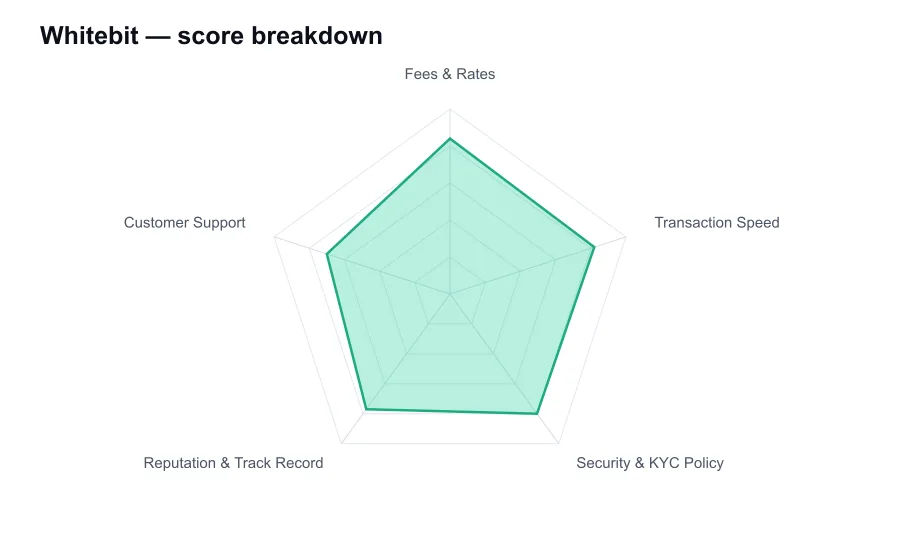
| Criterion | Score | Note |
|---|---|---|
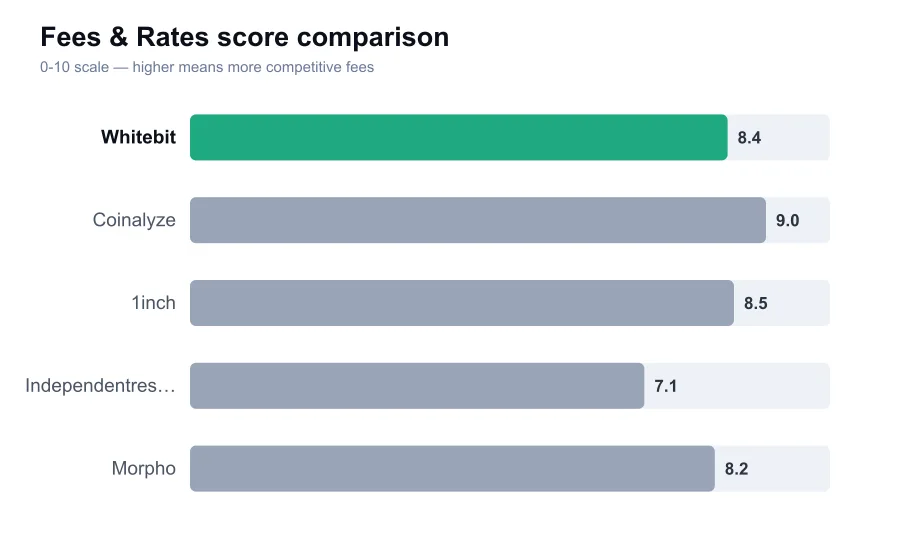
| Fees & Rates | 8.4 | Spot trading fees up to 0.1% before pair or tier discounts |
| Transaction Speed | 8.2 | Fast internal matching, withdrawals depend on network queues |
| Security & KYC Policy | 8.0 | Mandatory KYC, 2FA tools, and 96% cold-storage claim |
| Reputation & Track Record | 7.7 | Established since 2018, with a growing European presence |
| Customer Support | 7.0 | 24/7 channels, but compliance cases can be slow |
| Requirement | mandatory |
|---|---|
| Notes | WhiteBIT requires identity verification for normal account use. Expect standard compliance checks and possible additional review for certain transactions. |
| Notable Coins | Bitcoin, Ethereum, Tether, USD Coin, Solana, XRP, Dogecoin, WBT |
|---|---|
| Networks | Bitcoin, Ethereum, Tron, Solana, Polygon |
| Global | No |
|---|---|
| Restricted Countries | United States |
| Notes | Availability depends on the serving entity and local compliance rules. Check WhiteBIT's current terms before registering or depositing. |
| iOS | Yes |
|---|---|
| Android | Yes |
| Notes | WhiteBIT provides mobile trading apps for iOS and Android. |
WhiteBIT is a centralized cryptocurrency exchange founded in 2018 and closely associated with Ukraine. It is a very different service from Godex or Trocador. Users create an account, complete identity verification, deposit funds into an exchange wallet, and trade through an order book. That structure brings lower trading costs and more tools, but it also means WhiteBIT controls the assets held in the account.
The platform has grown into a recognizable European retail exchange with spot markets, conversion tools, staking-style products, margin-related offerings in some regions, and a branded ecosystem around the WBT token. It is built for users who want a conventional exchange interface rather than a one-time wallet-to-wallet swap. The company has invested heavily in sports sponsorships and mainstream branding, which has helped awareness, especially in parts of Europe.
WhiteBIT's spot fees are competitive. Standard spot trading fees are commonly set at up to 0.1 percent for maker and taker orders, with lower rates potentially available for particular pairs or volume tiers. That is far cheaper than paying a 0.5 percent instant-exchange fee plus spread. For frequent trading, the difference adds up quickly. Users should still examine each market because liquidity and spread matter just as much as the fee schedule.
The exchange's instant conversion function is convenient but should not be confused with the trading terminal. Converting an asset through a simplified interface can be easier for a newcomer, yet it may provide a less favorable rate than placing a limit order on a liquid spot pair. If you are trading a meaningful amount, use the order book, look at the spread, and consider a limit order. Convenience costs money on almost every exchange.
Deposits can be cheap or free at the exchange level, but blockchain network fees remain unavoidable. Withdrawal fees vary by asset and network and can change without much notice. That is where WhiteBIT can look less attractive than its headline 0.1 percent trading fee suggests. Always check the withdrawal page before buying a token specifically to move it elsewhere. A cheap trade followed by an expensive withdrawal is not cheap.
Execution speed is one of WhiteBIT's stronger areas. Internal trades match quickly, and the interface is responsive for mainstream pairs. A centralized matching engine has an advantage over an instant-exchange aggregator because it is not waiting for an outside provider to quote or source each conversion. Deposits and withdrawals are another matter. They depend on the selected network, required confirmations, and the exchange's own wallet processing queue.
The security arrangement is more mature than that of a casual swap service. WhiteBIT says that it stores 96 percent of user assets in cold wallets, which is a useful control if accurately maintained. The platform also offers two-factor authentication, withdrawal address controls, session management, and anti-phishing settings. Those tools are worth using. A secure exchange can still lose a customer account if the customer reuses a password or approves a phishing login.
KYC is mandatory for normal use. That will immediately rule WhiteBIT out for users who want anonymous crypto swapping. The verification requirement is not unusual for a centralized exchange serving European customers, and it can make fiat access and account recovery more workable. It also means you should expect identity checks, source-of-funds questions in some cases, and geographic restrictions tied to the company's compliance obligations.
WhiteBIT has presented itself as a regulated and compliance-focused European platform, but users should distinguish licensing claims from blanket protection. Crypto exchange regulation varies by entity and jurisdiction. A registration or authorization does not make every asset guaranteed, and it does not remove the possibility of a withdrawal review. Read which WhiteBIT entity serves your country and do not assume that a promotional page answers that question.
Its reputation is better than that of anonymous offshore exchanges, though it remains below the trust level of the oldest global names. Since 2018, WhiteBIT has built a substantial user base and has maintained visible commercial partnerships. It has also faced the ordinary skepticism that follows fast-growing exchanges, especially around token promotions, liquidity claims, and customer-service disputes. I would describe it as established and credible enough for ordinary use, not as a platform that deserves blind trust with every coin you own.
The WBT token is another point requiring restraint. Exchange tokens can offer fee discounts, product access, or promotional benefits, but they also concentrate risk. If WhiteBIT suffers reputational damage, regulatory trouble, or falling platform activity, the token and the exchange exposure can move in the same direction. Holding WBT for a limited practical discount is one thing. Treating it as a diversified long-term investment is another.
Customer support is available around the clock through help channels and ticketing, and WhiteBIT provides a more conventional support structure than a DEX or instant swap site. The experience is uneven during account reviews or withdrawal holds, where users can feel that responses are scripted and slow. That criticism is not unique to WhiteBIT. It is common on centralized exchanges because the support team often cannot disclose the full reasoning behind a risk decision.
WhiteBIT is best for users who want cheap spot trading, a familiar app-based exchange experience, and access to a centralized account with security settings. It is not built for privacy-first users, nor is it the best choice for someone who needs complete control of private keys at every stage. Keep only active trading capital on the exchange. Move long-term holdings to a hardware wallet once you are done trading.
My take is that WhiteBIT is a capable mid-to-large centralized exchange with genuinely attractive spot fees and respectable security controls, provided you accept its KYC model. Its weak spots are familiar: custody risk, variable withdrawal costs, and support that can feel opaque during compliance issues. I would rank it ahead of anonymous, lightly documented exchanges for a regular retail trader. I would still choose a self-custody wallet for savings and would verify local eligibility before depositing fiat or crypto.
| Pros | Cons |
|---|
WhiteBIT suits retail traders who want a conventional centralized exchange, lower spot fees, and an app-based trading experience. It is a reasonable option for users comfortable with identity verification and exchange custody. Privacy-focused users should use a self-custody swap service or DEX instead. Long-term holders should withdraw inactive balances to a hardware wallet rather than treat WhiteBIT as permanent storage.
WhiteBIT lists standard spot trading fees of up to 0.1% for maker and taker orders. Actual costs can vary by market, promotions, and account conditions.
Yes. WhiteBIT is a centralized exchange and requires identity verification for normal account use.
WhiteBIT states that 96% of user assets are stored in cold wallets. This is the company's published custody claim, not a substitute for self-custody.
Internal trades are fast, but withdrawals depend on the asset, selected network, required confirmations, and WhiteBIT's wallet-processing queue.
No. The conversion tool is simplified, while spot trading uses the order book. For larger trades, check the order-book spread and a limit order.
It is safer to keep only trading capital on a centralized exchange. Move long-term holdings to a wallet where you control the private keys.
Enable two-factor authentication, use a unique password, activate anti-phishing protections where available, and review withdrawal-address and session settings.
| Alternative | Score |
|---|---|
| Coinalyze Review | 8.2/10 |
| 1inch Review | 8.4/10 |
| Independentreserve Review | 7.7/10 |
| Morpho Review | 7.7/10 |
| LetsExchange Review | 7.7/10 |
| Kamino Review | 7.7/10 |