Editorial independence: our scores and rankings are produced using the fixed criteria above and are not influenced by advertisers. This is an independent ranking site and is not operated by, or affiliated with, any provider we list.
Affiliate disclosure: some links on this page may earn us a commission at no extra cost to you. This does not affect our rankings.
| Best for | Not for |
|---|
| Criterion | Score | Note |
|---|---|---|
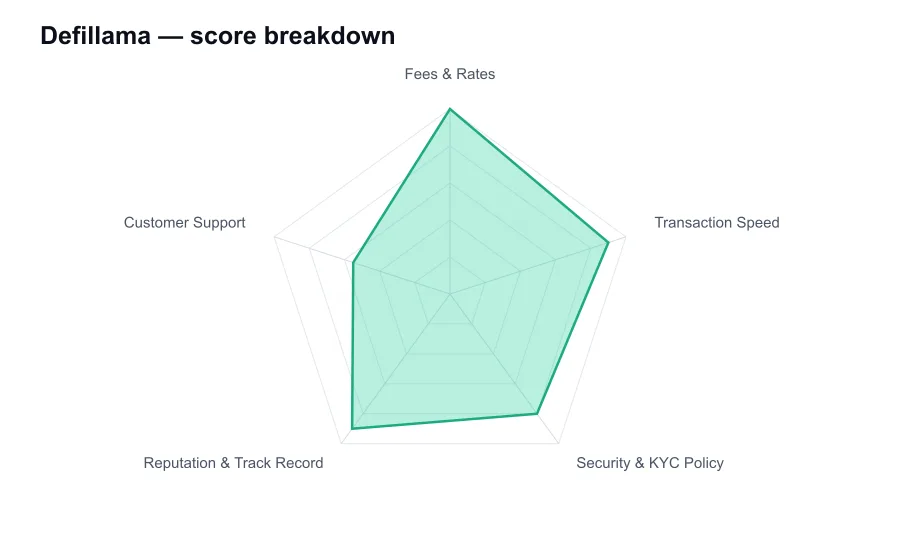
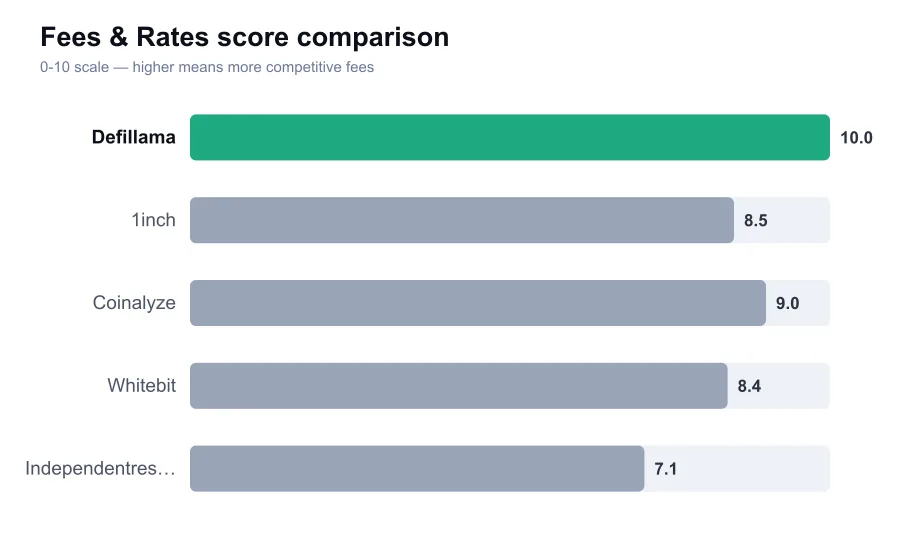
| Fees & Rates | 10.0 | Core DeFi analytics are publicly accessible without trading fees |
| Transaction Speed | 9.0 | Fast dashboards and data navigation, no transaction execution |
| Security & KYC Policy | 8.0 | No custody or routine KYC, but external links carry DeFi risk |
| Reputation & Track Record | 9.0 | Widely cited DeFi data source with transparent methodology |
| Customer Support | 5.5 | Community and documentation led, not consumer concierge support |
DefiLlama is not a crypto exchange, broker, wallet, or custodian. It is a data and research platform that has become one of the most useful public windows into decentralized finance. If you want to know where total value locked is rising, which chains are attracting stablecoins, how a lending protocol compares with competitors, or whether a yield source has any meaningful scale, DefiLlama is often the first tab to open. Its role is closer to a financial data terminal for DeFi than to a place where you click buy.
That clarification affects every score. DefiLlama does not charge a trading commission because it does not execute your trades. It does not settle a withdrawal because it does not custody your assets. It does not impose standard exchange KYC because its main dashboard is public data. Those are substantial advantages for accessibility, but they should not be inflated into claims about exchange safety or transaction speed. A useful reviewer has to judge the product it actually is, not force it into the wrong category.
The site is best known for its TVL rankings. Total value locked is imperfect, but it remains a useful starting metric for comparing DeFi protocols and networks. DefiLlama breaks data into chains, categories, protocols, stablecoins, bridges, yields, fees and revenue, raises, unlocks, and other dashboards. A researcher can go from a broad market view to a protocol page quickly. That organization is why the site became a staple for analysts, journalists, governance participants, and reasonably serious retail users.
The price is hard to argue with. Core access is free, with no account wall blocking ordinary research. At a time when crypto information is often packaged into expensive subscriptions or hidden behind a token-gated community, DefiLlama's public-first approach is a major service to the ecosystem. The platform does offer API-related products and has expanded into tools that may have their own commercial terms, but the primary research experience remains unusually generous. Free does not mean worthless here. It means the team has chosen distribution as a strategic advantage.
There is no trading spread concealed in DefiLlama's main analytics pages. That gives it a cleaner incentives story than a dashboard owned by a venue pushing users toward particular pairs or token listings. A protocol page may link out to a project or a related service, but the reader is not being handed a retail conversion quote and urged to act before it expires. This matters because DeFi research can already be distorted by token incentives, promotional treasury activity, and selectively presented metrics. A neutral data layer is valuable.
The platform's speed is excellent in the sense that counts. Pages are generally fast, the navigation is direct, and the datasets are presented without the heavy visual clutter that slows many crypto websites. A user can filter chains, compare historical values, inspect stablecoin supply, or look at protocol fees quickly. During volatile markets, that responsiveness makes a difference. Research loses value if the dashboard is buried under loading animations and autoplay charts.
Still, no data aggregator is instantaneous truth. DefiLlama relies on indexed blockchain data, protocol adapters, public sources, and its own methodology. Different dashboards may update at different intervals, and a complicated contract migration or a protocol-specific accounting change can create discrepancies. A headline move in TVL may reflect price appreciation, token emissions, a bridge accounting adjustment, or actual net deposits. The website gives users information quickly. It cannot eliminate the need to understand what that information measures.
DefiLlama's methodology is one reason it is widely respected. The project has often taken a stricter view than competitors about what should count as TVL, aiming to avoid obvious double-counting and inflated figures. That sounds technical, but it has practical consequences. A protocol can make itself look huge by counting recursively deposited assets or by presenting borrowed assets in a flattering way. A data provider willing to challenge those figures is more useful than one that simply republishes marketing numbers.
No methodology is beyond dispute. DeFi accounting is messy because chains differ, wrapped assets complicate ownership, bridges create duplicate representations, and protocols evolve faster than reporting conventions. Users should not treat any TVL figure as audited financial statements. DefiLlama is a strong first source, not a substitute for reading a protocol's documentation, inspecting contracts, checking governance proposals, or following the underlying chain. That caveat is not a criticism unique to DefiLlama. It is the cost of analyzing an open but chaotic financial system.
Security is unusually favorable for casual users because the main site requires no deposit and no wallet connection. You can research DeFi with a normal browser session and no identity submission. That sharply reduces the risk profile compared with an exchange account or a wallet-connected dApp. It also makes DefiLlama useful in regions where people want public market information without giving a commercial platform a personal profile. For basic research, the safest wallet is the wallet you never need to connect.
The danger appears when users move beyond data. DefiLlama includes links, yield information, protocol pages, and other routes into the DeFi ecosystem. A listing is not an endorsement, and a high APY is not a safety rating. Scam protocols can mimic names, incentives can collapse, and smart contracts can fail regardless of how polished a dashboard looks. DefiLlama can help a user identify where to research, but it cannot underwrite the protocol they choose. Anyone who clicks from an analytics page into a yield farm should slow down, verify URLs, and assess contract risk independently.
The brand's reputation is strong because it earned credibility during periods when DeFi data was frequently distorted by hype. It is commonly cited in crypto reporting and used by researchers who need a quick, broadly accepted reference point. The project has also cultivated a reputation for openness and a willingness to explain methodology. That is more meaningful than a large social following. Data platforms live or die by whether people return to them after the market narrative changes.
DefiLlama has not been free of controversy or governance tension, including a public episode involving a proposed token launch and internal disagreement. The episode was messy, but it also showed that the wider community paid attention to the project's independence and direction. The key question for users is whether the product continued to function and retain its analytical value. It did. Still, the incident is a reminder that even decentralized-branded infrastructure depends on people, domains, repositories, and business decisions.
The breadth of the dashboard is now both a strength and a potential weakness. Features such as yields, bridges, stablecoins, fees, revenue, hacks, airdrops, token unlocks, and developer tools make DefiLlama a powerful research hub. They can also encourage users to browse numbers faster than they comprehend them. The yield page is particularly prone to misuse. A high percentage may be subsidized, temporary, illiquid, or denominated in a volatile reward token. The best users treat the table as a screening tool, not as a shopping list.
Support is limited in the conventional consumer sense. DefiLlama is not a bank with a call center, and there is no reason to expect live agents to explain every metric or rescue a user from an unrelated DeFi transaction. Documentation, social channels, public methodology, and community-facing development channels matter more here than ticket queues. For a free public research tool, that is acceptable. For a newcomer confused by DeFi concepts, it can feel abrupt.
The API is one of the platform's important contributions. Builders, analysts, and developers can pull data into their own dashboards and research workflows rather than manually copying figures from a webpage. That openness has helped DefiLlama become infrastructure rather than merely a destination site. API users should still read terms, rate limits, attribution rules, and endpoint documentation. Free public data does not mean every use case comes with enterprise-grade guarantees or dedicated technical support.
My view is that DefiLlama is indispensable for DeFi research and potentially dangerous for anyone who mistakes data visibility for investment due diligence. It deserves a very high score for accessibility, speed, and reputation in its field. It earns no credit for exchange execution because it does not offer it, and that is not a failure. Use it to form questions, compare protocols, and spot changes in the market. Do not use a TVL ranking or yield percentage as permission to connect your wallet and send money.
For users who understand that distinction, DefiLlama is one of crypto's best public goods. It cuts through a great deal of promotional noise and puts important market structure in front of anyone with a browser. Its absence of KYC and custody makes ordinary research low risk, while its open-ended DeFi links demand personal discipline. I recommend it to researchers, investors, journalists, and builders. I would not recommend it as a standalone tool for a beginner making their first DeFi allocation without additional education and security practices.
| Pros | Cons |
|---|
DefiLlama is ideal for DeFi researchers, crypto journalists, investors, analysts, and builders who need fast public market data. It is especially useful for comparing protocol scale, chain activity, stablecoin supply, and yield sources. Beginners can use it to learn, but should not make deposits based only on a ranking or APY. Anyone seeking fiat purchases, trade execution, or account recovery needs an exchange or wallet provider instead.
No. DefiLlama is primarily a DeFi analytics and research platform. It does not operate as a conventional exchange or custodian.
No. Most dashboards can be used publicly without connecting a wallet or creating an account. Be cautious if following external links to DeFi applications.
No. APY is not a safety score. It may be temporary, incentive-driven, illiquid, or exposed to smart-contract and token-price risk.
| Alternative | Score |
|---|---|
| 1inch Review | 8.4/10 |
| Coinalyze Review | 8.2/10 |
| Whitebit Review | 8.1/10 |
| Independentreserve Review | 7.7/10 |
| Morpho Review | 7.7/10 |
| LetsExchange Review | 7.7/10 |