Editorial independence: our scores and rankings are produced using the fixed criteria above and are not influenced by advertisers. This is an independent ranking site and is not operated by, or affiliated with, any provider we list.
Affiliate disclosure: some links on this page may earn us a commission at no extra cost to you. This does not affect our rankings.
| Best for | Not for |
|---|
Anycoin Direct was a Netherlands-based cryptocurrency broker founded in 2013. It let retail customers buy and sell crypto through a quoted-price checkout flow and send purchased assets to a personal wallet. The company ceased services in 2024.
| Criterion | Score | Note |
|---|---|---|
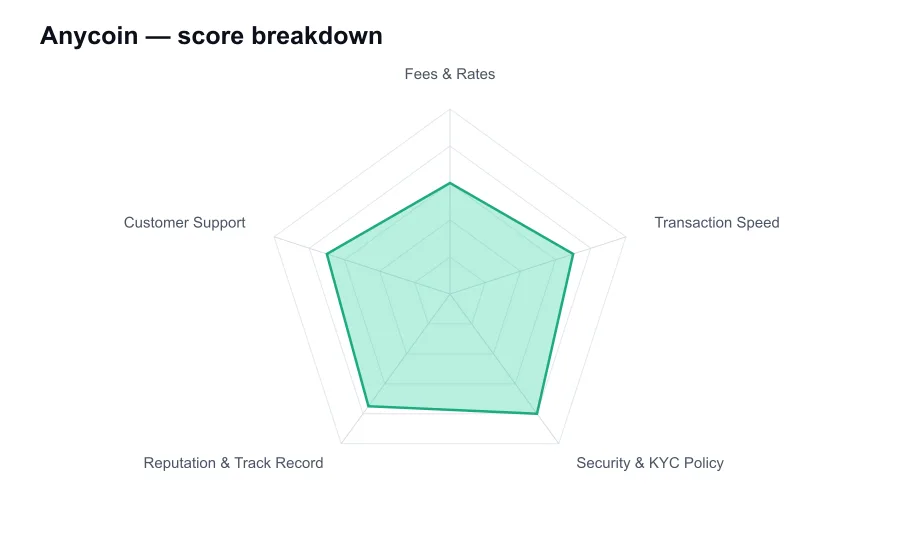
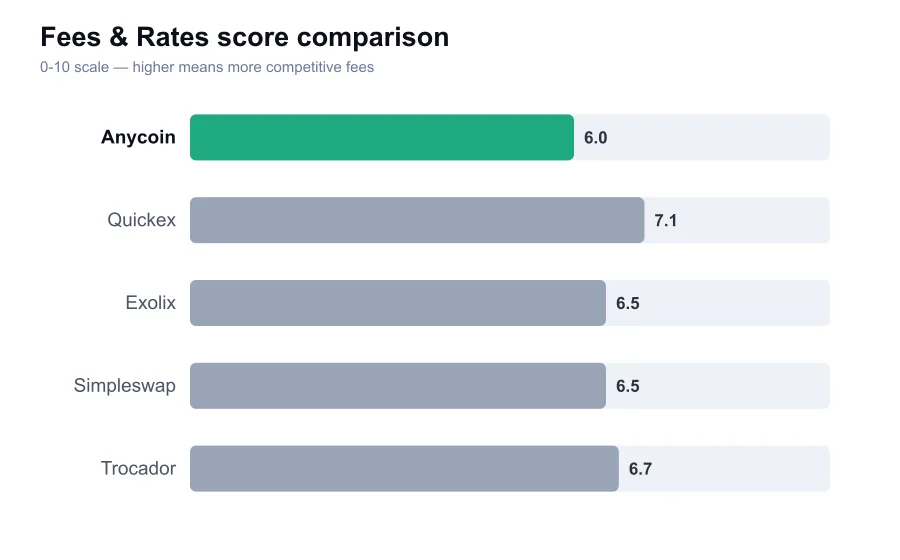
| Fees & Rates | 6.0 | Broker spread and payment costs were rarely the cheapest |
| Transaction Speed | 7.0 | Fast payment options, subject to verification |
| Security & KYC Policy | 8.0 | Dutch-regulated model with mandatory identity checks |
| Reputation & Track Record | 7.5 | Operating history from 2013, but now closed |
| Customer Support | 7.0 | Beginner-oriented multilingual support reputation |
| Fact | Value | Source |
|---|---|---|
| Founded | 2013 | - |
| Current status | Services ceased in 2024 | - |
| Service model | Retail cryptocurrency broker | - |
| Dutch registration | Registered with De Nederlandsche Bank | - |
| Identity policy | KYC required | - |
| Requirement | mandatory |
|---|---|
| Notes | Identity verification was part of Anycoin Direct's regulated broker model. Additional compliance questions could be requested depending on a transaction. |
Anycoin Direct was a Dutch cryptocurrency broker aimed at people who wanted a regulated, fairly simple route into Bitcoin and other major assets. It was never trying to be Binance. The service concentrated on buying and selling rather than active trading, and that made it appealing to European first-time buyers who preferred bank transfers, familiar payment methods, and a company operating under Dutch supervision.
The important point for anyone researching it now is that Anycoin Direct is no longer an active choice. The company announced that it would cease its services in 2024. That changes the tone of this review considerably. A closed broker cannot be judged as a practical place to buy crypto today, however useful its past record may be as context for former customers seeking information about the business.
During its operating years, Anycoin Direct occupied a respectable middle ground. It was more regulated and more transparent about identity checks than many instant swap services. It was also simpler than a full exchange with order books, margin products, and hundreds of obscure tokens. Customers selected an asset, chose a payment method, completed verification where needed, and received coins to a personal wallet.
Its pricing was never its strongest selling point. Anycoin Direct generally embedded a spread in the quoted buy or sell price and could add a payment-method cost. That is common among retail brokers, but it means the number buyers saw was rarely comparable to the maker fee on Kraken Pro, Coinbase Advanced, or Bitvavo. Fast checkout is convenient, though convenience has a price.
For a small first purchase, the difference might have been acceptable. A customer paying with a card or a local instant payment method was buying ease of use as much as cryptocurrency. For recurring buyers or anyone putting several thousand euros into Bitcoin, the accumulated spread could become hard to ignore. Price-sensitive users were usually better served by a low-fee exchange and a separate withdrawal to self-custody.
Transaction speed depended heavily on the chosen payment rail and the verification stage. Established customers using rapid local bank payment methods could often have an order processed quickly. A first purchase was less predictable because compliance checks, payment confirmation, and blockchain withdrawal processing could all add time. That is normal for a broker, but marketing language around instant purchases should never be confused with instant on-chain settlement.
The service had a better security posture than anonymous swap sites because it treated compliance as a core part of the product. Anycoin Direct was registered with De Nederlandsche Bank as a crypto service provider during its period of operation. That did not make customer balances government-insured, and it did not remove crypto price risk, but it gave customers a clearer legal counterparty than many lightly identified offshore services.
KYC was part of the experience rather than an occasional exception. Customers could expect identity verification and, depending on transaction circumstances, further questions about source of funds or wallet ownership. Some crypto users dislike that model, but it was consistent with the company's Dutch regulatory position. Anyone wanting privacy-first swaps would have found Anycoin Direct a poor fit even before it closed.
The broker's approach to custody was sensible for its audience. It encouraged customers to provide a personal wallet address and receive purchased coins there. That reduced the temptation to leave a long-term holding on a broker account. Still, the buyer remained responsible for entering the correct address and selecting a compatible network. A broker cannot rescue funds sent to an incompatible destination after the fact.
Reputation was one of the reasons the company had a following. It had operated since 2013, which is a long time in retail crypto, and it was a familiar name in the Netherlands and parts of Europe. It did not have the global brand power of Coinbase or Kraken, but it had a more established identity than the many short-lived instant exchange websites that appear and disappear after a few market cycles.
That reputation should not be romanticized. A long operating history is useful, yet the closure itself is a reminder that regulated retail crypto businesses face high compliance, banking, and market-cycle costs. Former users should follow the company's official notices for any account, transaction-history, or support matters. They should not rely on lookalike domains, unsolicited recovery agents, or social-media accounts promising access to old balances.
Support was generally positioned as a human-facing strength. The broker offered customer service in multiple European languages and its educational material was unusually accessible for beginners. That is valuable when a buyer is worried about a failed payment or an unfamiliar wallet address. It was less compelling for advanced traders, who usually need sophisticated execution tools rather than explanatory help articles.
Anycoin Direct's closure leaves it in an unusual category. It deserves credit for having run a straightforward, regulated broker service for more than a decade, and for making self-custody more approachable than many platform-led alternatives. But no historical reputation offsets the obvious fact that new customers need an active provider, not a fondly remembered one.
My view is simple. Anycoin Direct was a credible retail broker in its day, especially for Dutch and European newcomers who valued regulation and easy payment flows over rock-bottom prices. Its fees were not competitive enough for serious frequent buying, and its compulsory compliance model was never for privacy-minded users. Since the service has ceased operating, prospective buyers should look to an active regulated exchange or broker instead.
| Pros | Cons |
|---|
Anycoin Direct is not suitable for new customers because it has ceased operating. Its former model suited European beginners who wanted a regulated broker and direct delivery to a personal wallet. Former customers needing account assistance should use official company communications only. Active buyers should compare regulated alternatives such as Bitvavo, Kraken, or Coinbase.
No. Anycoin Direct announced that it would cease its services in 2024, so it should not be treated as an active place for new crypto purchases.
It primarily operated as a retail crypto broker. Customers bought or sold at a quoted price rather than using a full public order book like those on major trading exchanges.
Yes. KYC was a central part of its regulated broker model, rather than an optional feature for most customers.
Broker quotes generally include a spread, and some payment methods can add costs. A chart price is not necessarily the final all-in purchase price.
During its operating period, Anycoin Direct was registered with De Nederlandsche Bank as a crypto service provider.
Use the company's official website or verified support channels. Avoid recovery firms or social-media contacts claiming they can retrieve old crypto balances.
| Alternative | Score |
|---|---|
| Quickex Review | 6.9/10 |
| Exolix Review | 6.9/10 |
| Simpleswap Review | 7.0/10 |
| Trocador Review | 7.0/10 |
| Kingex Review | 6.8/10 |
| Changelly Review | 6.8/10 |