Editorial independence: our scores and rankings are produced using the fixed criteria above and are not influenced by advertisers. This is an independent ranking site and is not operated by, or affiliated with, any provider we list.
Affiliate disclosure: some links on this page may earn us a commission at no extra cost to you. This does not affect our rankings.
| Best for | Not for |
|---|
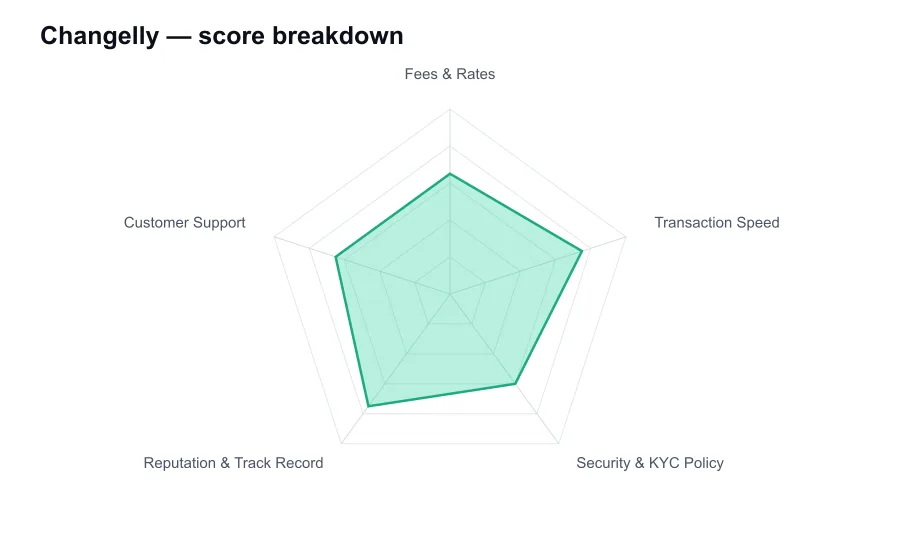
| Criterion | Score | Note |
|---|---|---|
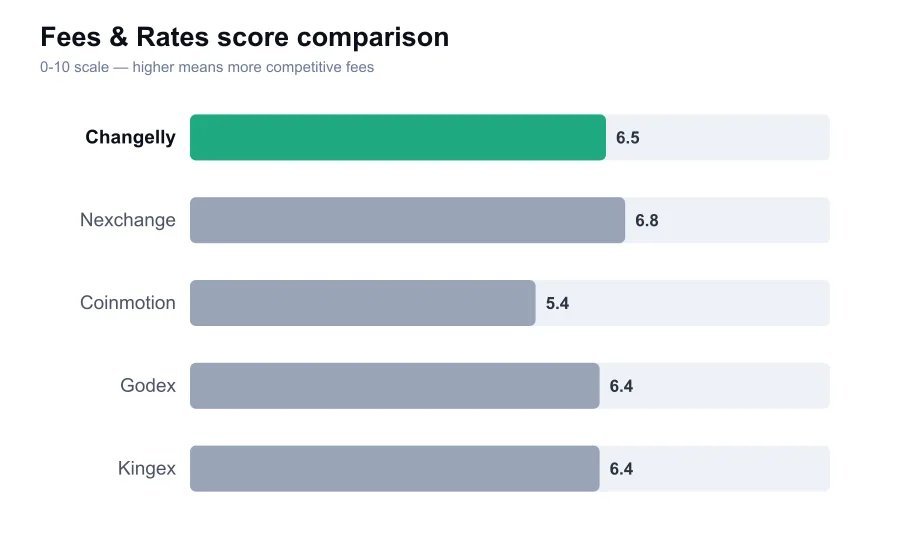
| Fees & Rates | 6.5 | 0.25% stated swap fee, but spreads and card costs add up |
| Transaction Speed | 7.5 | Usually prompt after network confirmation requirements |
| Security & KYC Policy | 6.0 | Risk-based KYC and partner routing limit the privacy promise |
| Reputation & Track Record | 7.5 | Operating since 2015, with a mixed dispute record |
| Customer Support | 6.5 | 24/7 assistance, but compliance cases can be frustrating |
Changelly is one of the oldest names in the instant crypto exchange category. Founded in 2015, it predates much of the current crop of one-click swap sites and has spent years building a recognizable consumer brand. Its core proposition remains familiar: users can exchange one cryptocurrency for another without operating a traditional trading account. It also sells crypto by card and offers a business API, but the instant swap function is still the reason most people arrive.
The interface is polished and beginner friendly. You select a pair, choose floating or fixed pricing where available, provide a destination address, and pay from your wallet. There is little of the intimidating machinery found on Coinbase Advanced, Kraken Pro, or Binance. That ease is genuinely valuable to someone who wants to convert assets once in a while. It is less compelling for anyone who already knows how to place a limit order.
Changelly is unusually direct about one component of its pricing. Its floating-rate crypto exchange service has historically advertised a 0.25 percent service fee, with network fees and the exchange rate reflected in the final quote. That figure sounds excellent beside many retail brokers. The catch is that the visible fee is not the whole economic cost. Liquidity-provider spreads and the route selected can have a far greater effect than the 0.25 percent line item.
On liquid pairs, Changelly's quotes can be perfectly acceptable. On thin pairs, card purchases, and volatile conditions, they can become expensive. Card providers and payment partners add their own charges, and the purchase flow is much less competitive than funding a proper exchange by bank transfer. Fixed-rate deals bring useful certainty, though Changelly prices the market risk into that quote. People should compare the delivered amount, not just the headline fee.
The service is not a good fit for frequent trading. A spot exchange with deep liquidity, maker orders, and a transparent fee schedule will almost always treat an active trader better. Changelly's advantage is reducing administrative friction. If you need to turn a wallet balance into another asset today, the premium may be acceptable. If you are trying to optimize every trade, it is the wrong tool.
Settlement times are usually decent, but the word instant needs context. Changelly still has to wait for a deposit to be recognized and for the relevant blockchain to confirm it. A fast asset such as XRP or LTC can move through quickly. Bitcoin may take much longer during congestion, and Ethereum-based transactions can stall if the sender chooses an inadequate gas fee. Those are network realities, not necessarily evidence that Changelly is failing.
The company uses multiple liquidity sources, so the route is not always visible in a way that lets users assess execution quality. That is normal for an aggregator, but it does mean you are taking a black-box approach to pricing. Fixed-rate orders have a stated window in which Changelly expects the deposit. Send too late, send the wrong asset, or send an incorrect amount, and the tidy quote can become a support case.
Changelly often describes its service as noncustodial, which is directionally true because it is not designed as a long-term account where customers keep a balance. Yet coins pass through the service and partner infrastructure during a conversion. This is not a self-executing DEX transaction. You are trusting Changelly to process the swap, manage partners, and release the output correctly. That distinction matters most during a dispute.
KYC is not universally required before using the crypto-to-crypto service. However, Changelly reserves the right to ask for verification and supporting documents under its AML and risk rules. Card purchases usually involve much more identity checking because payment processors demand it. The difficult part is that a user can send funds believing the transaction will be simple, then find it paused. That policy is common, but it remains the sharp edge of the product.
Changelly has received more public criticism than its polished front page suggests, largely around frozen transactions and document requests. Some complaints will involve legitimate fraud controls or users who sent incorrect funds. Others reflect a fair expectation that an instant exchanger should be clearer before it accepts a deposit. The company is established enough that I would not dismiss it as an obvious scam, but I would never send an amount I could not afford to have tied up temporarily.
Its longevity is a serious point in its favor. Changelly has operated through several bear markets, worked with major wallet and platform integrations, and maintained a much larger public profile than most small no-account exchanges. It has also had time to accumulate a mixed reputation. Strong brand recognition is not the same thing as flawless customer treatment. This is a mature service with mature-service baggage.
Support is offered around the clock through chat and email, with transaction IDs forming the center of the troubleshooting process. Straightforward questions tend to receive serviceable answers. Compliance disputes are much harder, because support staff cannot necessarily override a review team or promise a release date. The company does have substantial help documentation, though some users will find it too generic once their particular transfer has gone wrong.
Security-conscious users should also consider their own behavior. Never reuse an old address without checking it, do not send a token over the wrong network, and keep records of the quoted rate, transaction ID, and deposit hash. Changelly can help correct some mistakes, but blockchain errors are not always recoverable. A polished exchange widget does not protect someone from sending USDT on an unsupported chain.
I see Changelly as a capable veteran that has been overtaken in some respects by more transparent trading venues and sharper instant-swap competitors. It remains useful for uncomplicated conversions, particularly if its final quote is strong and the route is familiar. Its 0.25 percent advertised exchange fee is better than the vague fee claims used by some rivals, but it should not be mistaken for the complete price. Use it for convenience, not blind trust.
| Pros | Cons |
|---|
Changelly fits occasional users who need a familiar, simple route between major crypto assets and are willing to compare the final quote. It can also suit wallet providers seeking an integrated swap experience. Day traders, bargain hunters, and users needing certainty that no ID check will occur should look to a deep spot market, a DEX, or a provider with a different risk model.
Changelly has historically listed a 0.25% floating exchange fee. Network fees, liquidity pricing, and any fixed-rate premium affect the final amount received.
Yes. Crypto swaps may proceed without prior registration, but Changelly can request KYC or source-of-funds information under its compliance procedures.
It removes account funding and order placement, but blockchain confirmations still apply. Fast-network swaps can be quick, while Bitcoin and congested networks take longer.
| Alternative | Score |
|---|---|
| Kingex Review | 6.8/10 |
| Nexchange Review | 6.8/10 |
| Coinmotion Review | 6.8/10 |
| Godex Review | 6.8/10 |
| EasyBit Review | 6.8/10 |
| Coinomi Review | 6.7/10 |