
Editorial independence: our scores and rankings are produced using the fixed criteria above and are not influenced by advertisers. This is an independent ranking site and is not operated by, or affiliated with, any provider we list.
Affiliate disclosure: some links on this page may earn us a commission at no extra cost to you. This does not affect our rankings.
| Best for | Not for |
|---|
| Criterion | Score | Note |
|---|---|---|
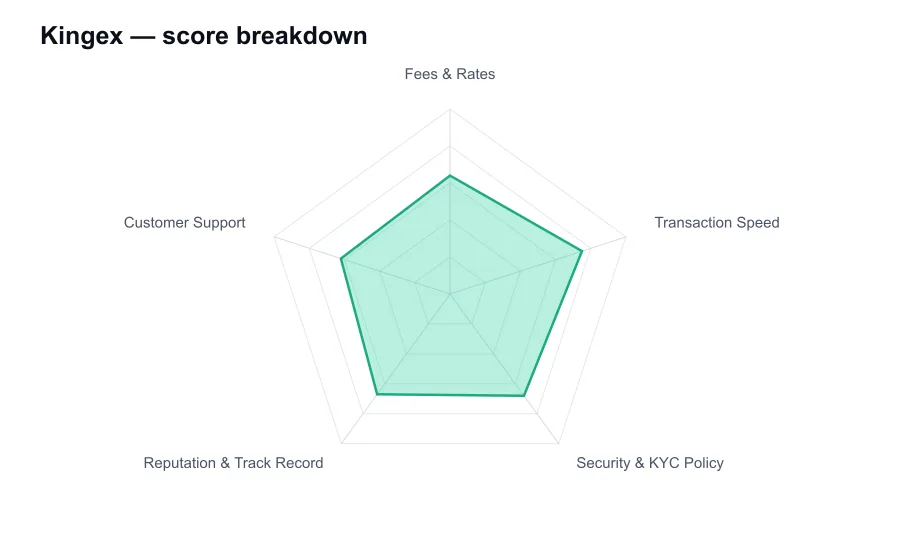
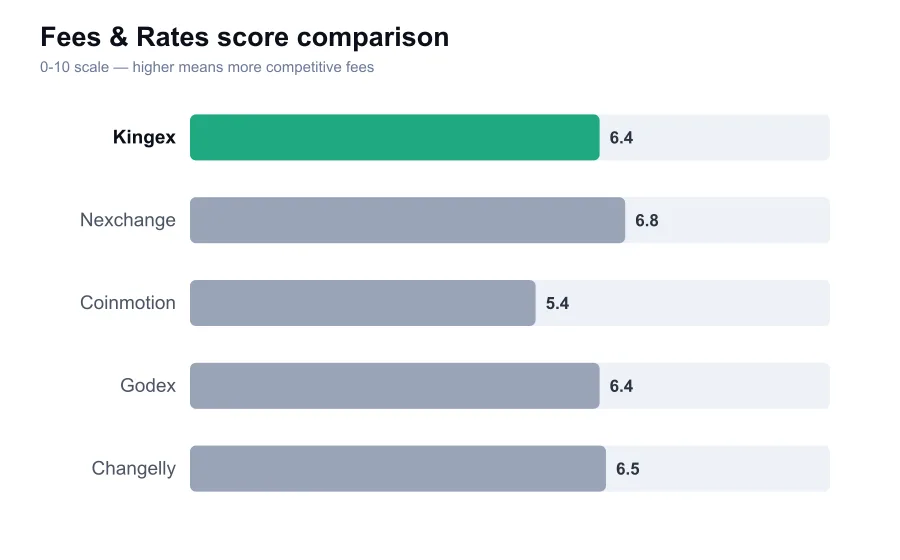
| Fees & Rates | 6.4 | Convenient quotes, but spreads can beat exchange fees |
| Transaction Speed | 7.5 | Fast on liquid routes after deposit confirmation |
| Security & KYC Policy | 6.8 | No account custody, but AML checks can occur |
| Reputation & Track Record | 6.7 | Established instant-swap brand, not top-tier regulated |
| Customer Support | 6.2 | Order tracking helps, complex cases may take time |
Kingex sits in the instant crypto exchange corner of the market, rather than trying to be a full trading venue with charts, order books, futures, staking, and a mobile ecosystem. Its pitch is straightforward: choose two assets, enter a destination wallet, send the funds, and receive the swap. That simplicity is attractive to people who already hold crypto and don't want to park coins at a centralized exchange. It also means Kingex should be judged as a conversion service, not against Binance or Coinbase's much broader product catalogues.
The interface is clean and easy to understand. A newcomer can get from quote to checkout without having to learn trading terminology, and the service supports a respectable range of major coins, stablecoins, and selected smaller assets. Kingex makes the most sense for one-off conversions such as BTC to USDT, ETH to BTC, or a stablecoin swap before moving funds elsewhere. It is less compelling for a person making repeated trades throughout the day, because the instant-exchange model is built for convenience rather than price discovery.
Rates are the central issue. Kingex does not present a simple, universal maker and taker schedule because it is not operating like a conventional spot exchange. The cost is folded into the rate displayed for a particular route, together with network costs and the liquidity available from its providers. That is normal for this category, but it makes lazy comparison difficult. A user looking only at the amount sent and received can miss how much the spread has moved between quotes.
In my checks, Kingex's quotes were usually plausible for popular pairs but not reliably market-leading. For a small BTC, ETH, USDT, or USDC conversion, the difference against a major exchange can be modest enough that the time saved is worth it. For a larger swap, even a one percent or two percent difference in the final rate is real money. This is where services such as ChangeNOW, SimpleSwap, and Changelly are useful reference points. Get simultaneous quotes, include withdrawal fees if you would otherwise use an exchange, and compare the final amount, not the headline exchange rate.
Fixed-rate orders are particularly relevant here. A floating quote can change while the incoming transaction is waiting for confirmations, especially during a fast market move or a congested period. A fixed rate offers more certainty but can contain a wider margin, and it may have a time limit for sending the deposit. That trade-off is sensible, but users need to read the quote screen carefully. Sending too late, sending less than the stated minimum, or using the wrong network can turn a quick swap into a support case.
Speed is good in ordinary conditions, though no instant exchange can make a blockchain instant. The first bottleneck is the confirmation requirement on the deposit chain. A Bitcoin transaction with a low fee can sit for a while before Kingex can act on it, while a well-funded USDT transfer on a fast network may move through much sooner. After confirmation, liquid mainstream pairs are often processed in minutes rather than hours. The final transfer still depends on the destination chain and the receiving wallet or exchange.
That distinction matters because complaints about exchange speed often mix up three separate events: the sender's transaction being confirmed, the provider completing the conversion, and the payout network clearing. Kingex can control only the middle stage. In a routine ETH or stablecoin swap it feels quick. During network congestion, a thinly traded route, or an AML review, it can stop feeling quick very fast. It is not the right service for a payment deadline where a missed hour would be costly.
Kingex's no-account flow is a meaningful privacy advantage, but it should not be confused with a promise of anonymity. The service applies anti-money-laundering controls and reserves the right to request identification or source-of-funds information if a transaction triggers its risk systems. That approach is common among non-custodial swap providers. It also creates the category's least pleasant scenario: a person who chose the service to avoid onboarding can be asked for documents after funds have already been sent.
The practical advice is unglamorous. Do not send funds connected to mixers, scams, sanctions exposure, stolen wallets, or gambling activity that could be flagged by a chain analytics system. Don't split a large amount into a dozen deposits in the hope of avoiding checks, either. For any material sum, test the route with a small transaction, keep the order ID and transaction hash, and use a wallet address you control. A no-registration service reduces account-custody risk, but it does not remove compliance risk.
On wallet security, Kingex's structure is preferable to leaving a balance on a poorly secured exchange because the service is designed to process a swap rather than maintain a customer trading account. Still, there is no public proof-of-reserves framework comparable to what a serious custodial venue might publish, and users cannot independently audit its liquidity partners. That is not a unique failing, but it limits the confidence I would place in it for a very large conversion. The safest use is transactional, not custodial.
Kingex has a longer visible operating history than many copycat instant-swap sites, and its brand recognition is strongest among users looking for Ukrainian-linked crypto services and straightforward wallet-to-wallet conversions. Its public reputation is mixed in the ordinary way for this industry. Many users report simple, fast transactions. Negative reports tend to involve delayed orders, misunderstandings about rate movement, or compliance verification. Those reports do not automatically establish wrongdoing, but they are a reminder that support quality matters most precisely when the automated flow breaks.
The company does not have the regulatory stature, public financial reporting, or household-name accountability of Coinbase, Kraken, or Bitstamp. That should affect the amount you are willing to risk. Kingex is not a place I would use to convert an entire treasury balance merely because the landing page looks polished. It is a service I would consider for a normal-sized personal swap after checking the quote, the network, and the destination address twice.
Support is available through the site's contact channels and is built around order tracking rather than the deep account management issues seen at a conventional exchange. For a clean transaction, you probably will not need it. For a missing payout, wrong memo, delayed confirmation, or AML request, response quality becomes decisive. Kingex does provide order identifiers and transaction status information, which is helpful, but users should set expectations realistically. A small support team handling blockchain investigations cannot always resolve a case in a few minutes.
I like Kingex most when it is treated as a convenience tool. It can be genuinely useful for converting assets directly to a self-custody wallet without opening another exchange account. The price of that convenience is less transparent fee disclosure, a variable spread, and the possibility of post-deposit verification. If you are fee-sensitive, trade frequently, or need institutional assurances, a liquid regulated exchange will be the better answer.
My final view is positive but guarded. Kingex is a credible option for smaller and medium-sized swaps in established assets, particularly for users who value a simple no-account workflow. It is not the cheapest route every time, and the fixed versus floating choice deserves more attention than most buyers give it. Compare the final received amount before sending, avoid rushed high-value orders, and keep records. Used that way, it does its job well enough. Used as a substitute for due diligence, it can become expensive.
| Pros | Cons |
|---|
Kingex suits self-custody users making occasional BTC, ETH, or stablecoin swaps who value speed and fewer account steps. It is a reasonable fit for people moving between wallets, not for active traders. High-volume users should compare it with Kraken, Binance, or Coinbase Advanced. Anyone unable to complete potential identity checks should choose carefully.
Kingex does not normally require account registration for a routine swap, but its AML controls can request identity or source-of-funds documents for flagged transactions.
A liquid swap may complete within minutes after the deposit receives enough confirmations. Bitcoin fees, blockchain congestion, and compliance review can make it take longer.
The cost is generally reflected in the quoted conversion rate and network costs, rather than a simple exchange-style maker and taker fee table.
| Alternative | Score |
|---|---|
| Changelly Review | 6.8/10 |
| Nexchange Review | 6.8/10 |
| Coinmotion Review | 6.8/10 |
| Godex Review | 6.8/10 |
| EasyBit Review | 6.8/10 |
| Coinomi Review | 6.7/10 |