Editorial independence: our scores and rankings are produced using the fixed criteria above and are not influenced by advertisers. This is an independent ranking site and is not operated by, or affiliated with, any provider we list.
Affiliate disclosure: some links on this page may earn us a commission at no extra cost to you. This does not affect our rankings.
| Best for | Not for |
|---|
| Criterion | Score | Note |
|---|---|---|
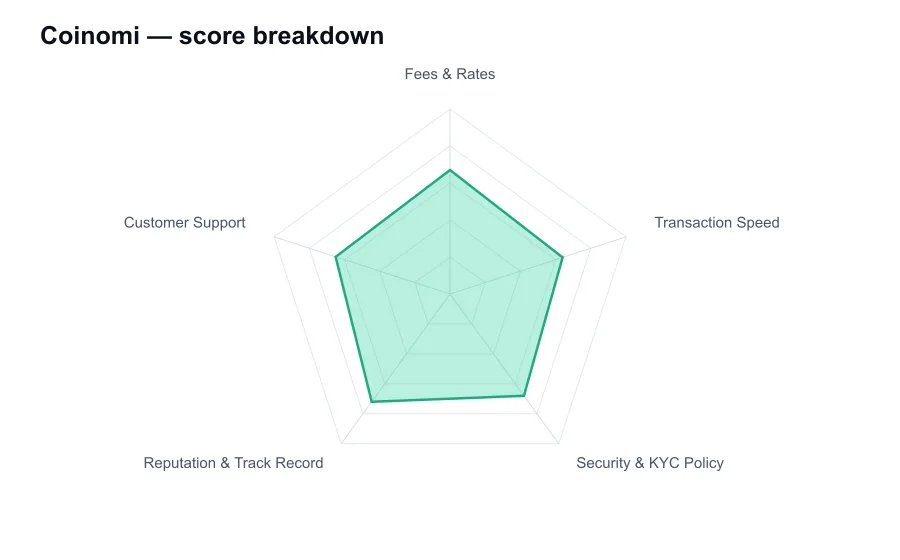
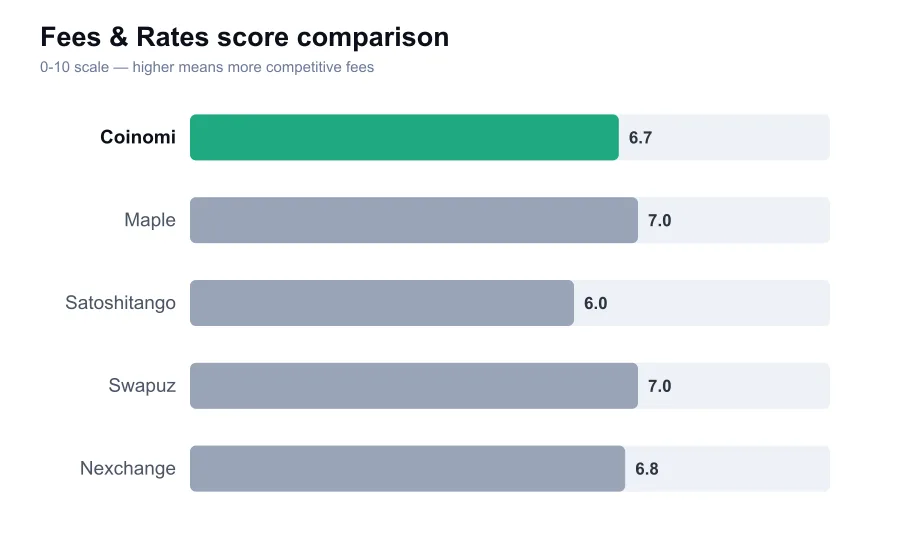
| Fees & Rates | 6.7 | Free wallet use, but partner swaps can carry wide spreads |
| Transaction Speed | 6.4 | Speed depends on the blockchain and swap provider |
| Security & KYC Policy | 6.8 | Self-custody is strong, but hot-wallet risk remains |
| Reputation & Track Record | 7.2 | Operating since 2014 with broad asset support |
| Customer Support | 6.5 | Useful help resources, no recovery for lost keys |
Coinomi is a long-running non-custodial cryptocurrency wallet, not an exchange in the narrowest sense. It gives users a mobile and desktop place to hold, send, receive and swap a wide range of assets. That distinction matters from the start. Coinomi does not ordinarily hold your keys or operate like a bank account. It acts as the wallet interface while third-party services may handle swaps, purchases or other integrations. For users who want one wallet for older coins, major networks and a lot of token support, that remains its main attraction.
The wallet arrived in 2014, which makes it one of the older recognizable names in consumer crypto storage. Its longevity is valuable in a sector packed with wallets that disappear after a market cycle. Coinomi supports many blockchains and can manage Bitcoin, Ethereum, Litecoin, Bitcoin Cash, Dogecoin and large numbers of tokens from a single seed phrase. It also includes features such as built-in exchanges, wallet address formats for supported chains, and portfolio views. Breadth is impressive. It is also where some of the product's compromises begin.
There is no standard Coinomi custody fee for holding assets in the wallet. Sending crypto requires the normal network fee, which goes to miners or validators rather than Coinomi in the usual sense. Bitcoin fees can rise sharply during congestion, Ethereum gas can be expensive, and users should not confuse those network charges with a wallet subscription. Coinomi gives users fee controls on supported chains, but the practical flexibility varies by asset. A low fee can mean a slower confirmation, particularly on Bitcoin during busy periods.
The built-in exchange function is convenient, but convenience is not the same thing as cheap execution. Coinomi routes swaps through third-party providers, and the final rate can include provider spreads, network fees and minimum-order constraints. It is usually sensible to compare the quoted amount with a liquid centralized exchange or a major decentralized exchange before confirming. For a small, occasional swap, the extra cost may be worth avoiding a transfer. For frequent trading or large orders, Coinomi's in-wallet route is rarely the most economical option.
Buy-crypto integrations deserve the same caution. Card and bank purchase providers can charge meaningful fees, apply spreads and require identity checks. Coinomi itself may not ask for KYC simply to create or use a wallet, but regulated partners commonly do for fiat purchases. That is not deceptive, but it can surprise people drawn in by the wallet's privacy-friendly reputation. A self-custody wallet can be used without submitting identification, while the on-ramp embedded inside it may still collect a full set of personal information.
Transaction speed depends almost entirely on the chain and service involved. A Bitcoin payment may be visible quickly but takes time for confirmations. Ethereum transfers are normally faster, though congestion changes both time and cost. A swap can take from minutes to longer if the provider needs extra confirmations or a network becomes busy. Coinomi's interface cannot make Bitcoin settle like Solana. What it can do is make the process legible, showing transaction status and allowing the user to work from one familiar wallet rather than several separate applications.
Self-custody is Coinomi's central security proposition. The recovery phrase and private keys are generated and held locally by the user rather than stored in a conventional Coinomi account. That sharply reduces the risk of a centralized exchange failure freezing customer withdrawals. It also transfers responsibility directly to the owner. If a seed phrase is exposed, stolen, lost, photographed, typed into a fake support page, or backed up in insecure cloud storage, the wallet's security model has already failed at the human level.
Coinomi has a history of emphasizing local encryption and privacy. It does not generally require a user profile or routine KYC for basic wallet functions. Still, privacy-conscious users should understand metadata. Blockchain transactions are public, network requests can reveal information depending on wallet architecture, and third-party swap or purchase partners operate under their own policies. Coinomi is more private than leaving all assets on a regulated exchange, but it is not a magic cloak. Good operational habits matter, including using fresh addresses where supported and avoiding public disclosure of holdings.
The security record is not spotless. In 2019, a researcher publicly reported a vulnerability involving the desktop wallet's spell-check behavior that could potentially expose recovery phrases entered into the application. Coinomi disputed aspects of the disclosure and issued a fix. The episode does not prove that the wallet is unusable today, but it is a useful reminder that software wallets are not invulnerable and that security claims should be judged by response, transparency and architecture rather than marketing language alone.
For meaningful long-term holdings, I would still favor a reputable hardware wallet over any hot wallet, including Coinomi. A hardware device keeps private keys isolated from a general-purpose computer or phone, reducing exposure to malware and clipboard attacks. Coinomi can work well as a spending wallet, a multicoin utility wallet, or a place to manage smaller operational balances. Treating a mobile wallet as a vault for life-changing funds is a category error. The more assets involved, the more a hardware-backed setup becomes worth the friction.
Coinomi's reputation is mixed in the practical way many old crypto products are mixed. It has a long operating history and broad asset support, which count for a lot. It is also less visible in the current wallet conversation than MetaMask for Ethereum users, Phantom for Solana users, or Trust Wallet for mainstream multichain mobile use. That does not make it inferior by default. It does mean the ecosystem, integrations and current community momentum are not as strong in every segment as they are for specialized competitors.
Customer support is better than pure peer-to-peer wallet projects but limited by the non-custodial model. Coinomi has a help center, support channels and guidance for common problems. Support can explain an address format, transaction state or restoration process. It cannot retrieve a seed phrase, reverse a confirmed transfer, or restore money sent to a scammer. Users should never hand a recovery phrase to anyone claiming to be support. A legitimate agent has no reason to ask for it, regardless of how convincing the website or chat account appears.
Coinomi is best for someone who values broad coin compatibility and wants direct control over keys without installing a separate wallet for every chain. It is especially handy for people maintaining legacy assets that newer wallets may not support elegantly. It is not the best trading platform, the cheapest swap venue, or the strongest storage choice for a large long-term portfolio. Its broad design is practical, but specialists often do individual jobs better. That is a fair trade if one interface genuinely simplifies your crypto life.
My view is that Coinomi remains useful rather than exciting. Its strongest argument is longevity plus asset coverage, not cutting-edge design. Basic wallet use is inexpensive, and non-custodial control is a serious advantage, but the integrated purchase and swap services should be price-checked every time. Use it as a capable wallet, not as a substitute for a hardware device, a professional trading venue, or a fraud-recovery service. Users who respect those boundaries can get plenty of value from it.
| Pros | Cons |
|---|
Coinomi suits users who need one self-custody wallet for a diverse collection of established and lesser-known assets. It is a practical choice for smaller spending balances and legacy holdings. Active traders should use a venue with clearer execution pricing, while long-term holders with substantial balances should consider a hardware wallet. People who need account recovery should avoid self-custody wallets entirely.
Creating and using the non-custodial wallet does not generally require KYC. Third-party services for buying crypto or certain swaps may request verification.
Coinomi does not normally charge a wallet fee to receive assets. Sending assets requires the relevant blockchain network fee.
No. With a non-custodial wallet, the recovery phrase is controlled by the user. If it is lost and there is no backup, Coinomi cannot restore access.
| Alternative | Score |
|---|---|
| Maple Review | 6.7/10 |
| Satoshitango Review | 6.7/10 |
| Swapuz Review | 6.7/10 |
| Kingex Review | 6.8/10 |
| Changelly Review | 6.8/10 |
| Nexchange Review | 6.8/10 |