
Editorial independence: our scores and rankings are produced using the fixed criteria above and are not influenced by advertisers. This is an independent ranking site and is not operated by, or affiliated with, any provider we list.
Affiliate disclosure: some links on this page may earn us a commission at no extra cost to you. This does not affect our rankings.
| Best for | Not for |
|---|
SatoshiTango is an Argentina-founded centralized cryptocurrency and payments platform. It provides a way for customers in supported Latin American markets to buy, sell, hold, and move crypto, with a particular practical role for Bitcoin and stablecoins. It has operated since 2014.
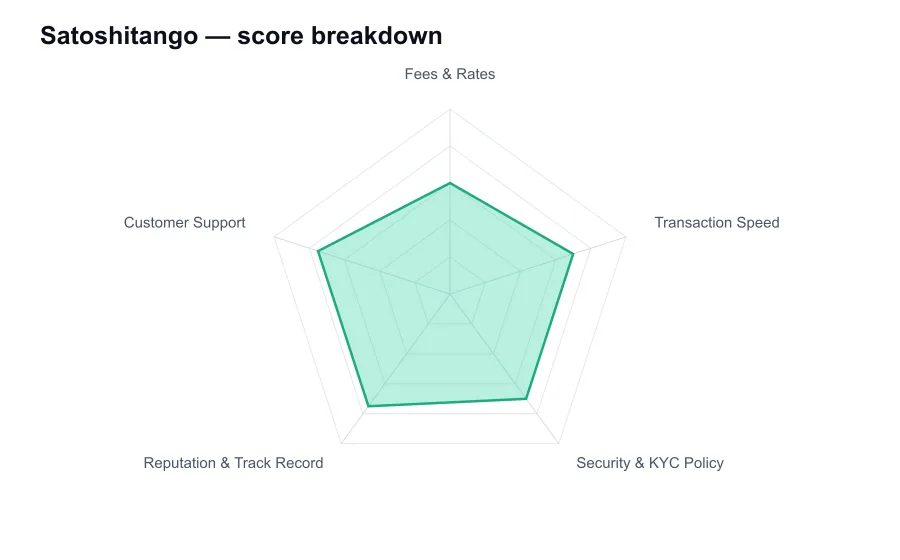
| Criterion | Score | Note |
|---|---|---|
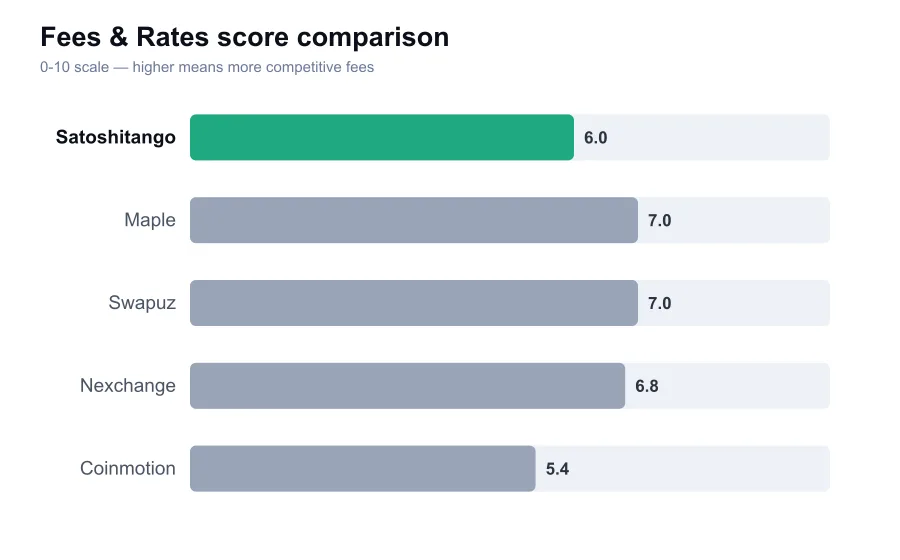
| Fees & Rates | 6.0 | Quote spreads and payment-route costs need checking |
| Transaction Speed | 7.0 | Quick for verified users and local payment flows |
| Security & KYC Policy | 7.0 | KYC-based centralized service, custody risk remains |
| Reputation & Track Record | 7.5 | Argentina-founded platform operating since 2014 |
| Customer Support | 7.5 | Regional Spanish-language focus is a real advantage |
| Fact | Value | Source |
|---|---|---|
| Founded | 2014 | - |
| Origin | Argentina | - |
| Service model | Centralized crypto and payments platform | - |
| Identity policy | KYC required | - |
| Core use | Local fiat-to-crypto access | - |
| Requirement | mandatory |
|---|---|
| Notes | SatoshiTango uses identity verification as part of its centralized fiat and crypto service. Extra review can occur for compliance or transaction-security reasons. |
| Notable Coins | Bitcoin, Ethereum, Tether, USD Coin |
|---|
SatoshiTango is an Argentina-founded cryptocurrency platform built around a practical Latin American use case: buying crypto with local money, moving value across borders, and paying for services in places where banking can be expensive, slow, or awkward. It is closer to a regional financial app with crypto rails than a pure trading venue for chart-watchers. That distinction matters before judging it against Coinbase or Binance.
The company has been operating since 2014, which gives it a longer history than many regional exchanges. It has lived through Argentina's inflation cycles, currency controls, and repeated changes in customer demand. That experience is meaningful. A platform that understands local payment behavior and local support expectations can be more useful to an Argentine user than a larger global brand with little local presence.
SatoshiTango offers buying, selling, swapping, and wallet functionality, with Bitcoin and stablecoins playing an obvious role. For many users, USDT is the practical product rather than an investment novelty. It can be used as a dollar-linked crypto asset for transfers, savings, or settlement. The platform's broader payment orientation has included services beyond spot crypto, which helps explain its appeal in Spanish-speaking markets.
Fees need close attention. SatoshiTango is not built around the ultra-low, clearly published maker and taker pricing that attracts professional traders to a large exchange. The actual cost can be a combination of the quoted crypto price, spread, and the chosen deposit, withdrawal, or payment route. Users should always compare the final amount of crypto received with a second venue, rather than assuming a zero-fee message means no economic cost.
That criticism is not unique to SatoshiTango. Retail platforms serving local payment channels often have higher operational costs than global exchanges funded by deep venture capital and institutional market makers. Still, a customer converting meaningful savings from pesos to USDT should be demanding. Even a modest difference in quote quality matters when repeated every month. Convenience is useful, but it should not become an invisible tax.
Speed is one of the better aspects of the service if the customer's account is already verified and the payment method settles quickly. Internal balance movements and completed crypto trades can be fast. External blockchain withdrawals remain subject to network conditions, wallet checks, and the asset's confirmation rules. A Bitcoin withdrawal during mempool congestion is not suddenly fast because the app's own interface is responsive.
The platform's real strength is that it has a regional operating model. Customers in Argentina and other supported markets can use payment methods and currencies that global competitors may treat as secondary. That can make the first conversion from fiat to crypto much easier. It also gives SatoshiTango an advantage for people who want local-language explanations rather than a generic global help center translated by software.
Security and compliance are not optional on SatoshiTango. Account registration requires identity information, and customers should expect KYC before accessing normal fiat and crypto functions. This is not a no-KYC swap desk. Some people will see that as a drawback, especially those who associate crypto with anonymity. I see it as a reasonable tradeoff for a platform handling local currency rails and payment-oriented services.
KYC does not eliminate user risk. Customers still need a unique password, two-factor authentication where available, and a personal habit of checking withdrawal details. The largest threat for ordinary users is often account takeover through reused passwords, phishing, or social engineering. A platform can have compliance controls and still be unable to protect someone who hands a one-time code to a fraudster.
SatoshiTango's custody setup deserves the same caution applied to every centralized platform. An account balance is a claim against the company, not the same thing as holding keys in a wallet you control. Keeping a working balance there for purchases or quick conversions can make sense. Holding a long-term life savings balance on any exchange, particularly in a country with volatile economic conditions, is a decision that deserves more care.
Its reputation is solid within its home region, though it does not have the globally audited, institutional profile of Kraken or Coinbase. The 2014 founding date is a genuine point in its favor. Surviving a decade in Latin American crypto requires more than good branding. Yet a long-running business should still be judged by present execution, support responsiveness, withdrawal reliability, and current quotes rather than by its age alone.
Support is likely to matter more here than on a platform aimed solely at advanced traders. A user trying to understand a local deposit delay, an identity review, or a card-related issue needs a real answer in Spanish, not a generic warning about blockchain irreversibility. SatoshiTango's regional focus gives it an advantage, although customers should document transactions and contact support through official channels if a deposit or withdrawal needs investigation.
For active speculators, the weaknesses are clear. The trading experience is less compelling than a deep-liquidity global exchange, fee transparency is less crisp, and asset selection is not the main reason to use it. The platform makes more sense as an access point, payment tool, or bridge between local money and major crypto assets. Trying to force it into the role of a professional trading terminal misses what it does well.
My take is that SatoshiTango is a credible regional choice with a real operating history and a useful understanding of Latin American customers. It deserves a better score for local relevance and practical access than for fee clarity or advanced execution. Use it for the jobs it was built to do, particularly local fiat conversion and straightforward crypto use. Compare live quotes carefully, keep substantial long-term holdings in self-custody, and look elsewhere if your priority is the lowest possible trading cost.
| Pros | Cons |
|---|
SatoshiTango fits Argentine and Latin American users who need a familiar route between local money and major cryptocurrencies, especially stablecoins. It is a better match for payments and straightforward conversions than for high-frequency trading. Cost-conscious traders should compare its final quote with Kraken, Binance, or a local order-book exchange. Privacy-first users should look elsewhere because identity checks are part of the service.
SatoshiTango was founded in 2014. That gives it more than a decade of operating history in the Latin American crypto market.
Yes. SatoshiTango is a centralized platform with identity verification for normal account and fiat-related use.
No. Its strongest use case is regional access, payments, and straightforward conversion between local money and crypto rather than advanced order-book trading.
The effective cost may include a quoted spread and payment-route costs. Compare the final crypto amount you receive, not just a headline fee.
You can hold an account balance, but it is custodial. For a long-term holding, a wallet where you control the private keys is generally safer.
No. The platform can process the request quickly, but Bitcoin settlement depends on blockchain confirmations and network congestion.
Users who need local-language help and a practical bridge between regional payment methods, local currency, Bitcoin, and stablecoins benefit most.
| Alternative | Score |
|---|---|
| Coinomi Review | 6.7/10 |
| Maple Review | 6.7/10 |
| Swapuz Review | 6.7/10 |
| Kingex Review | 6.8/10 |
| Changelly Review | 6.8/10 |
| Nexchange Review | 6.8/10 |