Editorial independence: our scores and rankings are produced using the fixed criteria above and are not influenced by advertisers. This is an independent ranking site and is not operated by, or affiliated with, any provider we list.
Affiliate disclosure: some links on this page may earn us a commission at no extra cost to you. This does not affect our rankings.
| Best for | Not for |
|---|
Maple is a decentralized finance credit protocol that connects lenders with institutional and other credit strategies on-chain. It is designed for lending and yield, not ordinary token trading. Its products can involve borrower, liquidity and smart contract risk.
| Criterion | Score | Note |
|---|---|---|
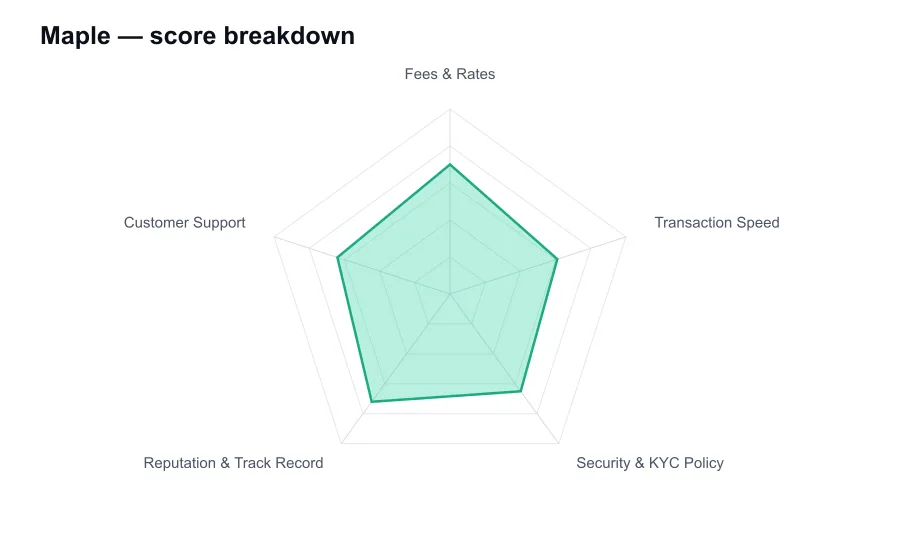
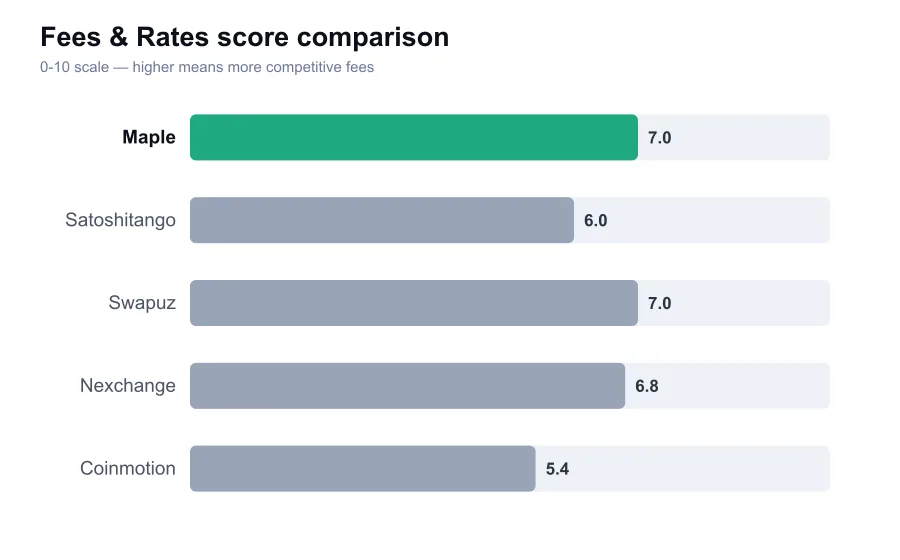
| Fees & Rates | 7.0 | Pool-specific terms are clearer than many yield products. |
| Transaction Speed | 6.1 | On-chain actions are quick, redemptions can be liquidity dependent. |
| Security & KYC Policy | 6.5 | Smart contract security does not remove borrower credit risk. |
| Reputation & Track Record | 7.2 | Established DeFi credit name, tested by a 2022 default. |
| Customer Support | 6.4 | Documentation-led support for sophisticated users. |
| Requirement | tiered |
|---|---|
| Notes | KYC and compliance expectations vary. Institutional borrowers and certain credit arrangements can require due diligence, while some wallet-based DeFi products are permissionless. |
| Notable Coins | USDC, USDT, ETH, WETH, MPL, SYRUP |
|---|---|
| Networks | Ethereum, Base |
Maple is not an exchange in the usual retail sense. It is an on-chain credit and lending protocol that has spent much of its history serving institutional borrowers and lenders, then expanded its product set toward broader DeFi access through Syrup. That distinction is essential. You do not come to Maple to quickly trade BTC for ETH. You come to lend stablecoins, seek yield tied to credit strategies, or understand how on-chain lending can work with underwriting rather than anonymous overcollateralized borrowing.
That makes Maple one of the more interesting projects in DeFi. Protocols such as Aave and Morpho generally center on collateralized markets where rules are enforced automatically. Maple's original model involved delegated credit, borrower assessment, and pool management. It brought real-world credit ideas into public blockchain infrastructure. The upside was potentially higher capital efficiency. The downside was obvious to anyone who has watched traditional lending: someone still has to assess credit correctly.
Fees are not simple trading fees. The cost and yield structure depends on the particular pool, vault, borrower arrangement, asset, and product. Lenders should focus on net annual percentage yield after management fees, performance fees where applicable, losses, and withdrawal conditions. A headline APY is a starting point, not the answer. A yield source that involves credit risk should never be compared casually with a risk-free savings account or a fully collateralized stablecoin pool.
Maple's recent products have commonly centered on stablecoin lending, especially USDC, and on a more accessible yield route through Syrup. The attraction is straightforward: rather than constantly managing positions, a depositor can place stablecoins into a lending strategy and receive a yield-bearing representation of the position. That is convenient. It also means the user is relying on Maple's risk framework, counterparties, smart contracts, and applicable liquidity terms.
The project has earned a better fee score than many opaque yield platforms because its product structure and pool documentation are usually more intelligible than a black-box high-yield service. But it does not deserve a top mark. Lending fees and terms require actual reading, and yield can change. If you cannot explain where the yield originates, who pays it, and how losses would be allocated, you should not deposit.
Transaction speed is mostly a function of the underlying blockchain. Deposits, withdrawals, redemptions, and token transfers are generally on-chain operations, so Ethereum congestion can make a simple action slow or expensive. The deeper timing question is liquidity. In a credit product, the ability to exit may depend on the vault's available liquidity and product-specific redemption rules, rather than an instant market sale.
That is a major difference from a DEX. You might sell a liquid token immediately, accepting market price. A lending position can have a queue, an epoch, a withdrawal window, or limits based on available cash. Maple users need to distinguish settlement speed from liquidity speed. The blockchain confirmation may take minutes. Access to the full deposited principal can be governed by the product's design and current demand.
Security requires a broader lens here. Maple is a DeFi protocol with smart contract exposure, and users should care about audits, admin controls, oracle assumptions, and wallet safety. But smart contract security alone is not enough. Credit risk is central. A perfectly functioning contract can still distribute losses if a borrower defaults or a lending pool has poor underwriting.
Maple has a painful historical lesson on this point. In late 2022, Orthogonal Trading defaulted on approximately $36 million of loans associated with Maple pools after the firm misrepresented its financial condition. That event was not a smart contract exploit. It was a counterparty and credit failure, which is precisely why it matters. Anyone claiming that on-chain lending removes lending risk is selling a fantasy.
To Maple's credit, the protocol did not simply disappear after that period. It has reworked its direction, placed greater focus on institutional lending structures and secured lending approaches, and developed Syrup as a route for broader participation. Survival through a credit crisis is meaningful, but it is not a free pass. A mature review should give Maple credit for persistence while remembering that its model has already been tested under bad conditions.
KYC depends on the specific Maple product and participant role. Institutional borrowing and certain institutional credit arrangements involve compliance and borrower due diligence. A wallet-based user accessing permissionless DeFi products may not go through traditional retail exchange KYC. That does not make the protocol an anonymous escape hatch. Product access, jurisdictional restrictions, and the role a user plays can all change the practical requirements.
Maple's reputation is stronger among DeFi credit professionals than among casual crypto users. It has a recognizable brand, a meaningful operating history, and a clear intellectual position within on-chain finance. It is also inherently more complicated than a simple lending app. The average retail depositor may see an attractive stablecoin yield and miss the embedded assumptions about counterparties, liquidity, and protocol governance.
Support is adequate for a protocol aimed at sophisticated users, but it is not a bank branch and it should not be treated as one. Documentation, dashboards, community channels, and product-specific materials matter. If a user has made an incorrect on-chain transaction, there may be no support route that can undo it. Before depositing, users should read redemption terms and test with a smaller amount rather than assuming their USDC remains instantly available.
My take is that Maple deserves respect, but not passive trust. It is one of the few DeFi projects that has tried to build serious credit infrastructure rather than merely recycle speculative collateral. That ambition brings a different class of risk, one that cannot be solved with a hardware wallet or a smart contract audit. Maple can suit investors who understand credit and can tolerate constrained liquidity. It is a poor fit for anyone treating stablecoin yield as a cash equivalent.
| Pros | Cons |
|---|
Maple fits informed stablecoin lenders and DeFi investors who understand borrower risk, withdrawal terms and smart contract exposure. It can also interest institutions exploring on-chain credit infrastructure. It does not fit users who need instant access to every deposited dollar or who view a yield-bearing stablecoin position as equivalent to cash. Simple traders should use an exchange or DEX instead.
No. Maple is primarily an on-chain credit and lending protocol. Users generally lend assets or access yield products rather than place ordinary spot trades.
In late 2022, Orthogonal Trading defaulted on roughly $36 million of loans linked to Maple pools after misrepresenting its financial position.
Not always. Blockchain settlement can be quick, but access to funds may depend on a vault's liquidity, product terms, redemption queue or withdrawal window.
It depends on the product and role. Institutional borrowing and credit arrangements can involve compliance checks, while some wallet-based DeFi products may not use retail KYC.
Syrup is Maple's DeFi-oriented access layer for stablecoin yield products. Users should still review the underlying lending strategy and redemption conditions.
No. Risks include smart contracts, stablecoin issuer exposure, borrower credit risk, liquidity constraints and changing yield terms.
| Alternative | Score |
|---|---|
| Coinomi Review | 6.7/10 |
| Satoshitango Review | 6.7/10 |
| Swapuz Review | 6.7/10 |
| Kingex Review | 6.8/10 |
| Changelly Review | 6.8/10 |
| Nexchange Review | 6.8/10 |