Editorial independence: our scores and rankings are produced using the fixed criteria above and are not influenced by advertisers. This is an independent ranking site and is not operated by, or affiliated with, any provider we list.
Affiliate disclosure: some links on this page may earn us a commission at no extra cost to you. This does not affect our rankings.
| Best for | Not for |
|---|
Nexchange is a cryptocurrency conversion provider that offers instant swaps and exchange infrastructure for other businesses. Retail users can exchange assets through a quoted order, while developers can use its API to add conversion features to wallets, apps, and other services.
| Criterion | Score | Note |
|---|---|---|
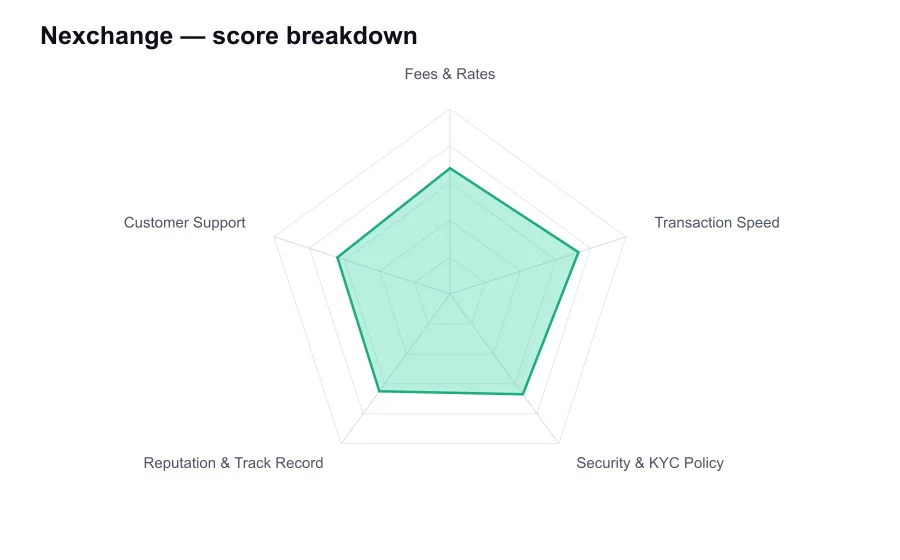
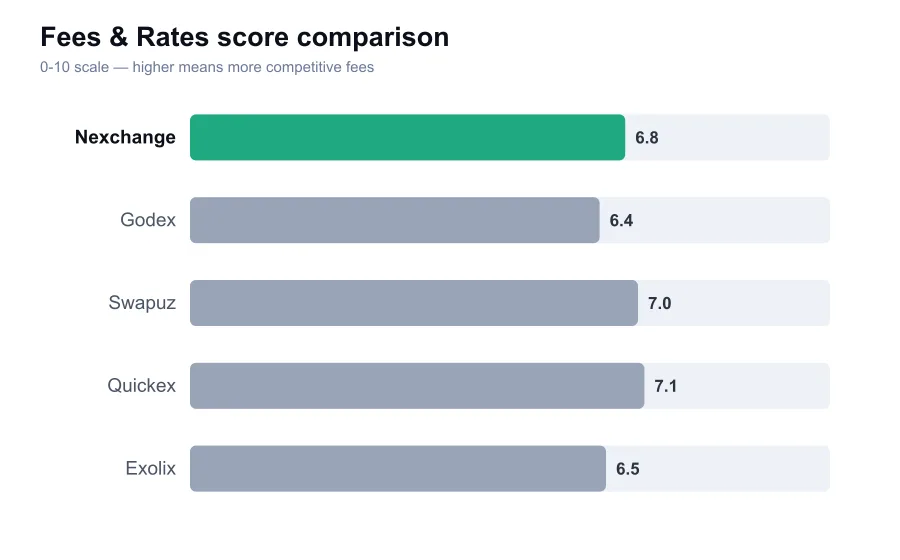
| Fees & Rates | 6.8 | All-in quotes can be competitive, but compare payout across providers. |
| Transaction Speed | 7.3 | Efficient routing, with timing still tied to chain confirmations. |
| Security & KYC Policy | 6.7 | Compliance controls and a business API model, without self-custody. |
| Reputation & Track Record | 6.5 | Established infrastructure focus, but not a top-tier retail brand. |
| Customer Support | 6.4 | Transaction details are essential for resolving edge cases. |
| Fact | Value | Source |
|---|---|---|
| Service model | Instant exchange and API infrastructure | Source |
| Execution model | Quoted conversion, no retail order book | - |
| Business product | API and exchange integration | - |
| Account flow | No account for many standard orders | - |
| Quote types | Floating and fixed-rate options may differ | - |
| Settlement dependency | Blockchain confirmations affect completion | - |
| Requirement | optional |
|---|---|
| Notes | A standard quoted swap can begin without a conventional exchange account. Nexchange may request verification or further details where compliance or transaction-risk controls require it. |
| Notable Coins | Bitcoin, Ethereum, Litecoin, XRP, Tether, USD Coin |
|---|
Nexchange is an instant crypto exchange platform and liquidity infrastructure provider rather than a full retail trading venue. A regular user sees a swap form. A business customer can see something more useful: API-driven exchange functionality that can be embedded into a wallet, payment product, broker, or other crypto application. That dual role gives Nexchange a different character from consumer-first names such as ChangeNOW or StealthEX.
For a user making a single transaction, the process is straightforward. Pick a pair, enter a destination address, create an order, and deposit the required amount. Nexchange then processes the conversion through its liquidity connections and sends the result. There is no familiar exchange book where you can place a bid, watch depth, or cancel a resting order. You are buying execution convenience.
The most important pricing point is that Nexchange quotes an all-in conversion amount. That is normal for instant exchanges, but it makes headline fee comparisons unreliable. The service's economics can include an exchange margin, liquidity-provider costs, and blockchain fees. The only number that matters to the customer is the exact amount expected to arrive in the destination wallet, along with whether that amount is protected by a fixed quote.
Nexchange can be competitive on common pairs, particularly where its liquidity routing is efficient. It should not be assumed to be cheapest. It has no reason to be the cheapest on every route, and neither does any instant exchanger. Someone converting BTC to ETH should open a few tabs and compare the final result. Someone trading actively should stop there and use a liquid spot market, where the fee schedule and order-book spread are visible.
The distinction between fixed and floating execution deserves attention. A floating order exposes the customer to market movement while the deposit travels across the network and receives confirmations. This is often harmless in quiet conditions, but it becomes painful when Bitcoin or a popular altcoin moves several percent in a short period. A fixed quote reduces that price uncertainty, though it may include a slightly wider margin for the provider's risk.
Speed is generally good for an instant exchange because the interface is designed to remove trading steps. Yet fast does not mean immediate. The provider must identify the deposit, wait for the relevant confirmations, complete its liquidity-side trade, and broadcast a payout. Litecoin, XRP, and stablecoin transfers on fast networks can feel quick. Bitcoin and congested Ethereum transactions can take much longer, particularly when the sender uses an inadequate network fee.
Nexchange's API focus is a meaningful strength. Businesses do not build on an instant-exchange provider because its homepage looks attractive. They care about quote reliability, callbacks, status endpoints, liquidity coverage, and a clear way to reconcile transactions. Nexchange has positioned itself for that use case. This is more substantial than a basic swap widget, although the value is mainly for partners rather than a casual retail customer.
The security model is also typical of a non-custodial-style swap service, with an important qualification. You control the destination wallet, but the provider takes custody of the coins you send for the duration of the exchange. It is not a self-custody protocol and there is no smart-contract guarantee that removes counterparty risk. You still need to trust the company to complete the order or resolve a problem fairly.
Nexchange has operated with compliance controls and can require verification in certain circumstances. That is sensible from an anti-fraud perspective, but users should be realistic about what no-registration means. It means a standard order may begin without creating a long-term account. It does not mean a suspicious transaction cannot be paused or that all counterparties will be accepted regardless of jurisdiction or blockchain-risk signals.
The company has a more credible business-facing profile than many anonymous-looking swap sites. Its API offering, documentation, and partner orientation give it a clearer commercial purpose. Still, this is not a household-name exchange with the consumer protections, financial disclosures, or enormous review volume of Coinbase, Kraken, or Binance. It deserves more confidence than a barebones swap page, but less than a heavily regulated, publicly scrutinized platform.
Support quality matters most in edge cases, especially a late deposit, a wrong memo, a transaction sent below the minimum, or a payout delayed by screening. Nexchange's business posture should help it understand transaction tracing, yet individual users must provide accurate details. A support request that includes an order reference, sending address, transaction hash, amount, and network has a chance of being resolved efficiently. A vague message saying money is missing does not.
One operational point is easy to miss. Destination-wallet requirements are not always the same across assets. XRP and some Stellar-based assets can require a destination tag or memo. Exchange deposit addresses may change, and stablecoins exist on multiple chains. If you are swapping into an exchange account, confirm that the recipient exchange accepts that exact asset and network before creating the Nexchange order.
Nexchange is best seen as a capable utility, not a trading home. It makes sense for a wallet user who needs a quick conversion and for businesses seeking exchange infrastructure. It makes less sense for a person trying to optimize every basis point or for anyone who wants margin, advanced charting, custody tools, and a detailed order history inside one account.
My view is positive but measured. Nexchange has a more serious underlying proposition than many small instant exchangers because the API and partner side require operational discipline. Its prices still need checking, its compliance process can still interrupt a transaction, and its retail reputation is not at the level of the biggest exchanges. Use it for convenient swaps or infrastructure, not as a substitute for a transparent trading venue.
| Pros | Cons |
|---|
Nexchange suits wallet users who want a practical one-time conversion and businesses that need embedded crypto exchange functionality. It is especially relevant to product teams looking for quotes and transaction-status integration rather than building their own liquidity stack. Day traders, large-volume execution-focused users, and people who want transparent market depth should use a major spot exchange instead.
Nexchange serves direct swap users and businesses that want crypto exchange infrastructure through an API. Its model is quoted conversion, rather than a retail order-book exchange.
No. A user receives a conversion quote and creates an order. There is no visible market-depth screen for placing bids, offers, or advanced limit orders.
A floating order can move with the market while your deposit is waiting for blockchain confirmations and liquidity-side execution. A fixed quote is preferable when price certainty matters.
Provide the order reference, sending address, blockchain transaction hash, asset, amount, and network. These details allow the transaction to be traced through the deposit and payout stages.
They can. XRP and some other networks use destination tags or memos. Confirm the recipient wallet's exact deposit instructions before creating the conversion order.
Yes. Standard swaps may not require an account, but compliance screening can trigger a request for identity or transaction information in particular cases.
| Alternative | Score |
|---|---|
| Kingex Review | 6.8/10 |
| Changelly Review | 6.8/10 |
| Coinmotion Review | 6.8/10 |
| Godex Review | 6.8/10 |
| EasyBit Review | 6.8/10 |
| Coinomi Review | 6.7/10 |