
Editorial independence: our scores and rankings are produced using the fixed criteria above and are not influenced by advertisers. This is an independent ranking site and is not operated by, or affiliated with, any provider we list.
Affiliate disclosure: some links on this page may earn us a commission at no extra cost to you. This does not affect our rankings.
| Best for | Not for |
|---|
Godex is a crypto-to-crypto instant exchange service. It routes a selected swap through its infrastructure and liquidity partners rather than offering a traditional trading account and order book. Users send crypto from a wallet and receive the exchanged asset at another wallet address.
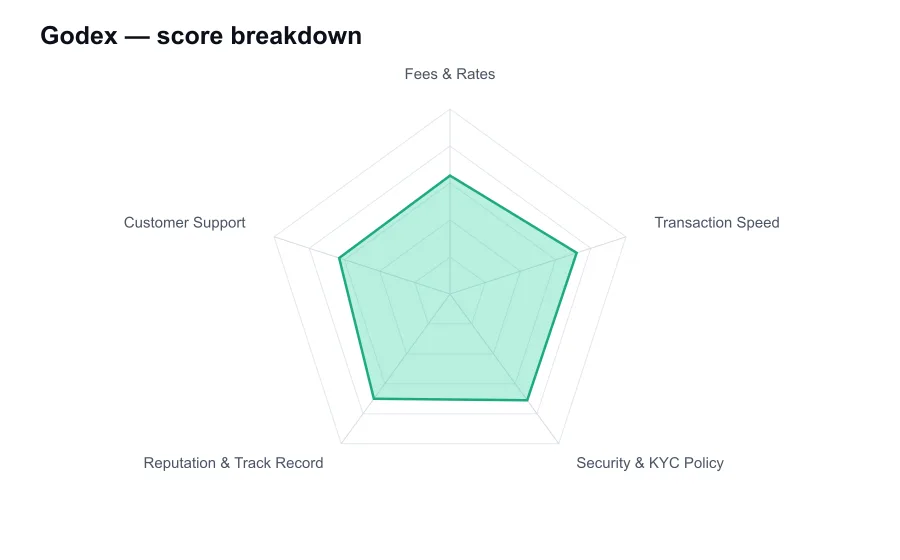
| Criterion | Score | Note |
|---|---|---|
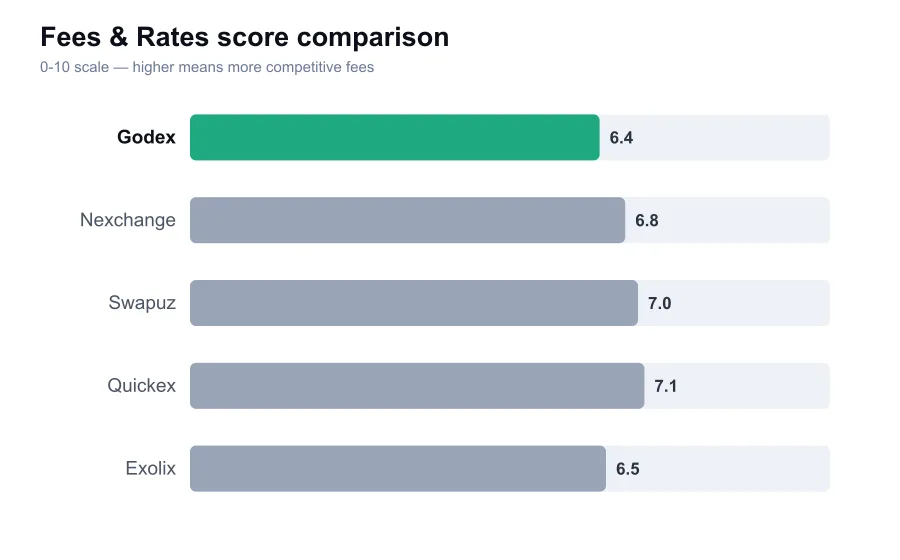
| Fees & Rates | 6.4 | 0.5% stated floating fee, plus spread and network costs |
| Transaction Speed | 7.2 | Usually minutes, but network and partner delays occur |
| Security & KYC Policy | 7.1 | No account custody, though reviews can still be triggered |
| Reputation & Track Record | 7.0 | Operating since 2018 with an established swap-service record |
| Customer Support | 6.3 | Live chat available, partner-related cases can drag on |
| Requirement | optional |
|---|---|
| Notes | Godex does not normally require registration or KYC, but it may request information for transactions flagged by compliance or risk systems. |
| Coins | 300 |
|---|---|
| Notable Coins | Bitcoin, Ethereum, Tether, Monero, Litecoin, XRP, Solana, Dogecoin |
| Networks | Bitcoin, Ethereum, Tron, Solana |
Godex is a non-custodial instant exchange service aimed at people who want to swap crypto without opening a trading account. It sits closer to ChangeNOW, SimpleSwap, and StealthEX than to a full exchange such as Kraken or WhiteBIT. There is no order book to study, no advanced trading screen, and no fiat gateway. You select a pair, enter a receiving address, send the deposit, and wait for the service and its liquidity partners to complete the conversion.
The appeal is obvious. Godex asks for very little personal information in a normal swap flow and does not require users to keep a balance on the platform. For a user moving from BTC to XMR, or converting an altcoin held in a self-custody wallet into ETH, that can be much less intrusive than registering with a centralized exchange. It is also simpler than routing funds through a DEX, bridging them, and paying several separate network fees.
Godex advertises more than 300 supported cryptocurrencies, although the practical selection changes with partner liquidity and network conditions. Major coins such as Bitcoin, Ethereum, Litecoin, Monero, USDT, XRP, Solana, and Dogecoin are the sensible reason to use it. Obscure pairs may appear in the interface but can carry higher spreads, slower completion, or a temporarily unavailable quote. I would not treat a visible pair as proof that it is a good market.
Fees are Godex's weak point, at least for anyone comparing it with a liquid centralized exchange. The service states that its floating-rate exchange fee is 0.5 percent, but that is only part of the price. The final rate also reflects partner liquidity, market movement, and network costs. A 0.5 percent fee can be acceptable for a private one-off swap. It is expensive if you are doing repeated conversions or moving a large portfolio.
The distinction between a quoted rate and a final received amount matters here. Godex offers floating-rate swaps and fixed-rate swaps. A floating transaction can settle at a better or worse rate if the market moves after your deposit arrives. A fixed quote gives more certainty, though the protection is usually priced into the rate. For a volatile pair, fixed rate is often worth paying for. For a stablecoin conversion on the same chain, compare the result against a DEX or exchange first because Godex can be noticeably pricier.
Godex does not charge users in the familiar maker and taker model, because it is not operating a public exchange book. That makes the site feel clean, but it can obscure the true all-in cost. The only comparison that matters is the amount you will receive after every fee and spread. Check that figure against at least one competitor before sending. Godex is convenient, not reliably the cheapest option.
Speed is generally solid for ordinary, well-supported routes. An ETH or USDT swap can finish in minutes after the required blockchain confirmations, while Bitcoin deposits naturally take longer. Godex itself cannot remove Bitcoin's confirmation delay or speed up a congested Ethereum block. It can, however, add delay if a partner needs to source liquidity or if the quoted route changes after a sharp market move.
The service gives each transaction an identifier and status page, which is useful, though the wording can be too vague during an extended wait. A swap marked as processing does not tell a worried customer much about whether the delay is a blockchain issue, a liquidity issue, or an internal review. For small routine transfers that is usually tolerable. For a time-sensitive payment or a trade that depends on an exact arrival window, it is not.
Godex markets itself as a no-registration and no-KYC service. That is broadly true for ordinary swaps, but it should not be read as an unconditional promise. Like nearly every instant exchanger, it can request information when its partners flag a transaction for compliance or risk reasons. Its terms also make clear that suspicious funds may be reviewed. Anyone claiming that a swap intermediary can guarantee zero compliance checks is selling fantasy.
The platform's non-custodial design reduces a particular kind of risk. You do not leave an account balance sitting on Godex for months waiting to be hacked or frozen. Yet the service takes custody during the swap, and you still have to trust it to deliver the purchased asset. This is not a trustless DEX transaction. Copying the receiving address incorrectly or selecting the wrong network can still produce a permanent loss.
Godex has been around since 2018, which gives it a longer record than many exchange widgets that appear and disappear within a year. Its public reputation is reasonably established in the instant-swap category, though it does not have the deep regulatory record, audited reporting, or institutional standing of major centralized exchanges. There have been customer complaints about delays and rate changes, which is normal for this segment but still relevant when you are deciding where to send a large amount.
Support is available through the website's live chat and email channels. In practice, support quality is strongest for a simple status question and much weaker for cases involving an external liquidity partner or a compliance review. That is a structural issue with aggregating liquidity. The front-end provider can answer you, but it may need another company to solve the actual problem. Save the transaction ID, deposit hash, amount, and screenshots before contacting support.
I like Godex for a modest, uncomplicated crypto-to-crypto conversion where account privacy and ease matter more than getting the tightest possible price. It is a poor fit for active traders, anyone requiring guaranteed execution, and anyone who will panic if a transaction takes an hour rather than ten minutes. A centralized exchange will usually be cheaper. A DEX may be more transparent. Godex's case is convenience with relatively little account friction.
My view is that Godex is competent but should be used with discipline. Run a small test if you have not used a route before, select fixed rate for volatile assets, and do not assume no-KYC branding means a transaction can never be paused. The service earns credit for a straightforward non-custodial workflow and broad coin support. It loses points because its pricing is less competitive than it first appears and its support has limited control over partner-side problems.
| Pros | Cons |
|---|
Godex fits self-custody users making occasional crypto-to-crypto swaps, especially people who do not want to open another exchange account. It is useful for converting major coins and privacy-oriented assets in modest sizes. Active traders, large-volume users, and anyone needing the tightest spread should use a liquid CEX or DEX instead. Avoid using it for deadline-critical transfers.
Godex states a 0.5% fee for floating-rate exchanges. The final receive amount can also include liquidity spread and blockchain network costs, so compare the quoted output before sending.
Normal swaps do not require account registration or routine KYC. A transaction can still be reviewed if a partner or compliance system flags it.
Yes. Godex offers fixed-rate swaps as well as floating-rate swaps. Fixed quotes reduce exposure to price moves while your deposit is confirming.
Common causes include required deposit confirmations, blockchain congestion, a sharp market move, or a liquidity-partner delay. Keep the transaction ID and deposit hash for support.
Godex does not provide a long-term exchange account balance. Funds are sent to a generated address for the specific conversion and are held during processing.
Yes. Match the deposit network exactly. Sending an asset through an unsupported network or to the wrong address can make recovery difficult or impossible.
| Alternative | Score |
|---|---|
| Kingex Review | 6.8/10 |
| Changelly Review | 6.8/10 |
| Nexchange Review | 6.8/10 |
| Coinmotion Review | 6.8/10 |
| EasyBit Review | 6.8/10 |
| Coinomi Review | 6.7/10 |