
Editorial independence: our scores and rankings are produced using the fixed criteria above and are not influenced by advertisers. This is an independent ranking site and is not operated by, or affiliated with, any provider we list.
Affiliate disclosure: some links on this page may earn us a commission at no extra cost to you. This does not affect our rankings.
| Best for | Not for |
|---|
Coinmotion is a Finnish custodial crypto service for buying, selling, storing and transferring selected digital assets. It focuses on euro users, recurring purchases and a regulated customer experience rather than advanced exchange trading.
| Criterion | Score | Note |
|---|---|---|
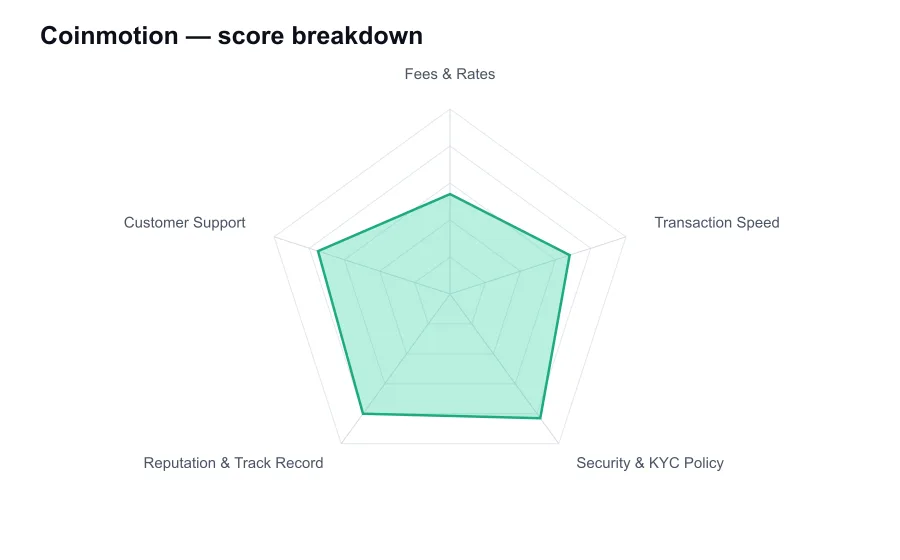
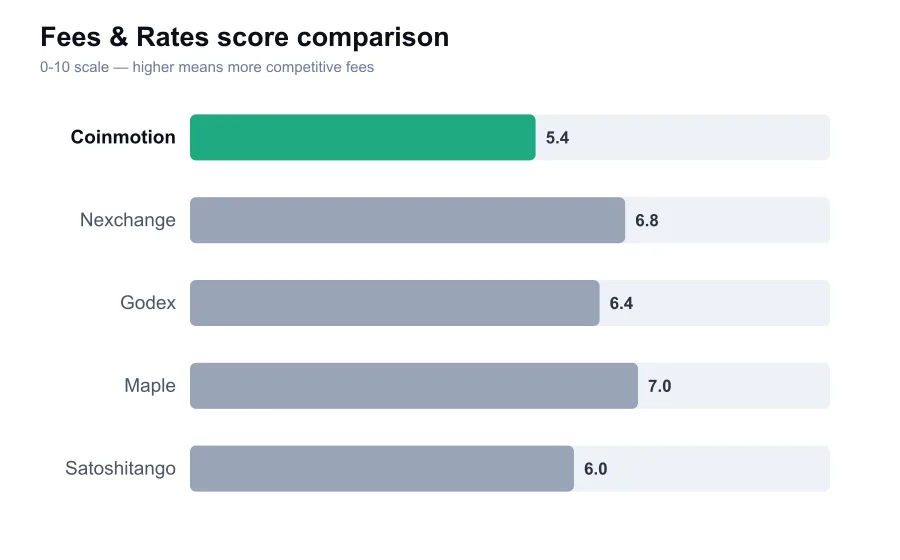
| Fees & Rates | 5.4 | Basic trading pricing around 2% is expensive for active users. |
| Transaction Speed | 6.8 | Useful SEPA access, but built for investing rather than rapid trading. |
| Security & KYC Policy | 8.3 | Mandatory KYC and FIN-FSA supervision support a cautious model. |
| Reputation & Track Record | 8.0 | Finnish operator active since 2012 with a conservative focus. |
| Customer Support | 7.5 | European-oriented customer service and private-client assistance. |
| Requirement | mandatory |
|---|---|
| Notes | Coinmotion requires identification and may request information about funds or transactions as part of its Finnish compliance obligations. |
| Notable Coins | Bitcoin, Ethereum, Litecoin, XRP, Stellar, USD Coin |
|---|
| Global | No |
|---|---|
| Notes | Coinmotion is aimed principally at European customers and its payment features depend on country eligibility. |
| iOS | Yes |
|---|---|
| Android | Yes |
| Notes | Coinmotion offers mobile access for account management and crypto transactions. |
Coinmotion is a Finnish crypto service that positions itself much more like a digital-asset financial provider than a high-turnover exchange. It began in 2012 under the name Bittiraha and later became Coinmotion. The company targets European users who want euro banking connections, custody, recurring purchases and a relatively calm interface. That makes it a serious alternative for conservative buyers, though it is a poor match for anyone expecting Binance-style market depth or a large catalogue of speculative tokens.
The service is built around buying, selling, holding and transferring a small set of established cryptoassets. Coinmotion also offers recurring purchases, a crypto savings approach, a payment card in supported areas and private-client services. The design is intentionally less intimidating than an advanced trading terminal. Beginners can understand it quickly. More experienced traders may find the absence of a deep order book and a wide range of order types restrictive.
Price is Coinmotion's biggest weakness. Standard buying and selling fees are commonly presented in tiers, with the basic level around 2% and lower rates available through volume or membership arrangements. Two percent is expensive in a market where serious spot exchanges routinely charge fractions of one percent. The company makes the process simple, but simplicity is not free. A user buying Bitcoin every month for years should calculate that drag carefully.
There are ways to reduce the damage. Higher account tiers and larger activity can bring pricing down, and recurring buying may appeal to people who value automation more than execution precision. Yet Coinmotion is still not where I would send a price-sensitive large order. Kraken Pro, Coinbase Advanced and Bitstamp generally offer a more competitive route for users happy to work with an order book. Coinmotion's fees only make sense if its service model genuinely saves you hassle.
SEPA transfers are central to the experience. Euro deposits and withdrawals are generally practical for customers in the European Economic Area, although banks and compliance reviews determine the real timing. Crypto deposits rely on the relevant blockchain confirmations. Coinmotion is quick enough for routine investing, but it is not optimized for rapid intraday trading. A bank transfer, account review or manual withdrawal check can turn a supposedly simple trade into a next-day task.
The platform's speed is therefore best judged as administrative reliability rather than trading velocity. Buying a major asset after a settled euro deposit is straightforward. Moving money in from a bank, getting enhanced verification approved or withdrawing a significant amount may take longer. That is normal for a regulated custodial business, but Coinmotion does little to hide the fact that it prefers measured controls to instant gratification.
Security standards are a genuine strength. Coinmotion is a Finnish virtual currency provider supervised by Finland's Financial Supervisory Authority, known as FIN-FSA. It requires customer identification and applies anti-money-laundering procedures. Its custody model includes cold storage, and it has promoted multi-signature controls for stored assets. None of this removes the risks of leaving coins with a company, but it is a more credible foundation than an anonymous broker with no clear jurisdiction.
KYC is mandatory, and users should expect the kind of source-of-funds questions that go with a regulated European provider. That can frustrate crypto natives who believe every transfer deserves instant approval. Frankly, that audience should not choose Coinmotion in the first place. The service is designed for users who accept that fiat access and custody services involve identification, monitoring and occasional questions about transactions.
Coinmotion has one advantage that does not show in a fee table, it has been operating since 2012. That puts it among the older surviving European crypto businesses. Its public profile is lower than Coinbase or Bitstamp, but its history through several Bitcoin cycles matters. It has not built its reputation by chasing every hot token or promising impossible yields. The company has instead concentrated on an identifiable European customer base and regulated operations.
That conservatism has a cost. The asset offering is narrow, and users looking for newer Layer 1 tokens, microcaps, futures or on-chain DeFi access will quickly run out of road. Coinmotion is principally a way to acquire and hold a core crypto allocation, not a complete crypto workstation. Its own custody can be useful for convenience, but users who understand self-custody should still consider withdrawing longer-term balances.
Support is generally more personal than what customers receive from the largest global exchanges. The company offers help material and customer service, and it has historically emphasized Finnish and European accessibility. Premium customers receive more dedicated service. Basic users should still expect normal ticket queues, especially where identity documents or a transaction review are involved. There is no realistic reason to assume that a support agent can override a compliance hold immediately.
The Coinmotion card is one of its more distinctive consumer features, though it should not be confused with a reason to hold all savings on the platform. Spending crypto through a card can create a taxable disposal depending on the user's jurisdiction. It may be convenient for occasional use, but constantly converting volatile assets into purchases is rarely the most disciplined investment plan. The card is a useful option, not the centre of the product.
For a European buyer who wants to automate a modest monthly Bitcoin or Ether allocation, Coinmotion can be pleasant. The interface is less overwhelming than professional trading software, and the regulated Finnish identity gives cautious users some comfort. For a sophisticated trader, the same features look restrictive. The cost gap becomes hard to justify once order size rises, and limited asset choice means most active users will eventually need another venue.
My judgment is fairly blunt. Coinmotion is trustworthy enough to consider, but its standard pricing is too high to call it good value for frequent or large trades. It works best as a simple, regulated euro gateway for people who prioritize ease and local accountability over best execution. Use it for that narrow purpose and it can be a good service. Treat it as a low-cost universal exchange and disappointment will follow.
| Pros | Cons |
|---|
Coinmotion fits European beginners, long-term Bitcoin buyers and customers who want a Finnish regulated provider with euro access. It can also suit people using recurring purchases who value a simple interface more than tight execution. Frequent traders, large buyers and users seeking many altcoins should use a lower-fee order-book exchange instead.
Coinmotion's basic buying and selling level is commonly shown around 2%, with lower pricing available through higher tiers or activity.
Yes. Coinmotion is a regulated Finnish virtual currency provider and requires customer identification for its services.
Coinmotion is supervised in Finland by the Finnish Financial Supervisory Authority, commonly called FIN-FSA, as a virtual currency provider.
Yes. Coinmotion is built around euro use and SEPA transfers for eligible European customers.
No. Its interface and fee model are better suited to investing and recurring purchases than high-frequency or price-sensitive trading.
The business originally operated under the name Bittiraha before becoming Coinmotion.
| Alternative | Score |
|---|---|
| Kingex Review | 6.8/10 |
| Changelly Review | 6.8/10 |
| Nexchange Review | 6.8/10 |
| Godex Review | 6.8/10 |
| EasyBit Review | 6.8/10 |
| Coinomi Review | 6.7/10 |