
Editorial independence: our scores and rankings are produced using the fixed criteria above and are not influenced by advertisers. This is an independent ranking site and is not operated by, or affiliated with, any provider we list.
Affiliate disclosure: some links on this page may earn us a commission at no extra cost to you. This does not affect our rankings.
| Best for | Not for |
|---|
| Criterion | Score | Note |
|---|---|---|
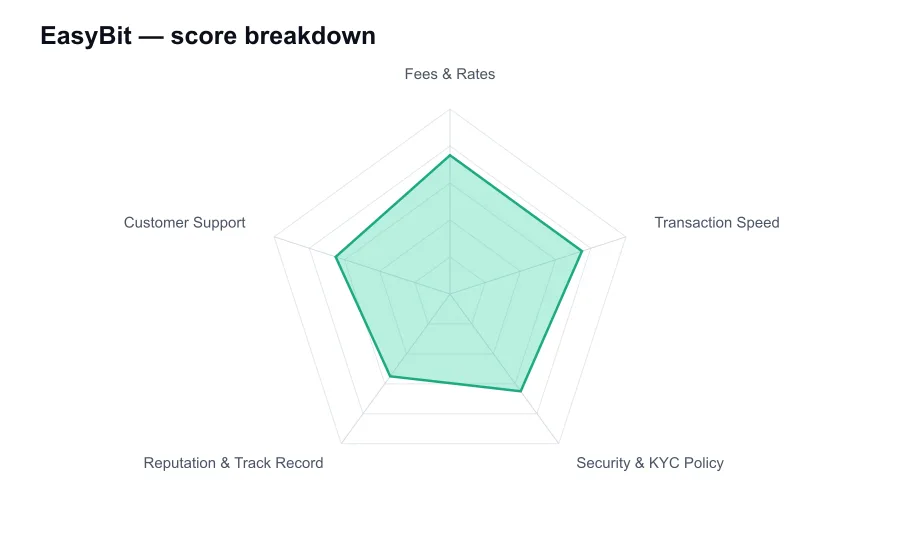
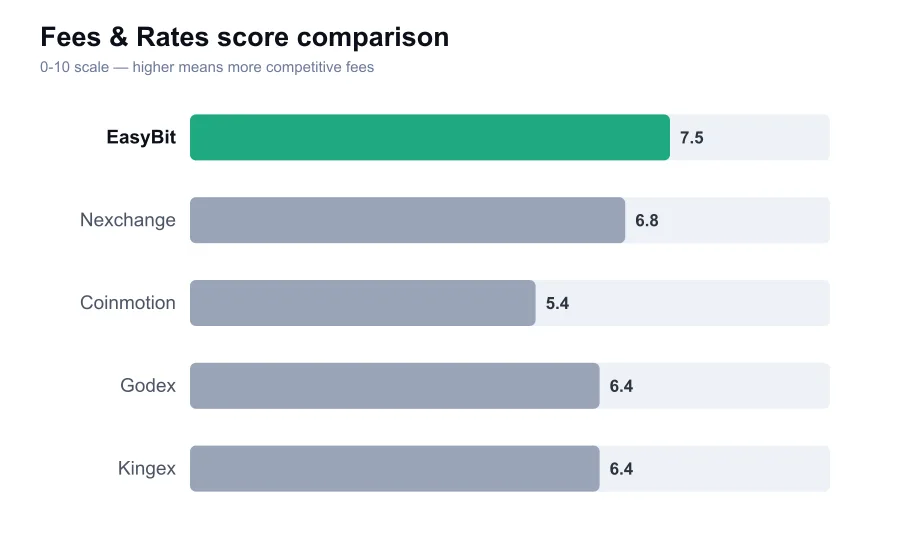
| Fees & Rates | 7.5 | Advertised low service fee, though route spreads still matter |
| Transaction Speed | 7.5 | Quick for liquid pairs once the deposit is confirmed |
| Security & KYC Policy | 6.5 | No-registration flow, with AML checks possible on flagged swaps |
| Reputation & Track Record | 5.5 | Useful service, but with a lighter public track record |
| Customer Support | 6.5 | Live chat and email are available around the clock |
EasyBit is a smaller instant exchange service aimed at people who want to swap crypto directly from one wallet to another without opening a full trading account. Its pitch is familiar, but the site has a cleaner and more focused feel than some of the sprawling aggregators in this niche. It emphasizes quick exchanges, no registration for standard transactions, and access to a sizeable range of assets. The appeal is obvious for a user who wants utility rather than an exchange relationship.
The service is simple enough that a first-time user can understand it quickly. Choose the send asset and amount, select the receive asset, enter a wallet address, and follow the payment instructions. EasyBit then processes the route and delivers the output. There is no custody dashboard with a balance to manage, which reduces one category of risk. It also means that accuracy matters from the first screen, because there is no account ledger to repair a bad address later.
EasyBit is more open than some instant swap services about the idea that its rate includes a service charge. The company has promoted rates built around a 0.2 percent service fee on certain exchanges, though that should not be read as a universal final cost for every pair. The quote can still include network expenses, liquidity conditions, and a margin related to the route. Users should treat the receive amount as the number that matters.
That approach is fair enough if the quote remains competitive, and often it does on mainstream pairs. It can compare well with larger no-account services for modest BTC, ETH, LTC, SOL, or stablecoin swaps. The weakness appears in less liquid assets and during sharp market movement, where available routes can thin out. EasyBit does not have the market depth or public institutional profile of a major exchange, so it is unwise to assume every pair will be efficiently priced.
The platform offers floating-rate and fixed-rate choices. Floating swaps can produce a better result if the market moves in your favor, but the amount received is not guaranteed. Fixed swaps are more practical for people paying an invoice, rebalancing a wallet at a precise value, or simply nervous about volatility. As with competitors, fixed pricing tends to cost more because the provider is assuming the short-term price risk. That premium can be justified, but only if you actually need the certainty.
EasyBit is generally quick on straightforward transactions. With a fast incoming chain and a liquid outgoing asset, it can complete a conversion within minutes after the deposit has been accepted. The marketing language around speed should still be read with common sense. A Bitcoin transaction waiting for confirmations, a congested Ethereum transfer, or an unusual token route can turn a quick swap into a long wait. No instant exchange can fully solve that.
I like that the exchange flow makes the transaction status relatively easy to follow. Users can see whether a deposit has been detected, whether the conversion is under way, and whether the payout has been broadcast. That visibility is more valuable than flashy design. The downside is that a status label does not always tell you why a transfer is delayed, particularly when the delay sits with a liquidity source or a blockchain rather than EasyBit itself.
EasyBit operates on a no-registration model for typical use. That is one reason it attracts privacy-conscious crypto holders. But no-registration is not identical to no-KYC in every circumstance. The company retains the ability to request verification if a transaction triggers its AML controls, and it may pause funds while that process is handled. That is a standard reality for centralized instant exchangers, even ones that advertise privacy prominently.
This is the point where I would be careful with large transfers. A smaller provider cannot offer the same level of public regulatory disclosure, financial transparency, or independently verifiable reserves as a major licensed exchange. EasyBit's noncustodial structure reduces the danger of leaving a large balance on the platform, which is good. During a swap, however, you still depend on the company and its counterparties to send the output. Keep the distinction clear.
EasyBit's public reputation is more limited than that of ChangeNOW or Changelly. That does not make it suspect by itself, and many users report smooth transactions. It does mean there is less history to examine when things go wrong. Smaller services can be excellent until a difficult support or liquidity event exposes their limits. I would treat its lighter track record as a reason to start carefully, not as proof that the service is unreliable.
Customer support is available through live chat and email, and the site presents itself as a 24/7 operation. For a normal question or an incorrectly timed deposit, this sort of direct access is helpful. It is less certain how well the support structure scales during a wave of market volatility or compliance reviews. The difference between good support and great support is not a chatbot response. It is whether someone can explain a stuck transaction and own it to resolution.
EasyBit does deserve credit for not trying to be everything. It is not pretending to be a derivatives exchange, staking platform, social network, and debit-card issuer all at once. That narrow focus helps its usability. It also means you will need another platform for limit orders, recurring buys, fiat withdrawals, tax reporting, or advanced portfolio management. For some people, that is a feature rather than a shortcoming.
Before using it, check the minimum and maximum limits for your chosen pair, confirm the exact network, and compare both floating and fixed quotes. Stablecoin transfers are especially easy to mishandle because the same ticker can exist on several networks. Sending USDT on an unsupported chain is a far more serious problem than paying a slightly higher exchange spread. A small test transfer is sensible if you are trying an unfamiliar route.
EasyBit is a credible option for modest self-custody swaps, particularly for users who value a clean interface and do not want to submit documents before every ordinary transaction. It is not the provider I would choose blindly for a major conversion, mostly because its public track record is shorter and thinner than the category leaders. Its pricing can be good, its speed is often good, and its limits are the familiar limits of a smaller centralized intermediary. Use it deliberately, not casually.
| Pros | Cons |
|---|
EasyBit suits experienced self-custody users making modest swaps between common assets, especially people who prefer a stripped-back interface. It is also a reasonable option for testing fixed-rate conversions before a payment or transfer. Users exchanging large sums, requiring detailed regulatory assurances, or wanting advanced order types should choose a major exchange instead.
EasyBit has promoted a 0.2% service fee on certain exchanges, but the final quote also reflects liquidity conditions and blockchain network costs.
Standard swaps can generally be made without registration. EasyBit may request verification if its compliance systems flag a transaction.
Yes, fixed-rate and floating-rate routes are offered for supported pairs. Fixed pricing provides certainty but may include a higher premium.
| Alternative | Score |
|---|---|
| Kingex Review | 6.8/10 |
| Changelly Review | 6.8/10 |
| Nexchange Review | 6.8/10 |
| Coinmotion Review | 6.8/10 |
| Godex Review | 6.8/10 |
| Coinomi Review | 6.7/10 |