Editorial independence: our scores and rankings are produced using the fixed criteria above and are not influenced by advertisers. This is an independent ranking site and is not operated by, or affiliated with, any provider we list.
Affiliate disclosure: some links on this page may earn us a commission at no extra cost to you. This does not affect our rankings.
| Best for | Not for |
|---|
Trocador is a crypto swap aggregator that compares offers from several instant exchange providers. It does not work like a conventional spot exchange with a public order book. Users select a quoted route, send crypto from their wallet, and receive the converted asset from the provider handling that route.
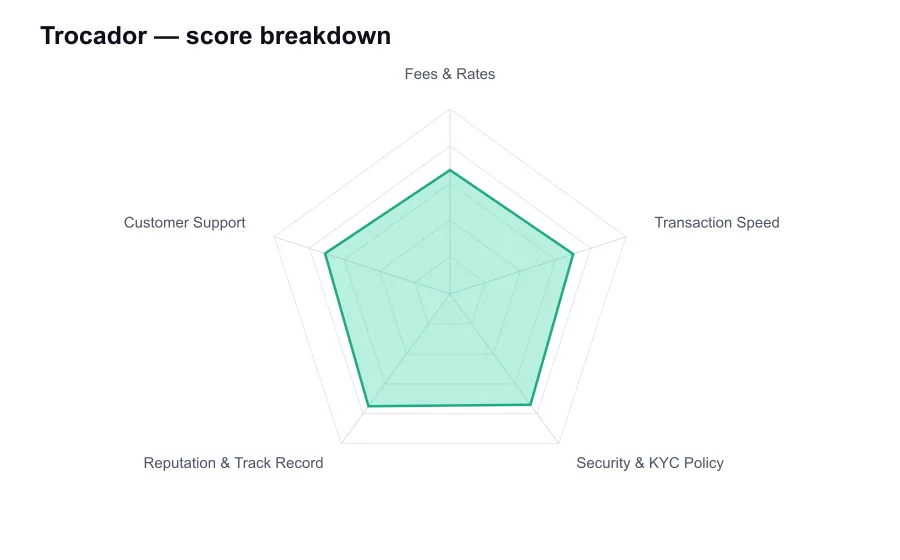
| Criterion | Score | Note |
|---|---|---|
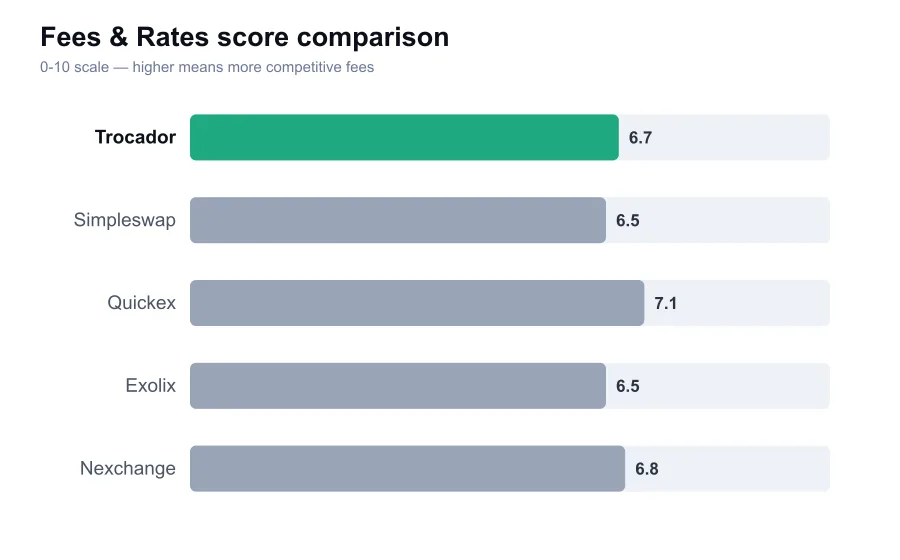
| Fees & Rates | 6.7 | About 0.5% platform fee, included in quoted routes |
| Transaction Speed | 7.0 | Speed depends heavily on the selected exchange partner |
| Security & KYC Policy | 7.4 | No standard account KYC, with partner-level review risk |
| Reputation & Track Record | 7.5 | Established 2019 privacy-focused aggregator |
| Customer Support | 7.1 | Responsive intermediary, but partners control execution |
| Requirement | optional |
|---|---|
| Notes | Trocador itself generally does not request routine KYC. The exchange provider chosen for a route can place a transaction under review and request documents. |
| Notable Coins | Bitcoin, Ethereum, Monero, Litecoin, Tether, USD Coin, Solana, Dogecoin |
|---|
Trocador is an instant-exchange aggregator with a distinctly privacy-minded identity. Rather than operating a conventional order book, it compares offers from third-party swap providers and presents routes to the user. That puts it in the same broad category as Swapzone and some exchange comparison widgets, but Trocador has built a following among users who care about no-account swaps, Monero access, and clearer information about whether a partner may ask for verification.
Its central idea is sensible. One instant exchanger can have excellent liquidity for BTC to ETH and an unattractive rate for LTC to XMR. Trocador lets you compare several providers without visiting each site individually. The comparison is useful because instant-exchange pricing is famously inconsistent. A provider advertising no fee can still offer a poor effective rate, while another with a visible fee may deliver more crypto to your wallet.
Trocador charges a platform fee that is generally included in the displayed quote. The standard rate has commonly been 0.5 percent, although the final price also depends on the provider selected, the pair, and blockchain conditions. That makes Trocador more expensive than trading on a liquid exchange book, where spot fees can be around 0.1 percent or lower. It can still be competitive against other instant exchangers because its comparison tool exposes routes that a user might otherwise miss.
Do not mistake the word aggregator for a guarantee of best execution. The best result shown by Trocador is the best result among currently integrated routes, not the best possible route across every DEX, exchange, OTC desk, and bridge. Stablecoin swaps are a good example. A user with USDC on Ethereum may find that a DEX route is cheaper, while someone moving BTC into Monero may find Trocador far more convenient than managing multiple platforms.
The interface offers fixed-rate and floating-rate options where the underlying provider supports them. Fixed rate is the safer choice when sending a volatile coin with slow confirmations, especially Bitcoin. Floating rate can be reasonable for a quick, liquid conversion, but the final amount is exposed to market movement between quote and settlement. Read the provider name before proceeding. Trocador is the comparison layer, while the actual exchange execution can be handled by another company.
That distinction shapes the speed experience. A fast partner can complete a popular pair in minutes once a deposit has the needed confirmations. A route involving Bitcoin, Monero, an illiquid token, or a congested chain may take much longer. Trocador cannot force its partners to process faster. It can show status information and help chase an issue, but it cannot fully control the wallet operations or compliance decisions made downstream.
One of Trocador's better ideas is its provider information and anonymity-oriented labeling. It gives users a way to think about privacy risk before choosing a route. That is more honest than pretending every instant exchanger has the same policy. Some partners process normal swaps without identity checks but reserve the right to request documents. Others are visibly more compliance-heavy. A privacy score is useful guidance, not a legal shield.
Trocador itself does not normally require an account or standard KYC for the swap interface. The catch is important: an integrated provider can still pause a transaction and request verification. That is not a rare theoretical exception in crypto. Chain-analysis flags, unusually large amounts, source-of-funds concerns, and mismatched transaction patterns can all cause a hold. If you cannot tolerate that possibility, no intermediary route is a safe choice.
The service is particularly relevant for Monero users because it has maintained an interest in privacy coins at a time when many centralized exchanges have removed or restricted them. That does not mean every XMR route will always be available, or that every country can legally use the same services. It does mean that Trocador has a clearer niche than a generic exchange widget trying to list every token under the sun.
Trocador also offers a Safe feature intended to add a layer of protection to supported exchanges by holding the provider's reserve as a safeguard for an eligible transaction. It is an interesting response to the ugly reality of instant-exchange failures. Still, users should read the conditions carefully instead of assuming every quote carries the same protection. A safeguard mechanism is valuable only if the precise route, amount, and dispute fit its rules.
Its reputation is stronger within privacy-focused crypto circles than among mainstream retail traders. The project has operated since 2019 and has survived long enough to establish recognizable branding, which matters in a sector full of disposable clones. It does not have the regulated status, audited financial disclosures, or scale of a large centralized exchange. Its business also inherits the reputational risk of every third-party provider it lists.
Support is available through the site, and the team is often more accessible than support desks at giant exchanges. That is a real benefit for a stuck swap. But a friendly support channel is not the same as direct operational control. If the selected provider has frozen funds for review, Trocador may be an advocate and messenger rather than the party able to release the money.
I would choose Trocador over a single instant exchanger when I want to compare routes without creating accounts, especially for BTC, LTC, and XMR conversions. I would not use it as a substitute for a serious trading venue. The aggregator structure is excellent for discovery and convenience. It adds another layer between the user and the company actually touching the funds, which complicates disputes.
Trocador deserves a good score for product focus rather than a perfect score for trust. It gives privacy-minded users tools that many mainstream platforms have abandoned, and it does a better job than most at acknowledging provider differences. Fees remain meaningfully higher than direct exchange trading, and the no-KYC experience has conditions attached through partners. Use it for deliberate, wallet-to-wallet swaps, not for frantic trades or transfers where a compliance hold would be catastrophic.
| Pros | Cons |
|---|
Trocador suits privacy-conscious self-custody users who want to compare instant-swap quotes, particularly for Bitcoin, Litecoin, and Monero routes. It is a practical tool for occasional conversions without a trading account. Day traders and users moving large sums on a deadline should look to a liquid exchange or a direct, audited protocol. Anyone unable to provide documents if challenged should avoid routes with lower anonymity ratings.
Trocador's standard platform fee is generally 0.5% and is included in the displayed quote. The selected provider's pricing and network costs also affect the final amount.
Trocador does not normally require an account or routine KYC. Its partner exchanges may request verification if a transaction is flagged.
Trocador Safe is a protection mechanism for eligible routes that uses an exchange reserve as a safeguard. Check the route-specific conditions before relying on it.
Trocador is an aggregator. It compares offers from integrated instant exchangers, and the provider selected on the quote normally executes the swap.
Trocador is known for listing privacy-focused routes, including Monero where an integrated provider has liquidity. Availability and limits can change by provider.
It is a guide to the provider's stated privacy and KYC posture. It does not guarantee that a particular transaction will never be reviewed or delayed.
| Alternative | Score |
|---|---|
| Simpleswap Review | 7.0/10 |
| Curve Review | 7.1/10 |
| Nexo Review | 7.1/10 |
| Quickex Review | 6.9/10 |
| Anycoin Review | 6.9/10 |
| Exolix Review | 6.9/10 |