
Editorial independence: our scores and rankings are produced using the fixed criteria above and are not influenced by advertisers. This is an independent ranking site and is not operated by, or affiliated with, any provider we list.
Affiliate disclosure: some links on this page may earn us a commission at no extra cost to you. This does not affect our rankings.
| Best for | Not for |
|---|
Quickex is a crypto swap service that exchanges one digital asset for another without requiring users to maintain a conventional trading account. It generates an order and deposit address, then sends the converted funds to the wallet address the customer provides. It offers fixed and floating exchange-rate modes.
| Criterion | Score | Note |
|---|---|---|
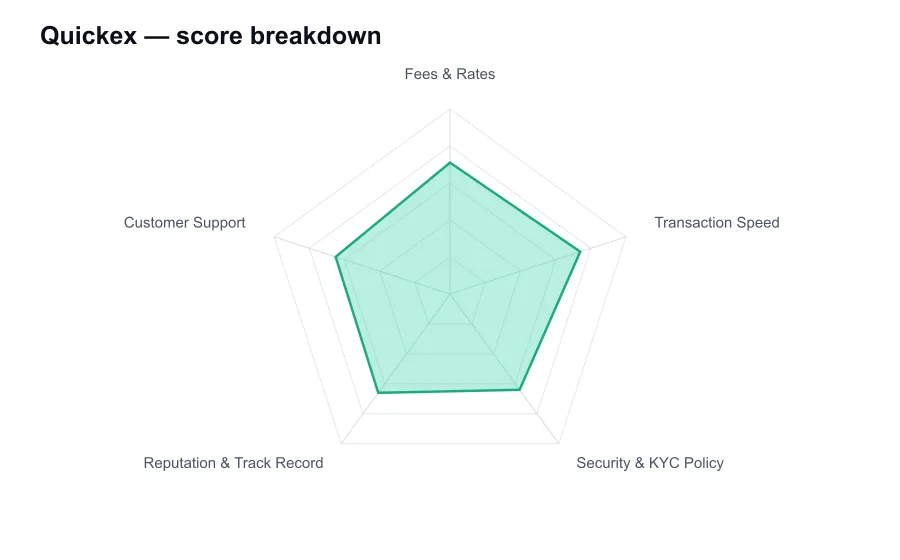
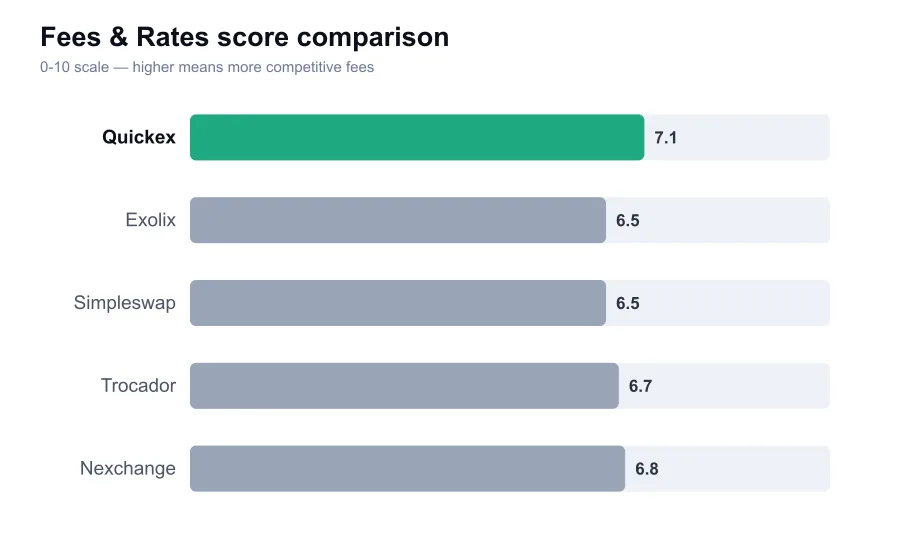
| Fees & Rates | 7.1 | Quotes are competitive on common pairs, but all-in costs vary. |
| Transaction Speed | 7.4 | Fast for liquid routes once required confirmations arrive. |
| Security & KYC Policy | 6.4 | No routine account, but swaps can face AML review. |
| Reputation & Track Record | 6.6 | Established instant-swap brand with a mixed complaint record. |
| Customer Support | 6.5 | Useful order support, less reassuring in difficult recovery cases. |
| Requirement | optional |
|---|---|
| Notes | Quickex does not usually require account registration or routine KYC before an order. It can request identity documents or source-of-funds information if automated AML checks identify risk. |
| Notable Coins | Bitcoin, Ethereum, Tether, USD Coin, Litecoin, Monero, Solana, Dogecoin |
|---|
Quickex is a non-custodial instant crypto exchange, aimed at people who want to swap assets without opening a trading account or learning a conventional exchange interface. It sits in the same broad category as ChangeNOW, SimpleSwap, StealthEX and ChangeHero. The pitch is straightforward: select two assets, send crypto to a generated address, and receive the output asset in a personal wallet. For small, occasional swaps, that simplicity has real appeal.
The service does not operate like Coinbase, Kraken, or Binance. There is no order book for users to inspect, no portfolio dashboard built around long-term custody, and no advanced trading terminal. Quickex sources liquidity through outside partners and calculates a quote for each conversion. That means the quality of a swap depends partly on the asset pair, the blockchain used, and the liquidity available at that moment. It is an exchange tool, not a full trading venue.
Quickex's main strength is a low-friction flow. A user can choose a pair, enter a receiving address, and get a deposit address without account registration. The site supports floating-rate and fixed-rate transactions. Floating quotes can move while the transaction is being processed, while fixed quotes aim to lock the displayed result for a limited period if the deposit arrives on time. Anyone who has been caught by a sharp market move during a swap will understand why the fixed option matters.
Fees are less cleanly presented than they should be. Quickex generally includes its service charge and partner liquidity costs inside the quote rather than showing a simple universal rate at every step. That is normal for instant exchanges, but it makes direct comparison harder. A quoted result can be competitive for a liquid BTC to USDT or ETH to USDC conversion, then distinctly less attractive for a thin altcoin pair. You need to judge Quickex by the final amount, not by a headline claim.
For common routes, Quickex can be reasonably priced. It often competes well with similar no-account services, especially if a fixed quote is not required. But it is rarely the cheapest route available for a large trade. A user willing to use a major centralized exchange, place a limit order, and withdraw manually will often pay less. The convenience premium is the product here. Quickex is useful because it saves steps, not because it consistently wins a fee comparison against deep spot markets.
The floating-rate option deserves caution. The displayed estimate is not a guarantee, and the gap between estimate and final payout can widen during volatility or network congestion. That is inherent to this business model, though it remains frustrating if the site does not make the changing economics clear enough before funds are sent. Fixed-rate swaps reduce that exposure, but they may carry a worse quote because Quickex and its liquidity partners are taking on the price risk.
Speed is usually good for established coins and chains. A normal conversion can be completed after the deposit receives the confirmations required by the source network, followed by the partner's exchange process and the outbound transaction. For fast chains this may feel close to instant. Bitcoin, Ethereum during congestion, and tokens with slow deposit confirmation rules are another matter. The word instant describes the interface more than it describes every blockchain settlement.
In practice, the biggest delays are rarely caused by Quickex staff manually processing a transaction. They tend to come from network fees, low-fee deposits, liquidity-provider checks, maintenance at an outside exchange, or a user selecting the wrong network. An ERC-20 token sent through an unsupported chain can become a recovery case rather than a quick swap. That is why users should check the displayed network label with almost obsessive care before confirming.
Quickex is non-custodial in the limited sense that it does not offer a persistent user balance or encourage customers to leave funds on the platform. That is a meaningful benefit. Still, a swap temporarily requires sending assets to an address controlled by the service or one of its partners. Non-custodial does not mean trustless. You are trusting Quickex to route the trade and send the promised output after it receives your deposit.
The company says it uses risk controls and can request identity verification where an anti-money-laundering check is triggered. That puts Quickex in the common instant-exchange category of no routine sign-up, but possible transaction-specific KYC. Users should not treat the lack of a registration screen as an ironclad promise of anonymity. A flagged transaction can be paused, and a customer may need to provide documents before funds are released or returned. That risk is particularly relevant for funds linked to high-risk exposure by blockchain analytics tools.
Security information available to ordinary users is thinner than it is at a large regulated exchange. There is no public proof of reserves, no deeply documented security architecture, and no long record of independently verified financial reporting. Quickex does publish policy material and support channels, but it has not earned the level of institutional confidence attached to older, regulated brands. For a quick conversion this may be acceptable. For a life-changing amount, it is not.
Quickex has operated for several years and has accumulated a visible online footprint, which is better than dealing with a newly launched anonymous swap page. Its reputation is still mixed in the way many instant exchangers are mixed. Satisfied users tend to mention simple transactions and prompt payouts. Negative reports commonly involve changing rates, delayed orders, compliance reviews, or recovery disputes. Those complaints do not automatically prove misconduct, but they are a reason to keep transaction sizes sensible.
Support is available through the website and email, with a help section covering order tracking and common problems. Responses can be effective on ordinary cases, especially a delayed but valid transaction. Hard cases are where support quality gets tested, such as a wrong-network transfer, a deposit sent after a fixed-rate window expired, or a compliance hold. Quickex is not known for the expansive phone support or formal escalation process a major financial institution would provide.
I would use Quickex for a modest swap where privacy from account creation, speed of setup, and a clean interface matter more than extracting the last basis point of price. I would use a fixed quote if the market is moving quickly, and I would save the order ID, transaction hash, and screenshots before sending anything. For larger conversions, I would compare the final output against StealthEX, ChangeHero, and a liquid centralized exchange first. Quickex is a legitimate convenience service, but it asks for more trust than its simple front end initially suggests.
| Pros | Cons |
|---|
Quickex fits self-custody users making modest, straightforward swaps between established assets. It is a practical choice for someone who does not want to deposit funds into a centralized exchange account. Large traders, users needing formal compliance assurances, and anyone who wants the lowest possible execution cost should look at a liquid spot exchange instead. It is also a poor fit for anyone unable or unwilling to complete KYC if a transaction is flagged.
No. Quickex normally lets users create an order without registering an account, but it can request KYC if its anti-money-laundering checks flag a transaction or wallet.
A floating rate follows market movement during processing. A fixed rate aims to preserve the quoted payout if Quickex receives the deposit within the stated time window, usually at a less favorable quote.
Check the order page and source-chain transaction hash first. Delays commonly result from missing blockchain confirmations, a low network fee, liquidity-provider maintenance, or a compliance review.
Only send funds through the exact network shown in the order. Sending a token through a different chain, such as BNB Smart Chain instead of Ethereum, can require manual recovery and may not be recoverable.
Quickex is designed for one-off swaps rather than persistent customer balances. Funds are still temporarily sent to a deposit address during the exchange process, so it is not a trustless transaction.
Use the order ID or the order-tracking page supplied after creation. Keep the deposit transaction hash, as support may need it to locate a delayed or incorrectly credited transfer.
| Alternative | Score |
|---|---|
| Anycoin Review | 6.9/10 |
| Exolix Review | 6.9/10 |
| Simpleswap Review | 7.0/10 |
| Trocador Review | 7.0/10 |
| Kingex Review | 6.8/10 |
| Changelly Review | 6.8/10 |