Editorial independence: our scores and rankings are produced using the fixed criteria above and are not influenced by advertisers. This is an independent ranking site and is not operated by, or affiliated with, any provider we list.
Affiliate disclosure: some links on this page may earn us a commission at no extra cost to you. This does not affect our rankings.
| Best for | Not for |
|---|
| Criterion | Score | Note |
|---|---|---|
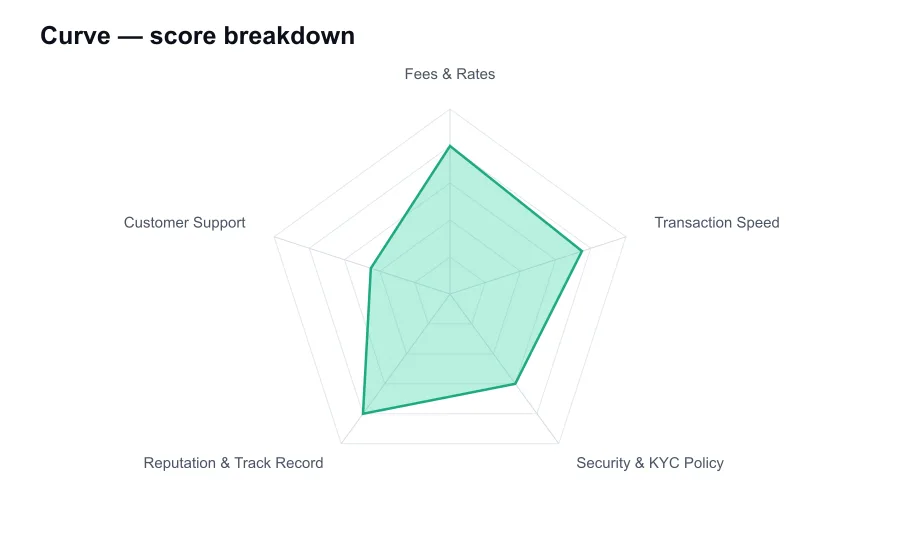
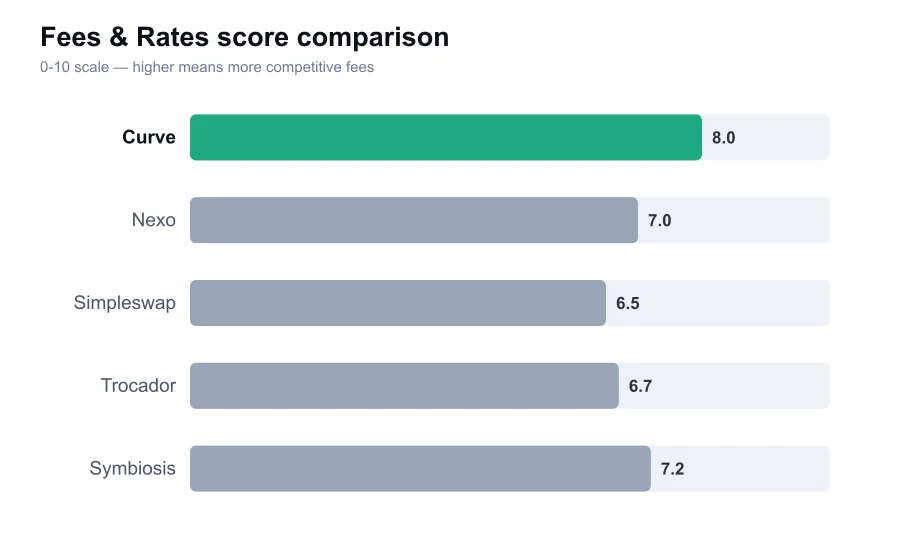
| Fees & Rates | 8.0 | Often around 0.04% in classic pools, with variable fees |
| Transaction Speed | 7.5 | Quick on L2s, but Ethereum gas and bridges add friction |
| Security & KYC Policy | 6.0 | Noncustodial and mature, but 2023 exploit remains significant |
| Reputation & Track Record | 8.0 | Foundational stablecoin DEX with a tested, imperfect history |
| Customer Support | 4.5 | Documentation and community help, not account level support |
Curve is one of the foundational decentralized exchanges in DeFi, built primarily for efficient trading between assets that should trade near the same price. Stablecoins, wrapped versions of bitcoin, and liquid staking derivatives are its natural territory. It is not where I would send someone to swap a random altcoin for ETH. But for stable value assets, Curve's specialized automated market maker design has influenced an enormous share of onchain trading and liquidity provision.
The central innovation is Curve's stableswap invariant. Traditional constant product pools, such as early Uniswap pools, can impose meaningful price impact even when swapping supposedly similar assets. Curve concentrates liquidity around parity, allowing a USDC to USDT or DAI trade to execute with very low slippage when the pool is balanced. That design made Curve a crucial piece of stablecoin infrastructure, especially during the years when onchain dollar liquidity grew rapidly.
Fees are generally clear at the pool level, though they vary. Many classic Curve pools use a trading fee around 0.04 percent, with a portion directed to liquidity providers and a portion historically connected to governance incentives. Some pools have different parameter settings, and users also pay network gas. The fee can be very competitive for stablecoin swaps, but the final answer is still the quoted output. A low fee does not save a trade entering an imbalanced pool with weak liquidity.
Curve's dynamic fee mechanisms are meant to charge more as a pool moves further from its intended balance. That makes sense economically because a severely one sided pool is taking on meaningful inventory risk. It also means the friendly 0.04 percent figure is not a universal promise. During stablecoin stress, depegs, or mass withdrawals from a particular asset, execution can worsen sharply. Users who only look at an advertised fee will miss the situation that matters most.
For ordinary swaps, speed is dictated by the blockchain. Curve began on Ethereum, where transactions may take seconds to minutes and can be expensive at peak demand. It has expanded across multiple networks, including Arbitrum, Optimism, Polygon, Base, and others over time, giving users cheaper and faster options. A swap itself settles promptly after block confirmation. Bridging assets before using a pool is often the slower and riskier part of the journey, particularly for users crossing chains without understanding bridge assumptions.
Curve is also deeply embedded in the liquidity provider economy. Depositing assets into a pool can earn swap fees and, in some cases, CRV incentives or external rewards. The catch is that providing liquidity is not the same as holding a basket of stablecoins in a wallet. Pool composition changes as traders take the asset they want and leave the asset they do not want. If one stablecoin comes under pressure, liquidity providers can end up heavily exposed to exactly the asset the market is trying to exit.
That risk became painfully visible during the 2023 crisis involving Curve founder Michael Egorov's large CRV backed borrowing positions. The situation raised legitimate concerns about CRV market pressure, governance influence, and broader DeFi contagion. Curve survived the episode, but it was not a trivial reputational footnote. A protocol can be decentralized in code while still facing concentrated human and token related risks. Investors should not pretend those risks disappeared because the immediate crisis passed.
The July 2023 exploit of several Curve pools, linked to a Vyper compiler vulnerability, is another essential part of the record. Attackers exploited affected pool contracts, and the incident caused significant losses and market stress. Curve and the broader ecosystem worked on recoveries, but the event demonstrated a hard truth about DeFi security: audited application logic is not enough if a compiler or dependency introduces a flaw. This was a serious failure, not something that should be softened with brand loyalty.
Curve has responded with continued development, security work, and a long record of operating through difficult conditions. Its contracts, governance processes, and economic design have been scrutinized more intensely than those of almost any newer DEX. That track record deserves credit. Still, I cannot give it a top security score after the Vyper episode and the protocol's history of complex integrations. Mature DeFi does not mean risk free DeFi. It means the risks are better documented and more battle scarred.
The platform is noncustodial. Users connect wallets and interact with smart contracts, retaining their private keys rather than depositing funds into a Curve controlled account. There is no normal KYC process for protocol use. That privacy and self custody model is a feature for knowledgeable users, but it removes consumer protections. A wrong network, bad approval, fake token, compromised wallet, or malicious frontend interaction can result in permanent loss. Curve cannot reverse a completed blockchain transaction.
Reputation is therefore mixed in an interesting way. Curve is unquestionably a major DeFi institution, with origins in 2020 and a historic role in stablecoin markets, CRV governance, and the so called Curve Wars around voting power and emissions. It has survived adversarial market conditions that would have ended many smaller projects. Yet its reputation is not spotless, and it should not be treated like a low risk cash management product simply because blue chip DeFi names integrate with it.
Customer support is limited in the way most decentralized protocols are limited. Curve offers documentation, official social channels, community resources, and an interface that experienced users can navigate. What it cannot provide is individualized transaction recovery, guaranteed response times, or a customer service team that can resolve a bad trade. The ecosystem has a long history of scam accounts impersonating support. Anyone who receives a direct message asking for a seed phrase or signature should assume it is fraudulent.
The interface has improved over time, but Curve's real complexity emerges around pools, gauges, LP tokens, boosted rewards, and governance. A simple stablecoin swap is manageable. Becoming a liquidity provider can turn into a chain of decisions about pool composition, reward claims, smart contract exposure, and tax tracking. I would not encourage a newcomer to deposit into a high yield pool without understanding why the yield exists. In DeFi, unusually high stablecoin yield is often payment for holding a risk someone else wants to avoid.
Curve is strongest where it has always been strongest: large or repeated swaps among deeply liquid stable assets and certain correlated staking derivatives. Compare output against Uniswap, 1inch, Cow Swap, or an aggregator because routing conditions change constantly. In some cases, an aggregator will route through Curve anyway. For users seeking a direct swap with transparent pool mechanics, Curve can be excellent. For broad token discovery, fiat onboarding, or beginner friendly investing, it is simply the wrong product.
My final view is that Curve remains indispensable infrastructure but not uncomplicated infrastructure. Its low slippage design and deep stable asset liquidity can be genuinely hard to beat, and few protocols have had comparable influence on DeFi markets. The exploit history, governance concentration concerns, and LP risk demand respect. Use Curve for the thing it does exceptionally well, not because its name sounds safe. Traders can benefit from it. Passive users should be far more cautious about becoming the liquidity behind those trades.
| Pros | Cons |
|---|
Curve fits DeFi users who need efficient stablecoin, wrapped asset, or liquid staking token swaps and understand onchain execution. It can also suit experienced liquidity providers who can assess pool composition and depeg risk. Beginners should use it for simple swaps only after learning wallet safety. Investors seeking a passive, low risk yield product, fiat access, or live support should choose another type of provider.
Many classic Curve pools have used fees around 0.04 percent, but pool settings and dynamic fees can differ. Network gas and price impact also affect the final cost, so check the quote before confirming.
Curve remains widely used, but the Vyper related exploit showed that smart contract and dependency risk is real. Use only official links, verify pools, and avoid treating any DeFi deposit as risk free.
Core protocol access is wallet based and generally does not require KYC. Transactions are public on the underlying blockchain, and regional frontend access can change.
| Alternative | Score |
|---|---|
| Nexo Review | 7.1/10 |
| Simpleswap Review | 7.0/10 |
| Trocador Review | 7.0/10 |
| Ripio Review | 7.2/10 |
| Symbiosis Review | 7.2/10 |
| ChangeNow Review | 7.2/10 |