
Editorial independence: our scores and rankings are produced using the fixed criteria above and are not influenced by advertisers. This is an independent ranking site and is not operated by, or affiliated with, any provider we list.
Affiliate disclosure: some links on this page may earn us a commission at no extra cost to you. This does not affect our rankings.
| Best for | Not for |
|---|
Symbiosis is a non-custodial cross-chain swap protocol. It lets users exchange a crypto asset on one blockchain and receive another asset on a different supported blockchain through one interface. Users connect their own wallets and retain custody of funds.
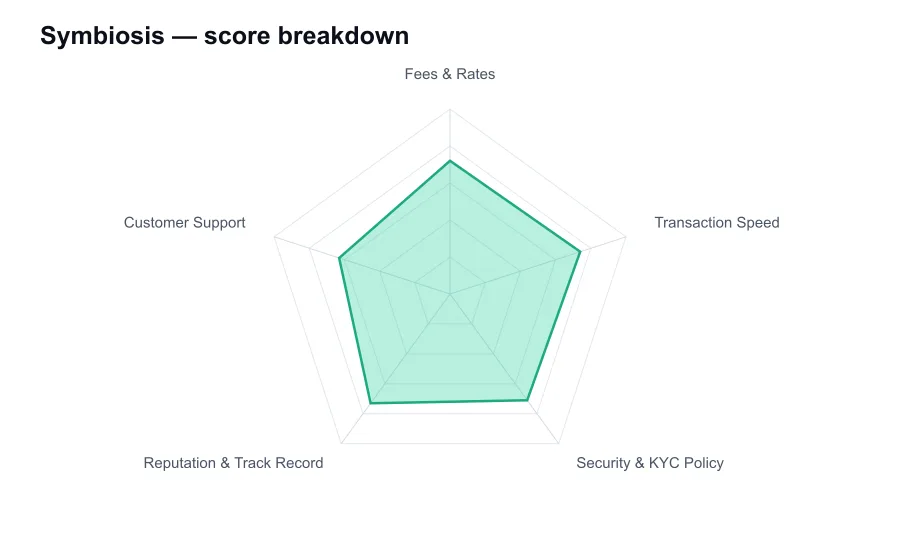
| Criterion | Score | Note |
|---|---|---|
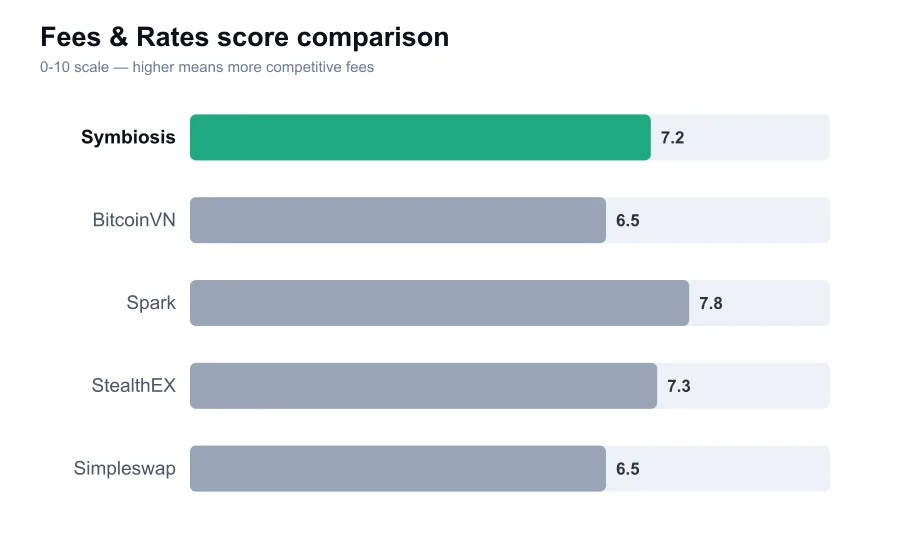
| Fees & Rates | 7.2 | Competitive bundled routes, but gas and liquidity costs vary. |
| Transaction Speed | 7.4 | Usually minutes, subject to chain and route conditions. |
| Security & KYC Policy | 7.1 | Non-custodial audited protocol, with inherent bridge risk. |
| Reputation & Track Record | 7.3 | Established cross-chain project, smaller than leading aggregators. |
| Customer Support | 6.3 | Community and documentation led support. |
| Requirement | none |
|---|---|
| Notes | Symbiosis is a wallet-based non-custodial protocol and does not normally require identity verification for swaps. |
| Notable Coins | USDC, USDT, ETH, WETH, WBTC, BNB |
|---|---|
| Networks | Ethereum, BNB Chain, Polygon, Arbitrum, Optimism, Base, Avalanche |
Symbiosis is a cross-chain liquidity protocol built for people who want to move and swap crypto between networks without manually bridging assets, changing wallets, and visiting several decentralized exchanges. Its pitch is simple: choose the token you have, choose the token you want on another chain, and let the protocol coordinate the route. In a market crowded with bridges, aggregators, and cross-chain messaging systems, Symbiosis occupies a useful middle ground. It is not a conventional exchange and should not be judged like one.
The service is best understood as a cross-chain swap layer. A user can exchange an asset on one supported network and receive another asset on a different network through one flow. That removes a frustrating sequence common in DeFi: bridge USDC, wait for finality, add the destination network, find a DEX, then swap again. Symbiosis reduces those steps. For smaller and medium-sized transactions, the convenience is genuinely meaningful.
Fees are where the marketing needs a closer reading. Symbiosis does not present a single all-in percentage that applies to every route. The quoted cost can include liquidity-provider fees, protocol charges, source-chain gas, destination-chain gas, bridge execution costs, and price impact. A route involving Ethereum is naturally much more expensive than one confined to lower-cost chains such as BNB Chain, Arbitrum, Base, or Polygon.
The protocol has historically used liquidity pool fees around 0.3 percent, but that figure is not the complete cost of a swap. It is a component. The number that matters is the amount shown in the interface before confirmation and, more importantly, the difference between the quoted and received amount on a floating-rate route. Symbiosis can be cost-effective for a multi-step cross-chain trade, yet it is rarely the cheapest choice for a simple same-chain swap where Uniswap, Curve, or a direct DEX aggregator can do the job.
Large trades require particular care. Cross-chain liquidity is fragmented, and a route that looks clean for a few hundred dollars can carry ugly price impact at five figures. The interface does show the estimated output, but experienced users should inspect the transaction details and compare at least one alternative, such as LI.FI-powered aggregators, Across, Stargate, or a direct bridge followed by a DEX trade. Symbiosis earns points for convenience, not for producing the best price every time.
Speed is decent rather than exceptional. Low-cost networks usually complete smoothly once source-chain confirmation and the destination-side execution are settled. In ordinary conditions, a transfer can feel close to instant compared with older bridge systems, often taking minutes rather than an hour. Ethereum-originated swaps can take longer because block confirmation and network congestion still matter. Nobody can make Ethereum gas conditions disappear.
The more important issue is that a cross-chain transaction has more ways to stall than a local swap. A destination chain may be congested. A relayer or liquidity route may lack capacity. A token contract can behave differently from the standard ERC-20 flow. The protocol generally communicates transaction status through its interface, but troubleshooting a partial or delayed cross-chain execution is inherently harder than resolving a failed trade on a single DEX.
Symbiosis is non-custodial in the ordinary DeFi sense. Users connect their own wallets and approve smart contracts rather than opening an account and handing over custody of coins. There is no routine identity verification for using the protocol. That privacy-friendly setup is attractive, but it shifts responsibility back to the user. A mistaken network, fake frontend, excessive token approval, or compromised wallet cannot be fixed by a support agent reversing a transfer.
The protocol's security model depends heavily on smart contracts, liquidity management, and cross-chain infrastructure. Symbiosis has published audit material and has operated for several years, which is better than trusting a brand-new bridge with no public technical history. Still, bridge risk is not theoretical. Cross-chain systems have repeatedly been among the most lucrative targets in DeFi, with incidents at Ronin, Wormhole, Nomad, and Multichain showing how damaging failures can be.
That broader category risk keeps Symbiosis below the strongest single-chain DEXs on security. The contracts may be audited, but an audit is not insurance and it cannot guarantee that every upgrade path, oracle dependency, relayer process, or liquidity mechanism will behave safely under stress. I would use Symbiosis for operational transfers and reasonably sized swaps. I would not use it as a place to route a life-changing amount without splitting the transfer and testing the path first.
Its reputation is respectable inside the cross-chain DeFi community, although it does not have the brand recognition of 1inch, Uniswap, or LayerZero. Symbiosis has survived more than one market cycle and has continued adding networks and route options. That persistence counts. The team has also maintained public product communications and documentation, which is more than can be said for many short-lived bridge projects.
Support is functional, though it is not a polished exchange-style help desk. Users will usually rely on documentation, community channels, transaction explorers, and the project's support routes rather than an instant live-chat team with account-level tools. That is normal for a non-custodial protocol, but it can be disappointing if a transfer is delayed. A support team can investigate a transaction. It cannot safely control your wallet or simply push funds back at will.
The interface itself is one of Symbiosis's better features. It makes the source asset, destination asset, network, expected output, and estimated route accessible without burying the user in bridge jargon. That said, the clean interface can create a false sense that all routes are equally simple. They are not. Stablecoin-to-stablecoin transfers are usually the sensible use case. Exotic tokens and thin liquidity deserve more skepticism.
My view is that Symbiosis is a good specialist tool, not a universal exchange replacement. It is particularly useful for DeFi users who value fewer steps and already understand wallet security. Its fees can be fair for a bundled cross-chain action, and its no-KYC model fits the decentralized ethos. The trade-off is unavoidable complexity beneath the surface. Use it with a self-custody wallet, read the quote carefully, and treat every bridge transaction as a risk-bearing operation rather than a routine bank transfer.
| Pros | Cons |
|---|
Symbiosis fits self-custody DeFi users moving stablecoins or major assets between supported chains. It is especially practical for users who would otherwise bridge and then swap manually. Beginners can use it, but should start with a small test amount. Traders seeking the absolute best execution for a large order should compare routes through several aggregators or use a direct bridge and DEX.
No routine KYC is required to connect a self-custody wallet and use Symbiosis. You interact with smart contracts rather than opening a custodial exchange account.
Many low-cost-chain routes complete in minutes, but timing depends on source-chain confirmations, destination-chain conditions, and available route liquidity.
Floating-rate routes can change before execution. Gas, pool pricing, liquidity and price impact affect the final output, especially for larger trades.
It combines both functions. The protocol can swap assets and deliver the resulting asset on another supported blockchain in a single user flow.
No. Blockchain transfers are generally irreversible once confirmed. Check the destination chain, token, wallet address and quoted output before signing.
It is not automatically safer. Symbiosis reduces operational steps, but it still introduces smart contract, cross-chain execution and liquidity risks.
| Alternative | Score |
|---|---|
| Ripio Review | 7.2/10 |
| ChangeNow Review | 7.2/10 |
| BitcoinVN Review | 7.3/10 |
| Curve Review | 7.1/10 |
| Nexo Review | 7.1/10 |
| Spark Review | 7.4/10 |